Cerebras Cloud Growth Depends on Securing Data-Center Capacity


Cerebras CEO Andrew Feldman argues that renting compute through the company’s first-party cloud has become a fast-growing, profitable business, with cloud and other service revenue rising 281% year over year to $126 million in the second quarter. He says the company’s ability to control its own data-center deployments lets it turn hardware into available capacity more quickly than its hardware customers can, even as demand and a $25.4 billion backlog build.
Cerebras can deploy cloud capacity it controls; hardware sales wait on customer sites
Andrew Feldman describes Cerebras as operating two businesses built on the same equipment but subject to different deployment constraints. In its first-party cloud, Cerebras designs, manufactures, and installs systems in data centers it controls, then rents compute to customers. That control matters: the company can place equipment in its own sites and turn it into cloud capacity.


Its hardware business depends on customers having somewhere to install the systems. Those customers may use the equipment themselves or divide its compute capacity among their own customers. Feldman said some hardware customers did not have data centers available in the second quarter, which limited what Cerebras could deliver despite what he described as strong demand.
Cerebras said core cloud revenue nearly quadrupled year over year, while cloud and other service revenue rose 281% to a record $126 million. Feldman called the first-party cloud operation “absolutely ripping.” He also said the company had $25.4 billion in backlog, 600 megawatts of capacity either signed or already live, and a pipeline of additional capacity measured in gigawatts.
Feldman said Cerebras expects revenue to more than triple next year. He presented the addition of 600 megawatts over six or seven months as evidence that the company is executing quickly enough to support that outlook, while acknowledging that data-center access remains a challenge across the industry.
You need more chips, more manufacturing capacity, more data centers to put these chips to build the cloud offering.
A demonstration network became a cloud business as demand accumulated
Cerebras initially built its first-party cloud to demonstrate its technology without moving hardware into prospective customers’ facilities, Feldman said. It also gave customers without data centers a way to use the company’s systems.
The company first deployed the infrastructure for its own use and demonstrations. Demand then made it a substantial commercial business, according to Feldman. Feldman said that growth has continued even after Cerebras added larger customers including AWS and OpenAI.
Capacity, in his account, is a chain rather than a single bottleneck. A cloud buildout needs data-center space, manufacturing capacity, and chip supply. Feldman said Cerebras had expanded manufacturing through partnerships with Flextronics, Sanmina, and Rocket EMS, and expects manufacturing capacity to increase by more than tenfold this year. TSMC, Cerebras’s fabrication partner, has assured supply sufficient to support the company’s planned growth, he said.
Warrant accounting obscured hardware growth as lockups pressured the shares
Ed Ludlow raised a separate source of confusion in Cerebras’s hardware results: the company’s core reporting showed hardware growth, while its GAAP presentation appeared differently.


Feldman said one large hardware customer held warrants whose value is subtracted from revenue under GAAP accounting. In his description, that treatment made reported GAAP revenue look smaller than the underlying hardware result. He said Cerebras beat guidance and consensus on core revenue and core gross margin, beat more substantially on core operating margin, and raised guidance across key measures.
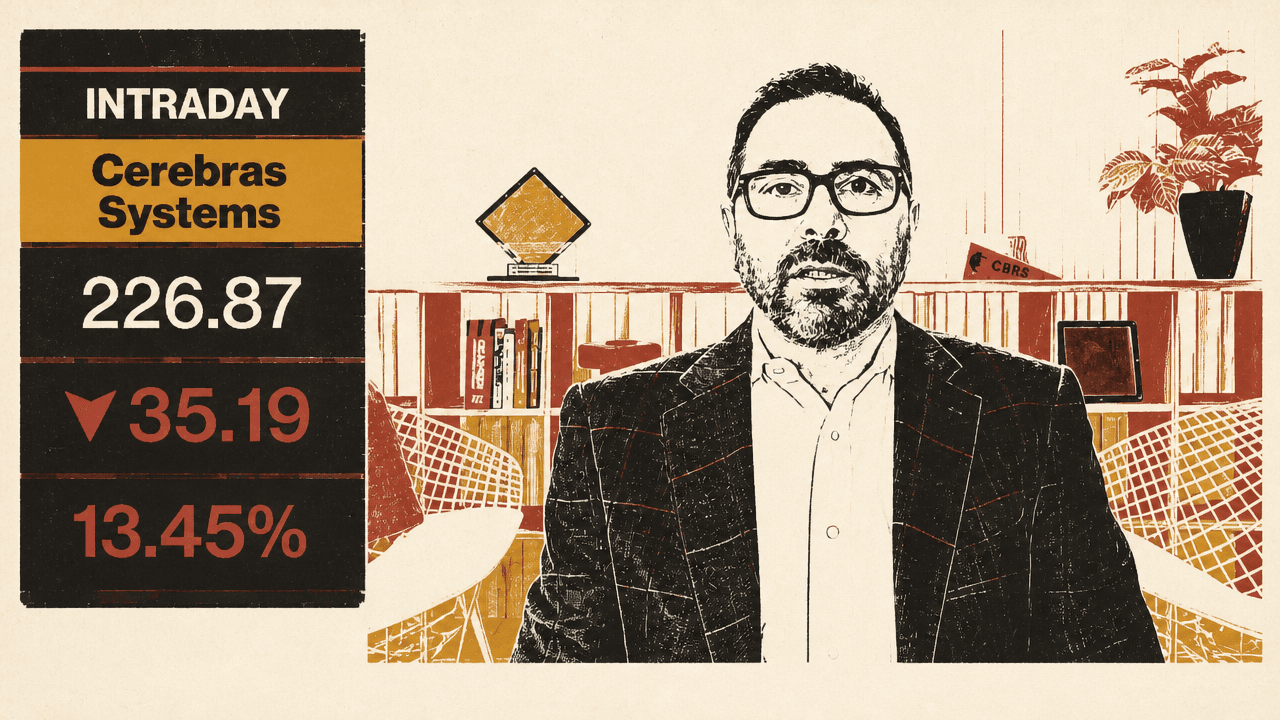
The share price nevertheless fell during the interview. The on-screen chart showed CBRS at $225.01, down $37.05, or 14.14%, intraday. Asked whether expiring lockups were contributing, Feldman said they were, and that some investors trade against those events.
We’re focused on long-term investors. We’re focused on delivering returns through investing in our people, in our technology, that will play out over years.
Feldman said Cerebras was addressing investors who want exposure to AI infrastructure alternatives to Nvidia and are willing to assess the company against a multiyear plan. He said 2028 and 2029 would be “giant” as well, alongside the company’s forecast that revenue would more than triple next year.
The AMD partnership is positioned as an alternative infrastructure configuration
Andrew Feldman said Cerebras and AMD already have disaggregated solutions running in their labs, with engineering teams working closely and deployments planned for the fourth quarter. He described customer demand following the announcement as “enormous.”
The commercial proposition, as Feldman framed it, is a combination of speed and throughput. GPUs are good at throughput but less strong on speed, he said, while Cerebras is particularly strong at speed and can improve in throughput. The disaggregated arrangement is meant to produce a faster, high-throughput system: throughput provides the economics, and speed shapes the customer experience.