Muse Wonder Combines Frontier-Model Claims With Personal Context


Meta is positioning its Muse Wonder model as both a bid to match rivals such as OpenAI and Anthropic and the engine for its consumer AI assistant, Muse. Bloomberg reporter Riley Griffin said chief AI officer Alexandr Wang described Wonder as competitive with leading models, while emphasizing that it was built for personal-agent tasks: using a user’s information to tailor responses. At launch, Griffin said, Wonder would be available through paid Muse subscriptions as Meta works to lower the cost of serving it.
Wonder is the model; Muse is the personal-assistant product
Meta is positioning Muse Wonder as the model behind Muse, its consumer-facing AI assistant. The distinction matters because the company’s pitch is not only that Wonder can perform demanding work, but that it can power an assistant designed to respond with a user’s personal context. Bloomberg’s Riley Griffin reported that Meta chief AI officer Alexandr Wang told her the model had been purpose-built for the consumer application.


We do genuinely think that we've taken a differentiated focus to make the personal-agent use case really sing.
The quotation was displayed on screen as Wang’s words in an interview with Bloomberg on Oct. 12. Griffin said Meta wants Muse to handle the details involved in remembering what a user is like over time. Wang’s stated distinction was a focus on personal-agent use; Griffin described the intended result as an assistant that can make use of relevant information about its user.
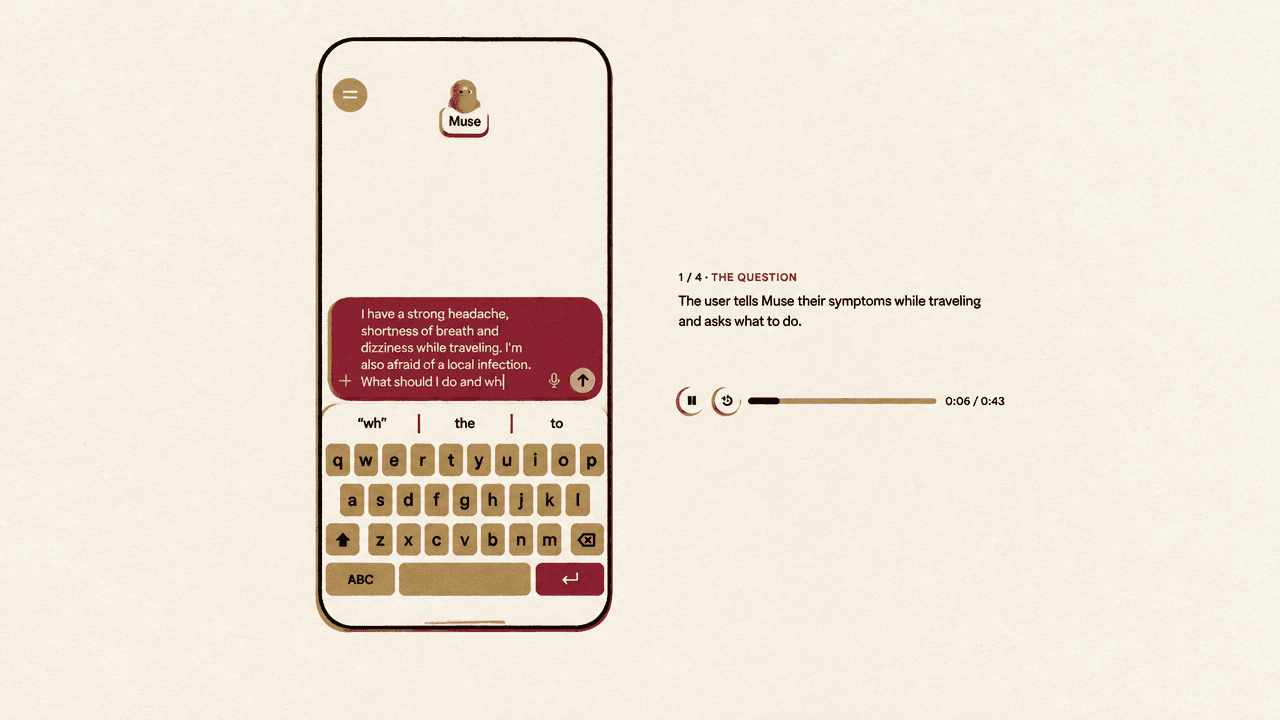
A demonstration supplied a concrete example. A user told Muse they had a headache, shortness of breath and dizziness while traveling, and asked what to do about a possible local infection. The on-screen explanation said Muse checked the user’s calendar, messages and email—connected apps that, according to the demonstration, needed no extra permission—and answered using what it found. The example presented personal context as more than a long-running memory: Muse could draw on information in other apps while responding to an immediate question.
The demonstration does not establish how the assistant handles every such request. It shows the product behavior Meta chose to highlight: a user describes a situation, and Muse consults connected personal information to shape its response. A separate promotional visual described Wonder as “Trained for you” and displayed the phrases “ACTIVE MEMORY” and “ACTIVE ME,” reinforcing the company’s emphasis on personalization.
Meta is also making a capability claim about the model itself. Wang said it was competitive with the best models, particularly for “personal and professional agentic work.” Griffin said Meta executives believed its capabilities matched rivals in coding, finance and legal expertise, while calling those claims strong and adding that time would tell. The distinctions in the pitch are therefore linked: Meta describes Wonder as highly capable, and argues that its particular value is applying that capability inside a personalized assistant.
Griffin said the model had been known to some observers as Watermelon and was expected in October. She described it as Meta’s most capable model since Mark Zuckerberg overhauled the company’s AI operation and appointed Wang as chief AI officer. Those details place Wonder within Meta’s effort to return to the frontier, but the product framing centers on what the model will do in Muse.
The subscription rollout makes efficiency a product constraint
Wonder is not being offered to every Muse user on the same terms at launch. Griffin said the model would power Muse for subscribers, naming premium prices of $20 and $100. Meta would like free users to have some of Wonder’s capabilities too, she said, but first the company is working to make the model more efficient.
The constraint, as Griffin described it, is the cost of serving a highly capable model at the scale of billions of users. That makes efficiency part of the access plan: Meta wants to extend some capabilities beyond paying subscribers, but the current model is reserved for them while the company works on lowering the cost of running it. The source does not specify when free users might receive those capabilities or what features would be included.
The distinction between model and app helps explain why the rollout is framed this way. Wonder is the capability Meta says it has developed; Muse is the consumer product through which subscribers will use it. The personal-context features shown in the demonstration are part of the product proposition, while the subscription restriction and efficiency work describe the limits Meta currently faces in making that proposition widely available.
Ed Ludlow offered examples of using the existing Muse assistant to help compose Instagram posts and monitor flight prices for a planned trip to the UK, adding that it had given him “a lot of bad news.” His examples were ordinary consumer tasks, rather than the coding, finance and legal capabilities Griffin said Meta executives highlighted. Together, they make clear what remains at issue in Meta’s pitch: whether a powerful model can become a useful personal assistant, and whether the company can make that experience affordable beyond its subscription tier.