Meta’s Planned Capital Raise Looms Over AI Spending and Shares

Meta’s new nonvoting share class could give Mark Zuckerberg liquidity to cover a tax bill if California’s proposed wealth tax passes, while preserving his control, Ed Ludlow said. Alison Porter, a portfolio manager at Janus Henderson, said investors had anticipated a capital raise to support Meta’s growth spending and that uncertainty over its timing will weigh on the stock; without a third-party cloud business, she added, investors have less visibility into what the company’s AI spending will yield.
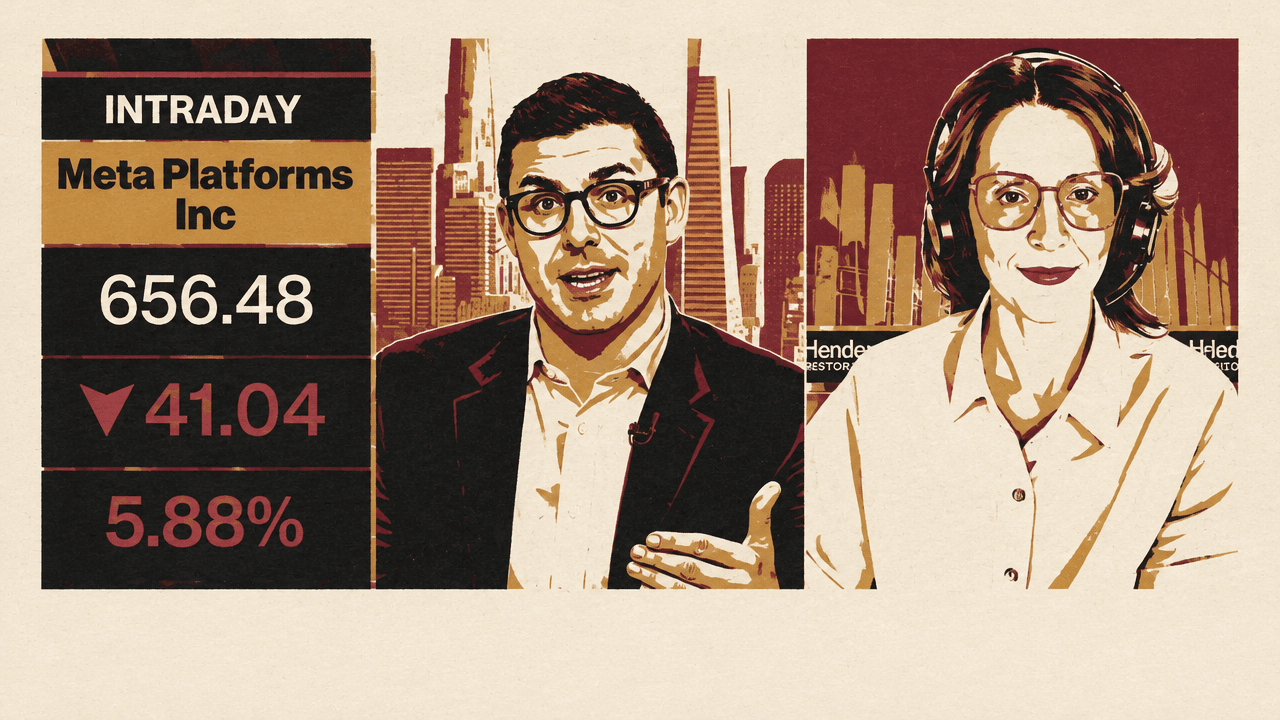
A possible capital raise—not the new share class itself—is the financing overhang
Meta’s new share class has economic value but no voting power. Ed Ludlow framed it as a way to give Mark Zuckerberg liquidity to cover a tax bill if California’s proposed Prop 40 wealth tax passes, while keeping him in charge. ? alison-porter, portfolio manager for Janus Henderson’s Global Technology Leaders team, described the share structure as intended to provide flexibility for several uses: potential acquisitions, employee compensation and capital spending.


Porter said investors had expected Meta to raise capital at some point, given the spending required to sustain its revenue growth. She distinguished that anticipated capital raise from the new share class, and expects the uncertainty around the raise to remain an overhang on the stock until it occurs, potentially in the first quarter.
We do think this is going to be an overhang on the stock through until we see that capital raise actually occur.
Ludlow noted that Meta’s CFO had presented the structure on the earnings call as a way to create flexibility in financing AI spending, while the regulatory filing also described an agreement with Zuckerberg. Porter said his continued leadership matters to the investment case. She compared Meta with other founder-led businesses, arguing that founders can bring a vision for investing in future growth.
But leadership is not, in her account, a substitute for returns. Porter said investors need evidence that capital spending is producing results, and pointed to management’s focus on shareholder returns and more granular monetization.
Advertising is growing; the new AI products still need a business model
? alison-porter said Meta’s core business was already benefiting from AI, with improvement in user engagement, ad pricing and ad volume across products. She cited expected growth of more than 20% into next year. The harder question is whether products such as Meta AI can be monetized.
Porter described Meta’s typical approach as building users and engagement before monetizing. But she said the company had discussed moving faster with its Mews product, seeking to show a path to monetization earlier. That evidence could matter to investors asked to fund further spending through an equity raise.
The third-quarter figures shown on screen put the established advertising business above estimates, while other revenue and Reality Labs were below them.
| Segment | Revenue | Compared with estimate |
|---|---|---|
| Advertising | $64.2B | +2% |
| Other revenue | $1.1B | -0.1% |
| Reality Labs | $443M | -14% |
| Total | $64.6B | +2% |
Large commitments are harder to underwrite without cloud revenue visibility
Ed Ludlow cited spending commitments of $825 billion, up from about $700 billion in July, and asked whether the scale was becoming concerning. The figure referred to commitments, not a new CapEx forecast: Ludlow noted that Meta had not yet guided for 2027 capital spending. ? alison-porter said the implications would depend on monetization, revenue growth and visibility into what the spending will yield.
Unlike Amazon and Google, Meta does not have a third-party cloud business, Porter said, so it lacks the same visibility into demand against which to plan capital expenditure. In her view, that makes Meta’s spending harder for investors to assess. She said the commitments would remain an overhang until a capital raise and more detail on the eventual scale of CapEx. Porter also said Meta needs to improve compute efficiency, because the unit economics of Mews were not attractive at present.
The same demand for AI compute could benefit cloud providers. Porter expected continued strength in the cloud divisions of Amazon and Alphabet, citing the computing needs of agentic applications and the potential fit with Amazon’s Graviton CPU products and Alphabet’s TPU business. She said vertically integrated cloud operations and growing backlogs could give those companies advantages in connecting demand to supply that Meta currently lacks.
The AI trade is shifting from infrastructure exposure to company-level execution
? alison-porter argued that investors can no longer rely on the broad trade of buying semiconductors and avoiding software. Some opportunities remain in semiconductors and physical infrastructure, she said, but valuation and product cycles matter. In her view, investors will need to be more selective as volatility persists.
Porter said her focus is shifting toward applications and platforms that can turn AI investment into revenue growth. She pointed to companies showing operational leverage from AI, including headcount reductions, and said margin expansion could make technology companies attractive in 2027. The question is not simply which firms are buying compute, but which can use it to grow revenue or improve efficiency.
That shift also changes how investors should read free cash flow. Porter said cash is not necessarily disappearing from the technology ecosystem; it is moving through it. Hyperscalers are spending, while Nvidia’s free cash flow is expected to grow and, in her description, be reinvested into the supply chain. She compared that circulation to Apple’s investment in its supply chain after the iPhone launch.
Porter separately said she expected hyperscaler capital spending to peak into 2028 and anticipated positive free-cash-flow inflections in the back half of 2027 and in 2028. She presented these as timing expectations, not a single sequence.