Apple Is Expanding Its Devices Without Merging Their Software Boundaries

Bloomberg’s Mark Gurman argues that Apple is testing new form factors while keeping its operating systems and product categories distinct. Apple has tried macOS on iPads internally, he says, but he knows of no active plan to bring it to consumer iPads; a giant foldable iPad remains uncertain and may never reach the market. Across its products, Gurman says, Apple is weighing what new hardware can do against the cost, engineering constraints and practical questions of how people would use it.
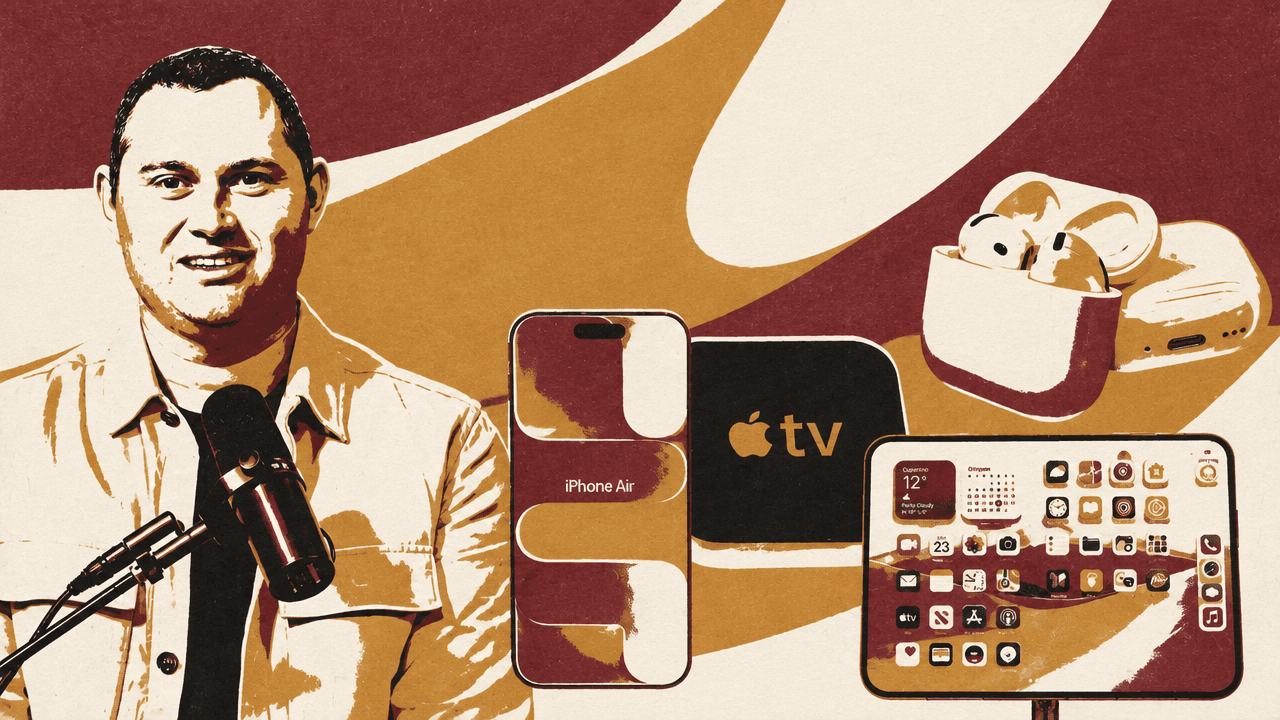
Apple is widening product boundaries without collapsing them
Mark Gurman says Apple has tested iPads running macOS for some time, a possibility enabled by the shared Apple Silicon architecture in iPads and Macs. But he knows of no active work to turn macOS into a consumer iPad operating system, or to create a new operating system for the iPad. Apple’s recent approach has been to bring Mac capabilities over in pieces: make iPadOS more Mac-like, as with its multitasking features, and rebuild apps such as Final Cut and Logic for the iPad.

Gurman thinks Apple should make a 15- or 16-inch iPad and put macOS on it. He does not expect the company to do so soon. He also points to a regulatory complication: in the European Union, Apple is regulated on an operating-system-by-operating-system basis. Bringing one operating system to more device types could make it harder for the company to deal with regulators, he says, giving Apple another reason to keep distinct systems for distinct hardware.
That boundary becomes harder to define with Project J312, a foldable iPad with a 19- or 20-inch display. Gurman describes it as a giant iPhone Duo without an external screen, potentially priced between $3,000 and $5,000. Its possible announcement has moved from 2027 to 2028 and, more recently, perhaps 2029; Gurman says it may never reach the market. Cost, display yields and the device’s size are among the problems. So is the basic question of what it would run: macOS, iPadOS or something new.
His own use of Apple devices illustrates how those categories can blur. Gurman used an iPhone, a 13-inch iPad Pro and a MacBook Pro for distinct purposes: the phone for carrying everywhere, the Mac as a work machine, and the iPad for browsing, games and video. With an iPhone Duo-sized display on his phone and a touchscreen MacBook Pro, the iPad Pro has ended up in a drawer. He says the two products have displaced his iPad Pro use, at least for now. But touch on the Mac could also make using an iPad alongside it more natural, including for Sidecar, because both devices would accept the same kinds of input. The overlap, he suggests, raises the bar for what the iPad Pro needs to offer.
The iPhone Air is another product whose future Gurman sees as a question of refinement rather than cancellation. He says an iPhone Air 2 is planned for the first half of 2027, with a more efficient A20 Pro chip and a wide-angle camera. He expects marginally better battery life and says the second generation could make the Air more compelling. The current model’s price has risen to $1,100; he does not know whether Apple will raise it again.
Gurman expects the Air to be one of three iPhones in that launch window, alongside the regular iPhone 18 and lower-cost iPhone 18 E. He characterizes those two as updates focused on specifications, modest camera improvements and efficiency rather than major changes. ProMotion, he says, is not coming to those models; it remains for higher-end phones, including the Air.
The shift to releasing Pro phones in the second half of the year and lower-tier models in the first is intended to spread launches and revenue across the year. Gurman says it may become associated with John Ternus, but the decisions began two or three years ago. Manufacturing, financial and operational plans have to be fixed well in advance, he says, so the shift predates Ternus becoming CEO.
Gurman’s MacBook Air forecast comes with a timeline that is difficult to reconcile with the recording’s other dates. He names the next 13-inch and 15-inch projects as J913 and J915, and says they are coming in spring 2025 with an M4 chip and the Mac Studio. He also describes the current Air design as introduced in 2022 and expanded with a 15-inch model in 2023, then predicts a major redesign in 2027 or 2028, with OLED part of the discussion. He says the Air is Apple’s most popular computer and needs to stay fresh. The spring 2025 date and M4 detail are Gurman’s stated forecast; the source’s surrounding dates do not make that timing a settled chronology.
Wearable AI depends on turning what a camera sees into useful action
Gurman says Apple had planned a higher-end AirPods Pro update with small cameras, though not necessarily under an “Ultra” name. The cameras would enable visual-intelligence features: identifying an object, attaching a reminder to something the wearer sees, or suggesting what to cook from ingredients in a refrigerator. The longer-term idea is to connect what the device sees to Siri app intents—first get information, then ask Siri to take an action through an app on the iPhone.
He describes Apple’s smart glasses as pursuing similar functionality in a different form. Some people will not want to wear glasses, he says, so Apple wants to offer camera-equipped wearables either way. He calls the glasses “AirPods for your face.” Gurman expects them to be thinner and higher quality than Meta’s second-generation Ray-Bans, with stronger audio, more battery life and additional sensors. The central test, he says, is whether Siri app intents work well enough to make the features useful.
That distinction—between recognizing something and doing something with it—also shapes Gurman’s account of Apple’s AI infrastructure. He says Apple is working on Project ACDC, a more powerful version of its M-series chips designed specifically for AI servers. Apple uses Private Cloud Compute for some Siri and Apple Intelligence functions, and Gurman describes the company as building server infrastructure for more powerful features.
But the infrastructure needs software to justify it. Gurman says Apple’s harder task is building those features, and that the servers are being used less than Apple expected because Apple Intelligence features have had low penetration. Asked whether Apple might sell servers and compete for AI hardware business, he says he would be surprised if it entered the market, although he thinks it should consider selling to businesses and infrastructure providers.
Apple’s reluctance to enter other hardware markets is not simply a matter of technical capability, in Gurman’s account. He does not expect the company to build its own television, despite loose discussions about the idea a year and a half or two years earlier. He cites infrequent upgrades, weak margins, the logistical burden of manufacturing and shipping large displays across Apple’s markets, and the difficulty of making a television distinctive enough to sell in large quantities. The Vision Pro, he says, was a lesson that people will not necessarily buy an expensive product just because it carries the Apple logo.
Instead, Apple is trying to sell a more capable Apple TV box. Gurman calls its $299 price too high, though he considers it useful for people in Apple’s ecosystem. He would prefer a streaming stick below $100 to expand services revenue, but says it could undercut the higher-margin box. Apple has integrations with television makers including LG and Samsung; Gurman thinks Apple’s preference remains to sell its own hardware.
The Duo exposes the cost of fitting familiar features into new hardware
The iPhone Duo launched with Touch ID because Apple decided early on that it wanted the same unlocking method on the inner and outer screens. Gurman says the inner display’s under-screen camera cannot accommodate facial recognition. On the outside, the screen is too thin for Face ID’s depth sensor and dot projector. Those components require physical space, and he says fitting them into either panel was not feasible for the first generation.
Apple has reduced the size of Face ID components over successive iPhone generations, but Gurman says the module remains difficult to fit into the Duo. He also says Apple knows that internal testers most want Face ID: it is faster and more convenient than Touch ID and preserves an unlocking experience that users have become accustomed to.
Apple has prototypes of an iPhone Duo 2 with Face ID, but Gurman says the company is now at the point of locking in the design and has not yet solved the problem. Whether the next model will include Face ID remains a toss-up.
The Home View has a different constraint. Apple wanted it to recognize who was looking and show that person’s content, but adding Face ID would have raised the cost. Instead, Apple introduced a less secure, AI-based face-unlock feature. Gurman says it can open notifications when someone looks at the outer screen, but it cannot authenticate apps that require Touch ID, provide access to passwords or authorize Apple Pay. It works only within a 45-minute interval and can fail in the dark, particularly when screen brightness is at or below 40 percent. He finds it useful for viewing missed notifications, but says it does not replace Face ID’s security or payment functions.
A unified software organization is meant to bring features across platforms
Gurman says Apple now has one software engineering organization building iOS, iPadOS, macOS, watchOS and visionOS concurrently. WatchOS and visionOS once had dedicated engineering organizations; they have been brought together as Apple seeks to deliver new features across platforms at the same time. He connects the change to aligned version numbering and to features such as the Liquid Glass redesign appearing across operating systems.
Home software is an exception. Apple TV and HomePod run a common core based on tvOS, Gurman says, with much of that work handled by the services software engineering organization under Eddy Cue and Jeff Robbin. For the other platforms, he says, it is no longer useful to think of entirely separate iOS, macOS and watchOS teams. Their work is interlinked, with areas such as audio, sensors and wearable software grouped across products.
Cook is likely to remain Apple’s political operator as Ternus takes the internal role
Asked whether Mark Gurman expects John Ternus to change Apple’s political approach, Gurman says Tim Cook is likely to remain active as executive chairman for at least the next few years, perhaps through 2030. Cook would continue handling political relationships while Ternus focuses on engineering, products and the company’s internal operations. Gurman describes the arrangement as Cook the “external CEO” and Ternus the “internal CEO.”
Gurman understands why some Apple customers and employees are upset by Cook’s engagement with the Trump administration, including donations and other concessions. He says others view those choices as necessary to protect Apple and its shareholders from tariffs and geopolitical pressures. The unresolved question, in his view, is how much of Cook’s approach is about protecting the company and how much reflects Cook’s personal relationship with Trump.
That’s something that only Tim Cook could answer.
Gurman does not assume Ternus will eventually take on the same political role. Other large technology companies have senior executives who handle government relations, and Apple could appoint someone to do similar work after Cook. For now, Gurman says, it is too early to know. He also does not know how major shareholders view the division of responsibilities. To him, Ternus still appears to have a boss even as CEO, while Cook remains the more recognizable public figure. That could change as Ternus becomes better known.
The touchscreen MacBook Pro stands out among Gurman’s scoops
Among the Apple rumors he has covered over nearly 20 years, Gurman singles out the touchscreen MacBook Pro. He says he reported in late 2022 or early 2023 that Apple was preparing to reverse its long-held opposition to touchscreen laptops. In the years that followed, he gathered details about pricing, chips, specifications, design and software features, including the Dynamic Island, battery and a lighter frame.
Gurman says the report mattered to him because consumers wanted the product, he wanted it himself, and he believes it is good for Apple. His enthusiasm is personal as well as professional: he says he is excited to use it when it comes out.
Apple’s hardware choices sit alongside a services strategy
In a brief exchange about people playing audio through phone speakers, Gurman speculates that improving phone speakers may be one factor, while wireless earbuds can feel cumbersome to charge, keep track of and store. He also mentions that some people may have concerns about radiation from AirPods, while explicitly saying he has no scientific backing for that speculation. He and producer Alexis Haut note that wired EarPods and other wired headphones seem to be appearing more often, particularly among younger people. Gurman suggests Apple may have had to restart production of wired EarPods to meet that demand, though he frames this as a guess.
Apple TV+ offers a different example of a product whose value may not be measured only by direct hardware sales. Gurman recalls that the service launched in November 2019 with four shows, charged $5 a month, and then faced a large production gap during COVID. He says it has since become a cultural phenomenon and a success for Apple, even if he does not know whether it makes money. If treated as a marketing lever for the company, he says, Apple should be very pleased with it. The exchange also contrasts Apple’s focus on a smaller slate of shows with services that carry much more content.