Robotics Still Lacks Its ChatGPT Moment


Google DeepMind’s head of robotics, Carolina Parada, says recent advances in language and vision models have moved robots beyond treating their surroundings as meaningless coordinates toward understanding instructions, environments and tasks. But she argues robotics has not yet reached its “ChatGPT moment”: a system that can reliably respond to a person’s request in an unfamiliar setting. Humanoids may help deploy such intelligence in spaces built for people, she says, though many tasks will call for other robot forms.
The robotics ‘ChatGPT moment’ is still ahead
Carolina Parada defines a meaningful breakthrough in robotics less as an impressive demonstration than as a broadly accessible interaction model. For her, a “ChatGPT moment” would arrive when people can interact with a robot in a new setting, tell it what they want, and have it respond appropriately.


That threshold has not been reached, Parada says, though she sees it coming into view.
In my opinion, a ChatGPT moment for robotics would be one where everybody can experience what it’s like to interact with the robot, and the robot responds to what you want and does what you want in a completely new environment or a completely new setting.
The technical objective Parada describes is an intelligence layer that can power any robot: one that is intuitive for humans to use, can perform a broad range of tasks, and can understand an environment, reason about it, and act on a newly assigned task. The destination, in her account, remains ahead rather than already achieved.
From spatial coordinates to task understanding
Asked by Tom Mackenzie what technological barriers must be overcome, Carolina Parada points to the intelligence layer DeepMind is pursuing. She says robotics has made “significant progress” over the past three or four years, and describes the change as a shift in what a robot can make sense of.


Earlier robots, in her account, did not understand objects or their surroundings as meaningful things. Their environments were “points in space without any meaning.” The introduction of large language models and vision-language models into robots around 2022 changed that, she says, by enabling systems to understand natural language, reason about their environments, and take action toward a semantic or otherwise meaningful task.
That is more than a claim about improved perception or movement. Parada is describing a system that connects an instruction to an environment, reasons about what is there, and directs physical action toward the task it has been given.
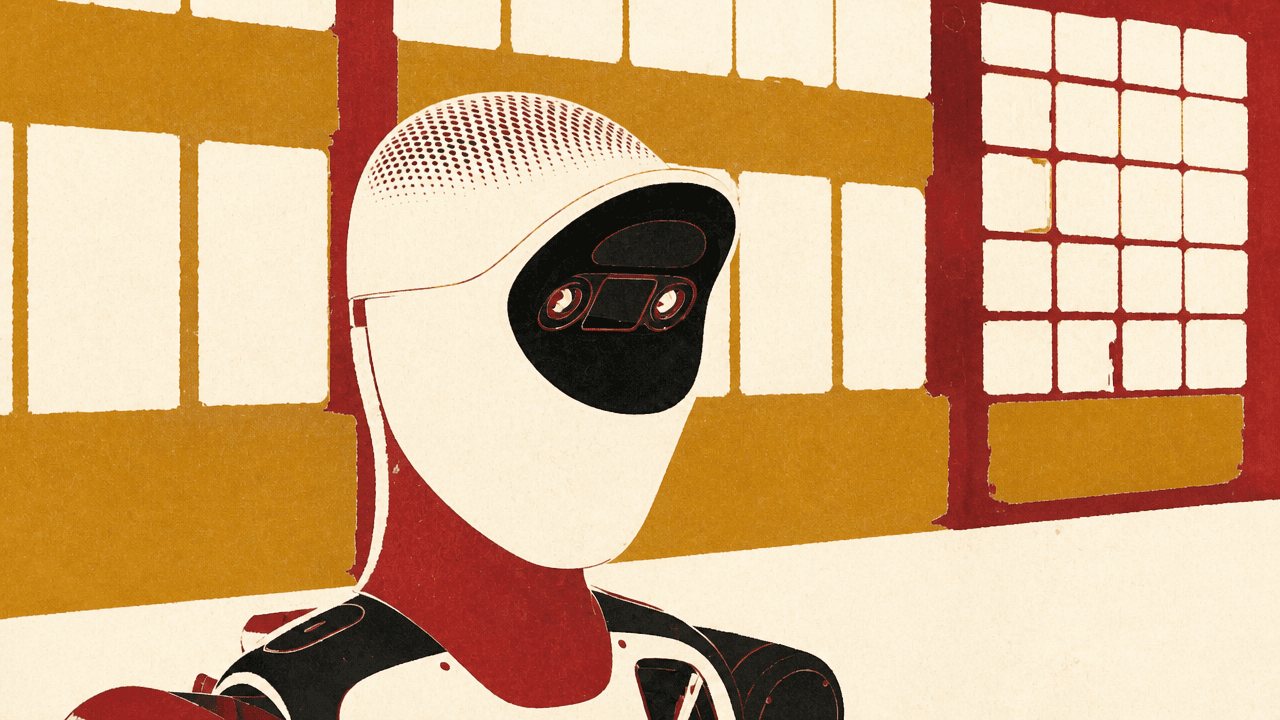
Footage credited on screen to Agile Robots illustrates the combination of perception and manipulation she is describing. A humanoid moves through a warehouse; a digital sensor view shows the environment; robotic hands manipulate metal parts and use a drill. Another clip focuses on the robot’s joints and camera sensors as it interacts with a person.
Humanoids fit human spaces, but not every job
Carolina Parada does not treat humanoid robots as the inevitable form for every deployment. She expects many robot types, and says a non-humanoid form factor will be the practical choice for many tasks. Her stated interest is in bringing intelligence to all kinds of robots.
Still, she sees humanoids as an important form factor for two practical reasons. First, the built world is designed around people. A robot with a human-like body may be easier to deploy in human-centric environments.
The world is made for humans. So if you want to immediately deploy a robot in an environment that is human-centric, then a humanoid is probably going to be an easy one to deploy.
Second, a shared form factor may make learning from human demonstrations easier. Parada’s example is cooking: if a robot watches a person prepare a recipe, a human-like body can make it easier to translate what the person is doing into the actions the robot itself should take.
Humanoids also matter to Parada as a way of making a more ambitious capability visible. She says her goal is to show that artificial general intelligence can reach the physical world, which she defines here as a robot being able to do anything a human can do. Humanoids are not, in her view, the exclusive path to useful robotics; they are a form factor through which that level of physical capability could be demonstrated.