Google’s Gemini Connects Fragmented Healthcare Records, Coverage and Clinical Systems

Google Cloud is positioning Gemini for Healthcare as a way to connect medical records, coverage information and administrative systems that often do not communicate. Aashima Gupta, the company’s global healthcare leader, argues that linking those sources could reduce work in tasks such as billing, scheduling and nurse handoffs, giving care teams more time for patients. She described privacy, security and HIPAA compliance as core requirements, while offering no headline estimate of time saved.
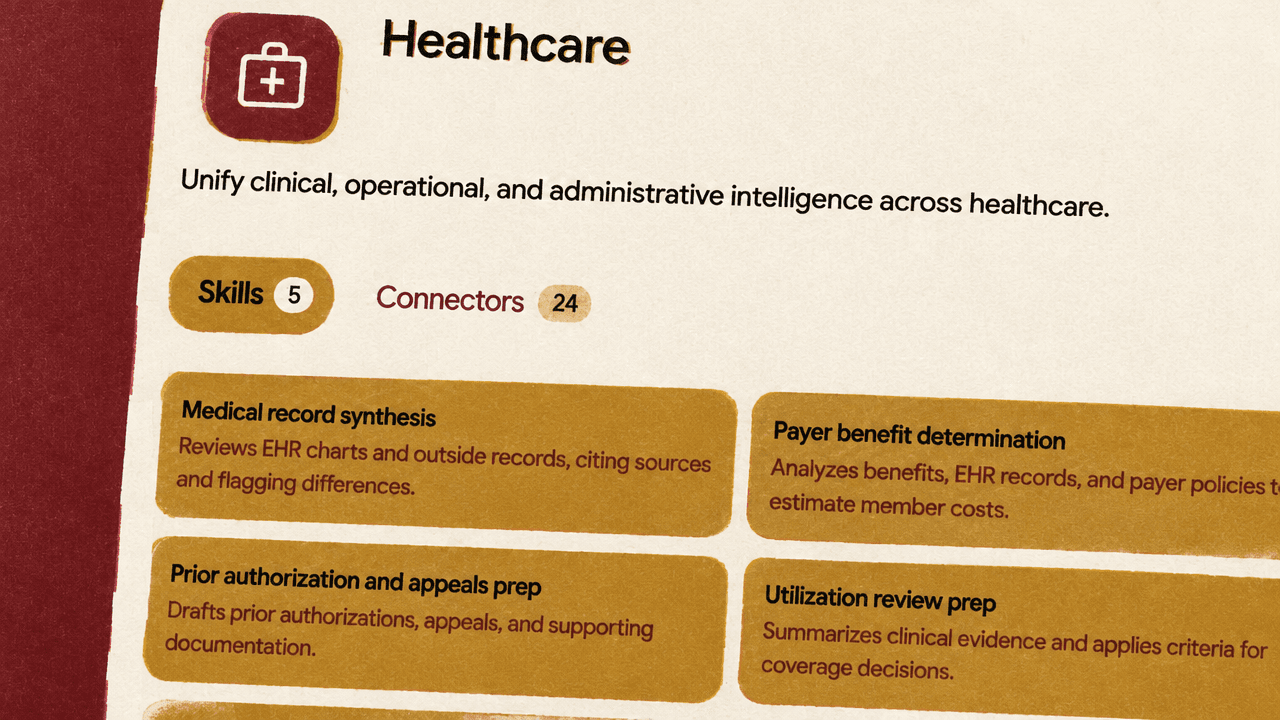
Gemini is designed to connect records, coverage and administrative systems
Healthcare’s data problem is not confined to the exam room. As ? aashima-gupta, Google Cloud’s global healthcare leader, put it, administrative work also accumulates in billing, call centers and scheduling. Information sits in systems that often do not communicate, alongside paper forms, faxed documents and PDFs.
Google’s Gemini for Healthcare is designed to connect those sources. Gupta described three parts to the announcement, beginning with connectors to systems hospitals, insurers and providers already use. The interface shown during the interview listed 24 connectors and five skills. The visible skills included medical-record synthesis, payer-benefit determination, prior-authorization and appeals preparation, and utilization-review preparation. Connectors shown included Epic EHR, CMS Coverage, Optum, InterSystems FHIR Server and BMJ Digital Health.
The intended reach extends beyond medical records. Gupta said the platform was being announced with more than 24 partners. She named Epic and Oracle Health as sources of medical records; the American Society of Clinical Oncology and the British Medical Journal as sources of clinical guidelines; Optum and CMS for benefits and coverage; and Workday and ServiceNow among the applications it can connect to. A partner graphic also displayed health organizations including HCA Healthcare, Hartford HealthCare, Highmark Health, Massachusetts General Hospital, Northwell Health and Stanford Medicine.
A Google interface shown on screen illustrated one possible workflow: a user asks what preventive care a patient is due for under Medicare, with a chart and a specialist’s faxed records attached. The screen showed the question and documents as the system began working; it did not show a completed answer. The demonstration illustrates how Gemini could bring clinical records, an outside document and coverage information into one workflow.
Gupta said the connections are designed to respect the privacy and security of the underlying systems. The product is presented as an enterprise tool for connecting information across organizations, not as an open-ended consumer chatbot.
The test is time returned to care
Asked how Google would measure whether the product helps, Gupta did not offer a headline target for reduced paperwork or time saved. She framed the test more broadly: whether providing and receiving care becomes easier.
Her example was nurse handoff at HCA Healthcare. At the end of a shift, a nurse summarizes the patients seen for the incoming staff; Gupta said the task takes 60 to 75 minutes. HCA is working with Google on whether AI can reduce that time. Gupta said the organization has 60,000 such handoffs and calculated that saving five minutes on each would amount to 300,000 minutes a day.
The calculation conveys the scale Gupta wants customers to consider, but the example remains a use case under exploration: she said they were looking into whether AI could cut the time significantly. Her rationale was direct: a minute spent on paperwork is a minute not spent on care delivery.
The example also makes the proposed measure of success more concrete. It is not enough for a model to produce a useful summary. The value depends on whether it can fit into a care team’s existing work and reduce the administrative effort around it.
Google is positioning Gemini as a platform, not a single-model product
Riley Griffin asked how Google Cloud would distinguish itself from healthcare AI startups pursuing similar problems. Gupta described the strategy as “ecosystem-first”: Google wants to be a platform partner for startups and digital-health companies, rather than claiming that innovation should come only from Google.


She identified three differentiators. First, Google combines an AI research lab, its own chips and models, and cloud infrastructure. Gupta said that lets the company pursue efficiency at multiple layers and bring those efficiencies to healthcare organizations and partners.
Second, the platform offers model choice. Gupta said healthcare customers want flexibility while AI is still in its first inning in the industry, and that the platform supports more than 200 models, including models from other frontier labs. Her argument is that customers should not have to commit to a single model as they build workflows.
Third, Gupta emphasized enterprise controls. She said actions are citable and referential, and described the platform as HIPAA compliant, with privacy and security built in from the ground up. For organizations connecting sensitive information across systems, Gupta’s pitch is that model flexibility must come with those enterprise controls.