GameStop May Swap Its $56 Billion eBay Bid for a Partnership
 Bailey Lipschultz
 Ed Ludlow
 Spencer Soper
 Ryan CohenBloomberg TechnologyMonday, August 10, 20264 min read
GameStop may withdraw its proposed $56 billion bid for eBay after eBay rejected the approach and instead seek a partnership or joint venture, Bloomberg reports. Bailey Lipschultz says the companies could use GameStop’s 1,600 US stores to authenticate collectibles for eBay sellers, giving the marketplace a physical intake network without an acquisition. Spencer Soper cautions that similar efforts have struggled before, and that a store footprint alone does not establish customer demand or workable economics.
The $56 billion bid is giving way to a less ambitious path
A month after Ryan Cohen said GameStop was “coming for eBay one way or another,” Bloomberg reported that he may withdraw the company’s proposed $56 billion bid for eBay and instead pursue a partnership or joint venture.


The shift follows eBay’s rejection of the takeover idea. GameStop had presented an acquisition as a way to capture synergies Cohen saw between the two companies, but eBay is “magnitudes larger” than GameStop, as Bailey Lipschultz put it. A partnership would preserve some version of that strategic premise without requiring eBay to accept an outright sale.
I'm not going to call my shots, but we're coming for eBay one way or another.
GameStop is not approaching eBay solely as an outside suitor. Lipschultz said it is eBay’s second-largest shareholder, behind Vanguard, with a stake just below 10%. GameStop had also been raising capital and seeking to diversify its offerings, including through collectibles. The eBay proposal was part of that broader push.
The reported pivot therefore does not abandon Cohen’s interest in eBay. It changes the mechanism: rather than buying the larger company, GameStop could try to make its own physical presence a service eBay might use.
The stores would turn collectibles into a physical handoff
The reported joint-venture concept would use GameStop’s network of stores around the country. As Spencer Soper described it, customers could bring collectibles into those locations to have them authenticated.


That is the operating logic behind a possible partnership. An online marketplace can connect buyers and sellers, but GameStop’s stores could provide a place for people to physically bring in collectible items and have them assessed before they are sold. In the reported concept, the store network is not simply a branding asset or a retail presence for eBay; it is meant to handle an in-person step that an online transaction cannot perform on its own.
That could give eBay access to a physical footprint through a partner. Soper’s point, however, was that the premise should not be treated as novel or self-evidently valuable. eBay tried a different physical-intake initiative roughly a decade ago, aimed at helping people clear out closets and garages; customers could bring items such as golf clubs to FedEx locations.
The comparison matters because both approaches depend on persuading sellers to add an offline step to an online sale. eBay’s earlier effort involved household goods rather than collectibles and used FedEx rather than GameStop stores, but it similarly sought to create a convenient drop-off point for people who wanted to sell physical items. The existence of GameStop locations does not itself resolve the execution question: whether customers will use the stores, whether authentication adds enough value, and whether the process works economically at scale.
Soper also pointed to Amazon’s stumbles with physical retail as a reason not to assume that stores automatically improve an online-marketplace business. The proposed use of GameStop locations for collectibles authentication may be worth exploring, he said, but it is neither a fresh idea nor one that becomes viable simply because a nationwide store network exists.
If you're going to announce to the world a 56 billion dollar deal, you should make sure you have 56 billion dollars first.
eBay shares lost the takeover scenario investors had been pricing in
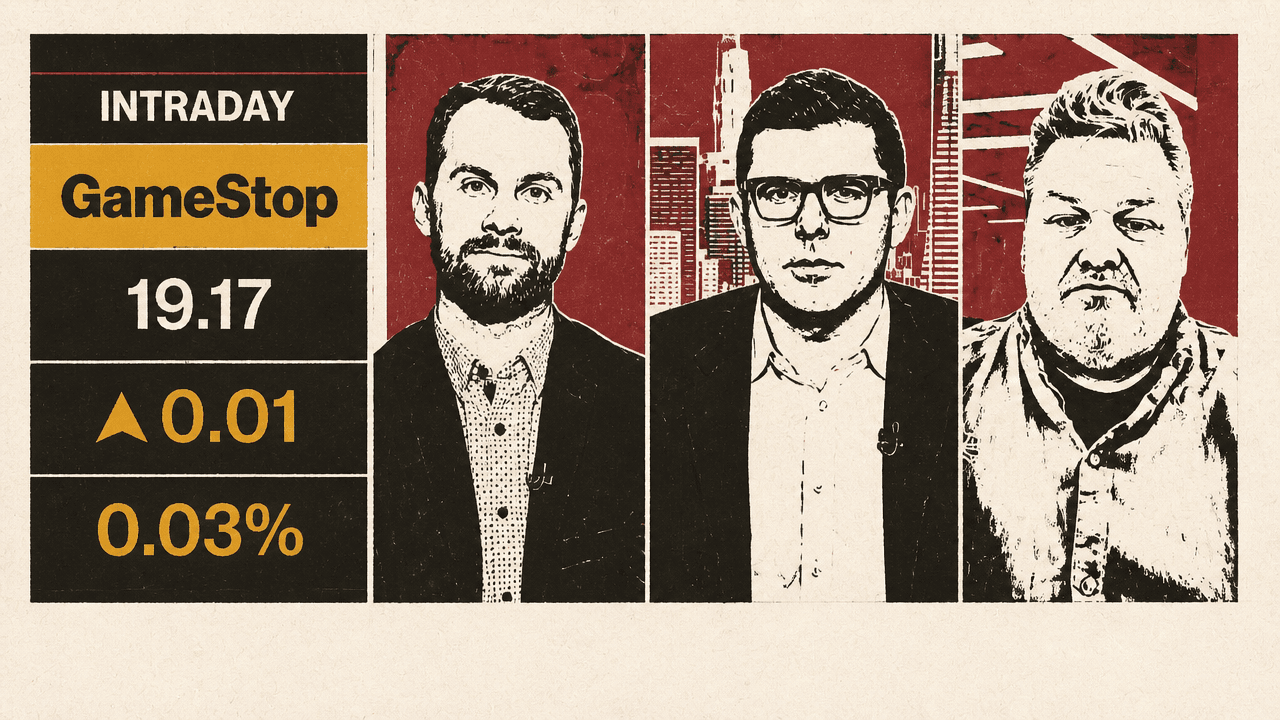
The intraday market move tracked the change in deal expectations. eBay shares were down 3.38%, to $108.20, while GameStop was essentially flat at $19.17, up one cent.
Bailey Lipschultz said the decline removed some of eBay’s “upside optionality.” Put more plainly, a possible $56 billion acquisition gave investors a distinct scenario in which eBay could be bought at a deal valuation. A partnership or joint venture may offer commercial benefits, but it does not carry the same prospect of an acquisition.


GameStop’s muted reaction was less surprising, Lipschultz said. Its shares had generally moved “down and to the right” over the prior 12 months, and the company had handled some of its converts by diluting shareholders. More immediately, eBay had already shot down the acquisition idea, so the reported pivot did not amount to an entirely new setback.