Broadcom’s AI Financing Could Reach $100 Billion Through an SPV


Bloomberg’s Ed Ludlow reports that Broadcom is discussing an AI-infrastructure financing structure that could total $100 billion across senior and junior debt, rather than a single $100 billion corporate borrowing. Under the proposed arrangement, an SPV financed by lenders and investors would buy Broadcom equipment and lease it to an end tenant, while Broadcom backstops the $60 billion to $70 billion senior-debt portion. Ludlow argues that the structure leaves debt central to the transaction but distributes ownership, borrowing and equipment-use obligations among several parties.
The potential $100 billion stack is not a single Broadcom borrowing
Ed Ludlow described the reported Broadcom arrangement as potentially reaching $100 billion, but said that figure should not be read as a conventional $100 billion debt raise by Broadcom itself. The structure under discussion consists of $60 billion to $70 billion in senior secured debt and $30 billion in junior debt.


Broadcom would, in Ludlow’s description, backstop the senior debt. That is the part of the structure that ties the company directly to the financing, even as the larger transaction distributes ownership, lending and equipment-use roles across multiple parties. The company would not simply receive a single pool of borrowed funds and hold all of the associated infrastructure on its own balance sheet.
It’s not as simple as to say, well, Broadcom’s borrowing 100 billion dollars.
The distinction matters because the headline amount combines different layers of capital and different obligations. Senior secured debt would sit ahead of the junior layer, while Broadcom’s backstop would support the senior portion. Ludlow did not characterize that as removing debt from the transaction; rather, he described a financing mechanism in which Broadcom’s role is narrower than being the sole borrower for the full potential amount.
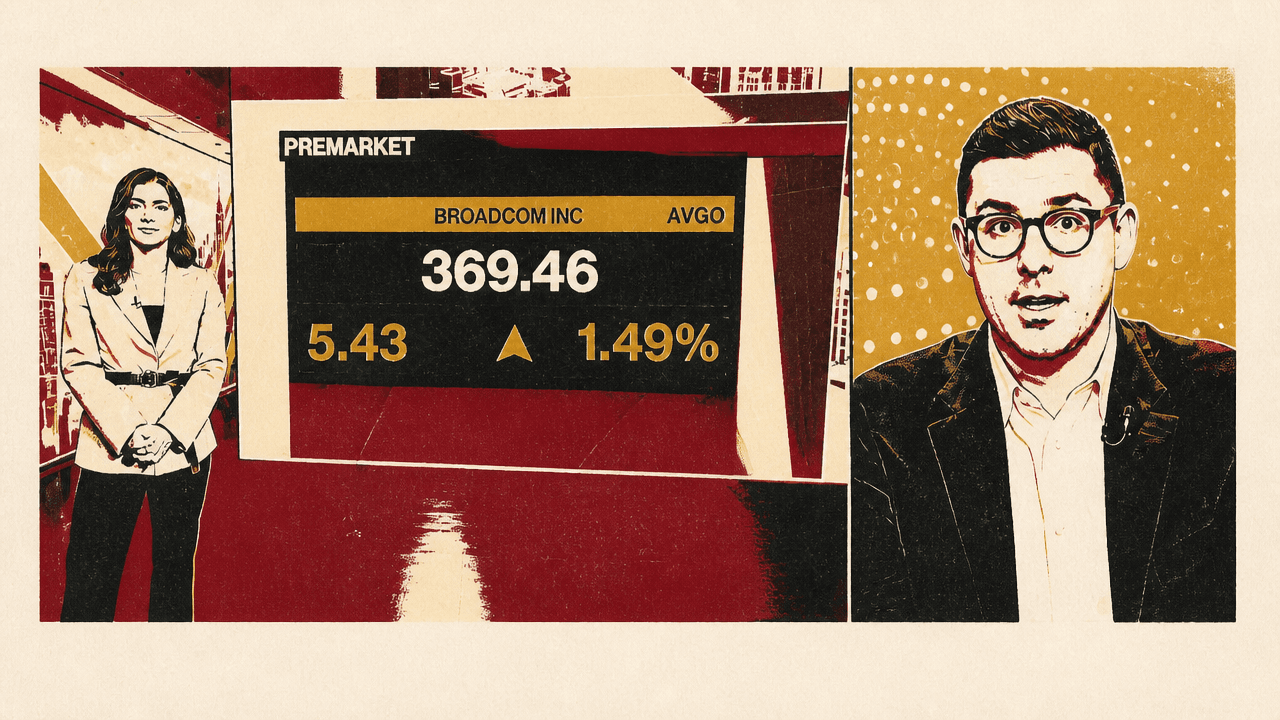
Bloomberg’s on-screen reporting described the more than $60 billion AI-chip financing deal as one that would benefit Anthropic and other companies. Broadcom’s stock was shown up 5.18% year to date in the accompanying Bloomberg chart.
The SPV would own the equipment while an end tenant leases it
According to Ed Ludlow, the next step in the reported arrangement would be the creation of a special-purpose vehicle, or SPV, that buys the AI infrastructure. Investors and lenders would finance that vehicle; Broadcom equipment would be purchased, then leased to an end tenant.
That ownership-and-leasing chain is what separates the proposal from a direct corporate borrowing. The SPV would hold the infrastructure assets, outside capital would fund the entity, and the eventual user would lease the equipment. Broadcom, as Ludlow described the structure, would supply the gear and backstop the senior debt rather than simply borrow the full potential amount to purchase and retain the assets itself.
Ludlow compared the arrangement to a separate Nvidia proposal involving six Wall Street firms. He stressed that the Nvidia agreement was a distinct transaction, but said the underlying aim was similar: to lower the bar for financing AI infrastructure at scale. In his account, the role of the Wall Street firms was to act as a conduit for third-party capital.
The comparable function of the SPV structure, as Ludlow presented it, is to assemble financing around the infrastructure itself and lease that equipment to a user. That can create a path for lenders and investors to finance the asset-owning vehicle rather than requiring the end tenant or equipment provider to serve as the sole direct borrower.
It’s debt that underpins it.
The scrutiny is over where AI infrastructure commitments appear
The discussion raised a broader question for debt-market investors: whether conventional measures of corporate debt capture the full set of financing commitments being assembled for large AI infrastructure buildouts when debt is routed through specialized vehicles and supported by several parties.
Ludlow’s answer was not that the obligations disappear. His point was that calling the arrangement a $100 billion Broadcom borrowing would obscure the roles of Broadcom, the SPV, lenders, investors and the eventual tenant. Debt remains central to the transaction, but the borrower, owner of the equipment, capital providers and user of the infrastructure need not be the same entity.
That framing also informed his comparison with Nvidia’s Wall Street-firm arrangement. Ludlow said investors had been relatively calmer about concerns over circular financing in that case because the six firms were conduits for third-party capital. He did not suggest that made the Nvidia transaction identical to Broadcom’s reported plan; the comparison was about how outside capital can be brought into a large infrastructure financing structure.
Ed Ludlow said the debt investor is willing at present. Citing Robert Schiffman at Bloomberg Intelligence, he said there is appetite whether technology companies present themselves directly to lenders or use what he called an “unusual mechanism” that is still being understood. For investors assessing the Broadcom proposal, the relevant question is therefore not only how much debt is involved, but where it sits, what supports it, who owns the equipment, and how the financing reaches the eventual user.