Apple’s Holiday Revenue Outlook Faces Pressure From Memory and Siri Costs


Apple’s holiday-quarter revenue forecast of 7% to 10% growth exceeded Wall Street expectations, but a warning of higher memory costs and Siri AI expenses weighed on the stock. Bloomberg’s Mark Gurman said the margin pressure could persist through fiscal 2027, while higher iPhone prices make revenue a less reliable measure of unit demand. He also said supply constraints on the new iPhone Duo could push sales into later quarters.
The margin warning outweighed the revenue outlook
Apple forecast holiday-quarter revenue growth of 7% to 10%, above the roughly 6.1% consensus estimate. The stock fell after the company reported a record fiscal fourth quarter, with attention turning to gross margins. Bloomberg’s Mark Gurman said Apple warned that memory costs would get worse in the December quarter and that pressure would continue through the rest of fiscal 2027. Apple also faces expenses from improving and rolling out its Siri AI digital assistant, another margin concern noted in the source description.


John Ternus said price increases made in June and September were only a partial offset to rising costs. Gurman said the company’s gross-margin forecasts reflected that pressure. Further price increases may be one response, but their effect on consumer demand is uncertain. So far, Gurman said, higher prices had helped Apple maintain growth; that does not establish how customers would respond to additional increases.
Higher prices make iPhone revenue a blurry demand signal
Apple’s fiscal fourth quarter was the September quarter. The iPhone Duo launched in late October, after the quarter ended; the quarter included two weeks of iPhone 18 Pro and Pro Max sales.
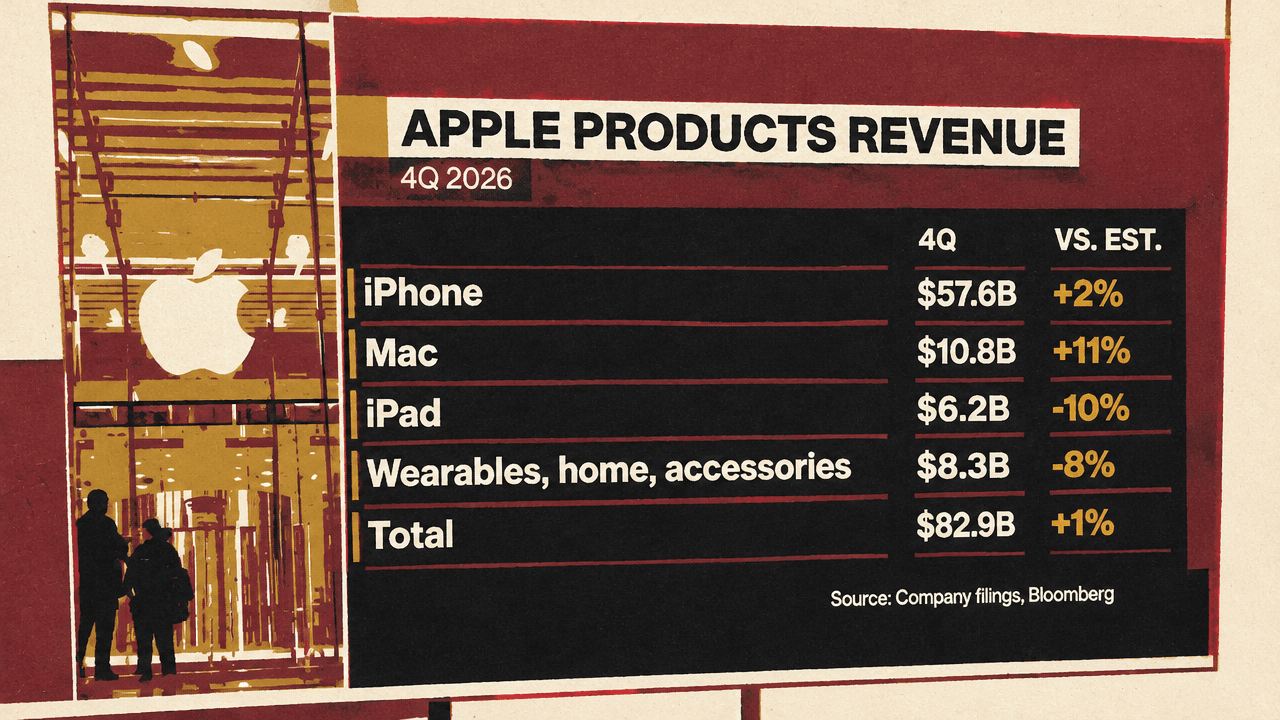
The product figures were mixed. iPhone and Mac revenue exceeded estimates, while iPad and Wearables, Home and Accessories fell short. Total product revenue was $82.9 billion, 1% above estimates.
| Product category | Revenue | Versus estimate |
|---|---|---|
| iPhone | $57.6B | +2% |
| Mac | $10.8B | +11% |
| iPad | $6.2B | -10% |
| Wearables, home and accessories | $8.3B | -8% |
| Total | $82.9B | +1% |
Gurman said iPhone revenue came in above $57 billion, compared with Wall Street expectations of about $56.5 billion. He cautioned that the revenue figure does not settle whether unit sales rose: Apple’s $100 price increase, and larger increases for higher storage capacities, could make up for some shortfall even if fewer phones sold.
Even if demand actually shrank, even if unit sales actually shrank, that $100 price increase and, you know, higher price increases on the higher storage capacities makes up for some of that potential shortfall.
Gurman distinguished the year-over-year comparison from the quarter-to-quarter one. iPhone growth accelerated annually in the fourth quarter, but decelerated sequentially. He said the price increases had buoyed Apple so far; the available revenue comparisons, however, leave unit demand difficult to determine.
Duo supply constraints could shift revenue into later quarters
Gurman said Apple’s decision to push most of the new-phone lineup beyond the September quarter worked in the sense that iPhone revenue still beat expectations. But supply shortages for the Duo meant many customers might not be able to get the phone until February, March, April or May. Sales could therefore appear in later financial results rather than immediately after launch.
He said that timing could smooth revenue across the second, third and even fourth quarters. The year’s cycle also would not include an iPhone Air or a regular iPhone 18, he said. The September quarter’s iPhone result, then, came before the Duo launch and included only two weeks of sales for the 18 Pro and Pro Max; it cannot show how much Duo demand will translate into revenue, or when.
That leaves two different pressures in view. The holiday outlook points to growth above consensus, while memory costs and spending on Siri AI weigh on margins. Higher prices have supported revenue, but make it harder to read unit demand from sales figures; Duo supply constraints may also spread its contribution across later quarters.