Apple Extends Broadcom Deal Through 2031 for Server-Side AI Chips


Bloomberg’s Mark Gurman says Apple’s expanded Broadcom agreement, which runs through 2031 and covers custom chips for multiple generations of Apple products, is chiefly about server-side AI silicon rather than another connectivity component for consumer devices. He says Broadcom is working on technology for a new Apple server chip, known internally as Baltra, as Apple moves its Apple Intelligence infrastructure beyond repurposed Mac processors toward purpose-built ASICs.
Apple’s expanded Broadcom deal points to server-side AI silicon, not another iPhone connectivity part
Broadcom’s new Apple agreement runs through 2031 and covers custom chips for “multiple generations of Apple products,” but Mark Gurman said the important part is what Apple is building behind that deliberately broad language: a new server chip for Apple Intelligence.


Gurman described supplier announcements involving Apple as vague by design. In his account, the Broadcom work is “specifically for a new server chip that Apple is developing,” using Broadcom technology in custom ASIC silicon. He framed the use case narrowly: single-purpose silicon, in this context, is for AI processing.
Apple’s current Apple Intelligence server infrastructure, according to Gurman, uses M2 processors originally designed for Macs. The new chip, known internally at Apple as “Baltra,” would be Apple’s first server-specific chip. Gurman said Apple could begin rolling it out as early as next year.
The chip is described as a version of the M5 Ultra, which Gurman called Apple’s most powerful chip ever. He said the server chip would have four times the performance “on the GPU and on the CPU side,” with Broadcom technology included.
This is specifically for a new server chip that Apple is developing.
Ed Ludlow connected the architecture to a familiar reference point: Google’s TPU. Gurman agreed that this was “very similar tech.” The comparison placed Apple’s project in the same broad category of custom AI accelerators built for specific workloads rather than general-purpose client-device processors.


Broadcom’s stock reaction showed investors treated the Apple work as material
Ed Ludlow said Broadcom was not merely participating in a broader rally but was “at the center of the biggest news item.” On the day of the announcement, the stock was up about 4%, after having been up as much as 6%, and Ludlow said it was on track for its best day since February.
The market context shown in Bloomberg Tech’s intraday graphics was a strong session for technology and semiconductor names. The on-screen figures showed the Nasdaq 100 up 1.49%, the PHLX Semiconductor Index up 4.03%, AMD up 9.26%, Broadcom up 4.18%, and Apple up 1.28%.
| Instrument | Intraday level shown | Move shown | Percent change shown |
|---|---|---|---|
| Nasdaq 100 | 29,766.28 | +437.07 | +1.49% |
| PHLX Semiconductor Index | 13,135.07 | +508.85 | +4.03% |
| Advanced Micro Devices | 565.67 | +47.85 | +9.26% |
| Broadcom | 375.52 | +15.07 | +4.18% |
| Apple | 312.59 | +3.96 | +1.28% |
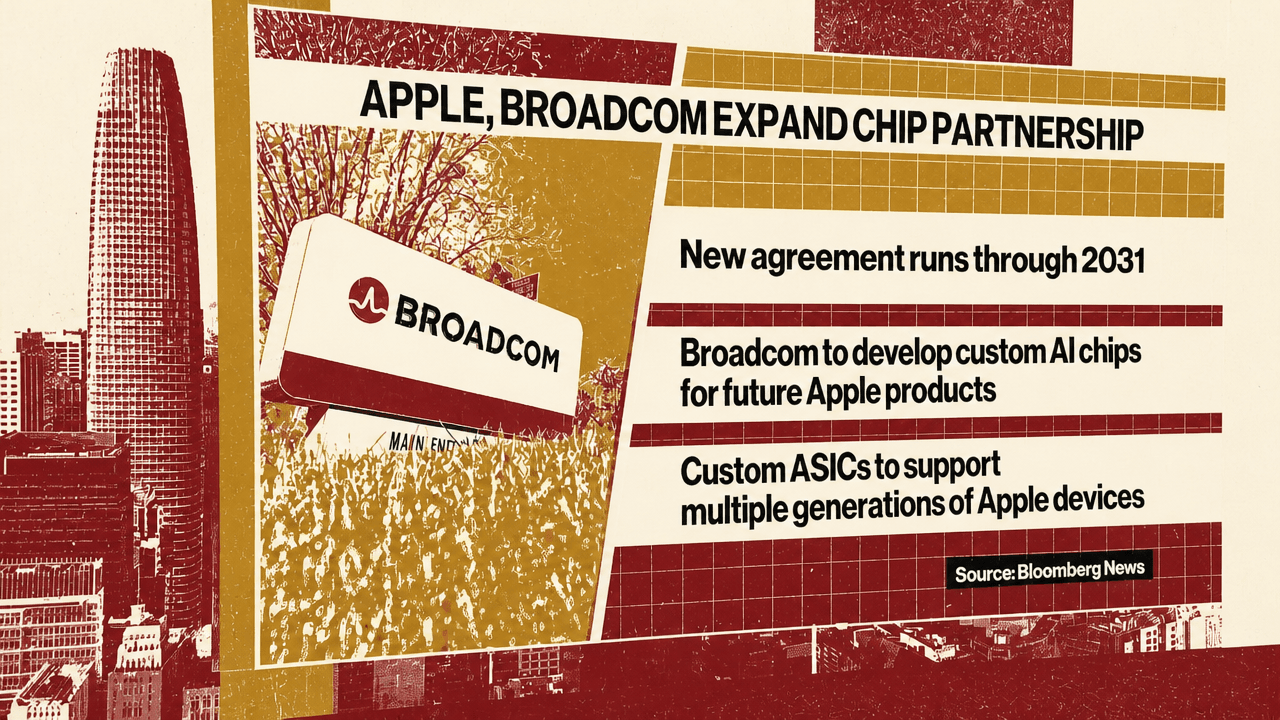
The on-screen Bloomberg News summary stated that the new agreement runs through 2031, that Broadcom will develop custom AI chips for future Apple products, and that custom ASICs will support multiple generations of Apple devices. The wording leaves room for ambiguity about where the chips will appear, while Gurman’s account tied the near-term significance to Apple’s AI server infrastructure.
“Multiple generations of Apple products” could sound like consumer hardware: iPhones, iPads, Macs, or wearables. Gurman instead said the agreement brings Broadcom back into Apple’s roadmap for AI and server purposes.
Broadcom’s old Apple role was shrinking; the new one is different
Broadcom’s history with Apple was in wireless connectivity. Mark Gurman said Broadcom had designed combined Wi-Fi and Bluetooth chips for Apple “for a number of years.” But Apple has been moving that work in-house.
Broadcom had been designed out of newer Apple product generations. Apple now uses its own N1 chip for Wi-Fi and Bluetooth in many new iPhones, Macs, and iPads. In that sense, the new deal is not simply an extension of Broadcom’s old role inside Apple devices. It is a re-entry through a different part of Apple’s technology stack.
That re-entry is why Gurman called the agreement “super exciting” for Broadcom and its investors. The company had been pushed out of a long-running connectivity function. The new work positions Broadcom inside Apple’s AI server effort, where Apple appears to be moving from repurposed Mac-class processors toward silicon designed specifically for server-side Apple Intelligence workloads.
Ludlow’s question drew out the uncertainty around whether this server relationship might broaden back into devices. Gurman did not say Broadcom is returning to iPhone or Mac connectivity. His answer pointed the other way: Broadcom is coming back “for AI and for server purposes.”