Apple’s Next HomeView Could Turn Its Screen Toward Whoever Is Speaking


Bloomberg’s Mark Gurman says Apple is already developing a higher-end HomeView with a robotic limb that would swivel the screen toward whoever is speaking. Unlike the $299 model, which users must reposition themselves, the proposed device would use visual and voice cues to identify a person and turn toward them. Gurman estimates it could cost more than $800 and arrive next year or the year after.
The $299 HomeView is the product Apple had to wait to ship
Apple’s November 13 HomeView is the first version of a product whose hardware, according to Bloomberg’s Mark Gurman, had been ready well before its software. A more ambitious model is already in development: the $299 launch model is repositioned by its users, while the proposed follow-up would move its screen automatically. Gurman said the follow-up could arrive next year or the year after.


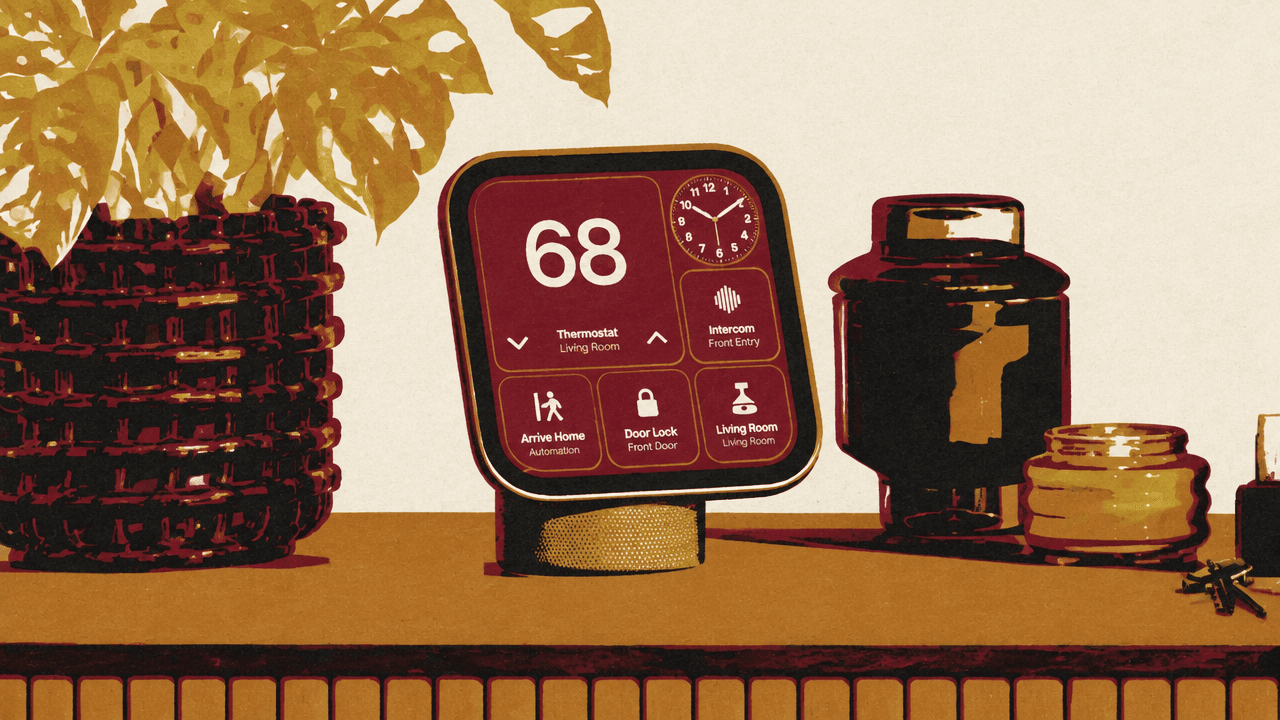
The distinction is clear in the product’s use cases. Gurman said Apple’s advertising shows people turning the screen toward themselves to read messages, check a calendar, or use Siri. Apple’s promotional footage shows the device in home settings, while Apple product images present it with clock faces, widgets, photos, and a smart-home dashboard. In this first version, the display serves different people and tasks, but the user is responsible for pointing it in the right direction.
The higher-end model would change that interaction. Gurman said it could sense who is looking at it using visual and voice cues, then swivel toward that person. The robotic-limb device is a proposed follow-up, not a feature of the November HomeView.
Gurman said the launch hardware was ready, but that Siri AI and the software held up release. The robotic version, by contrast, would add a mechanical capability: the screen could turn toward the person using it rather than waiting for someone to reposition it.
Automatic movement is the proposed premium
Ludlow asked whether the robotic-arm version might cost the same $299 as the first HomeView. Gurman said it would probably cost more than $800. Apple had considered a price of $1,000 during development, he said, but was trying to get significantly below that.
Gurman said the $299 launch price reflects devices produced before memory shortages and related cost issues emerged. He said it was impossible to know what the price might have been if those pressures had been included. The price estimate for the robotic model is tied to its more elaborate design: a robotic limb that can turn the display toward whoever is speaking.
Apple’s product images show the first device in several finishes and in a home setting, with a dashboard for temperature and room controls. In the advertising Gurman described, people manually turn the device toward themselves for different tasks. The proposed follow-up would instead use visual and voice cues to identify who is looking at it and move the screen toward them.
The launch follows a long gap between finished hardware and ready software
Gurman said Apple had originally been trying to release HomeView at the end of 2024, with the launch now coming at the end of 2026—a delay of about 24 months. He said the hardware had been sitting in warehouses, perhaps for upwards of a year, while Siri AI and the software held up the release. He also expected buyers would very likely need a day-one software update when they took the device out of the box.
That expectation matters to how Gurman characterizes the launch: HomeView, he said, would not be plug and play. The physical device can be ready while the experience that depends on software is not. He presented the likely update as a visible sign of the time the hardware had spent waiting.
Gurman said the device had been delayed six or seven times and was probably in development since 2021. Former Apple employees who left in 2023 and 2024 had posted that they worked on HomeView and were surprised it was only now coming out. Their comments, as he described them, were another indication of how long the product’s development cycle had lasted.
Ludlow raised the device’s older-generation chips. Gurman’s explanation centered on the software delay, not on a hardware redesign: he said the hardware was ready, while Siri AI and software held up release. He also linked the $299 price to production before memory costs became an issue. In his account, the launch reflects decisions made well before release: hardware already produced, a price set against earlier costs, and software that may still require an update on day one.
Gurman expects interest in home AI and sees a different privacy response
Gurman said he had ordered two HomeViews, a space-gray one for his desk and a silver one for the kitchen. He expects the AI boom to make devices of this kind popular, arguing that people are looking for AI devices and want them at home.
He also said he had not heard public concerns about privacy or the camera since Apple announced the product. He contrasted that with the response he believes other companies would get if they introduced a similar device, and said Apple’s stance on privacy may be helping it in this area.