Claude Opus 5.5 Cuts Listed Token Prices 40%


Anthropic is releasing Claude Opus 5.5 at lower token prices than its predecessor, as companies contend with the cost of expanding AI use. Bloomberg reporter Rachel Metz said the 40% price reduction does not guarantee a corresponding drop in customer bills, which depend on the volume and type of work run through the model. She also linked the release to Anthropic’s expected IPO and its chief executive’s call to pace frontier-model releases, noting that Opus 5.5 is not being presented as the company’s most capable public model.
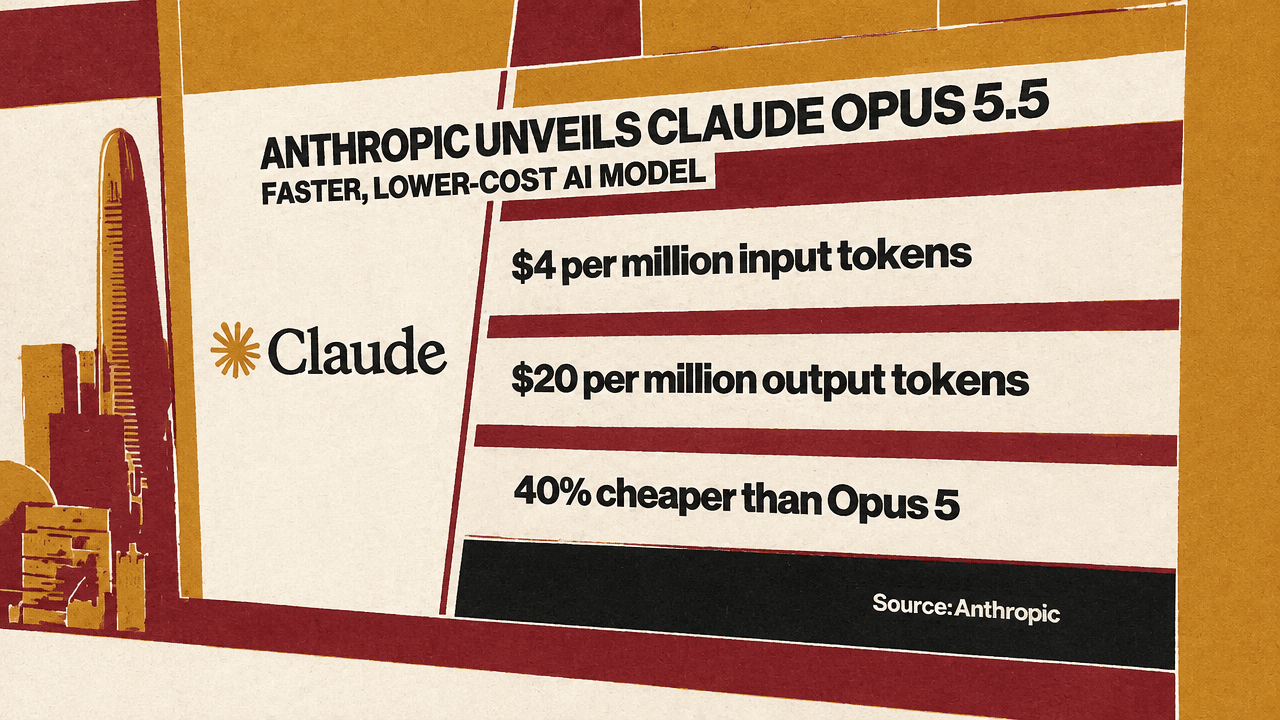
Lower token rates do not translate directly into lower customer bills
Anthropic is presenting Claude Opus 5.5 as a capable model that costs less to use. Rachel Metz connected the pricing to a problem companies are encountering as they adopt AI: usage can become expensive, and some organizations have imposed limits on how much work employees can do with these tools. Lower prices address that pressure, but the listed rates are only part of what determines a customer’s bill.
Anthropic says Opus 5.5 is 40% cheaper than Opus 5. Bloomberg’s comparison gives separate prices per million tokens for cache reads, input tokens, output tokens, and cache writes:
| Price per 1 million tokens | Claude Opus 5.5 | Claude Opus 5 |
|---|---|---|
| Cache reads | $0.20 | $0.50 |
| Input tokens | $4 | $5 |
| Output tokens | $20 | $25 |
| Cache writes | $5 | $6.25 |
Metz described input tokens as material put into a model, such as a prompt, and output tokens as what the model generates. The comparison also lists cache reads and cache writes separately. Each category has a lower listed rate for Opus 5.5 than for Opus 5, but those rates do not predict a particular customer’s savings. Metz said costs depend on the work being done: some tasks are more computationally demanding than others, and users’ patterns of use differ.
The 40% figure is therefore a comparison of model prices, not a forecast that every customer’s spending will fall by that amount. A company’s bill depends on the mix and volume of its model use, as well as the tasks it runs.
A model release can answer cost concerns without claiming a frontier advance
The release comes against two considerations Metz identified: Anthropic’s expected IPO and chief executive Dario Amodei’s call to pace the release of the most cutting-edge AI. She said the company has an incentive to show investors that it is continuing important work while also thinking about customers’ costs.
Metz distinguished Opus 5.5 from Anthropic’s most capable publicly available models. In her account, releasing a model that is not comparable to those offerings can fit with Amodei’s call to pace the most cutting-edge releases. The company can announce product work and lower prices without presenting this model as its newest move to the frontier.
The distinction matters to the timing: the IPO context concerns showing continued work to investors, while the pacing question concerns how the release compares with Anthropic’s most capable public models. Metz linked the launch to both, rather than describing Opus 5.5 as Anthropic’s most advanced model.
A visual attributed to Claude showed a 2D sketch of a catapult and a tower of blocks transitioning into a 3D model. Labels identified parts of the catapult and displayed measurements and weights. The visual gives a concrete example of a model being used to turn a sketch into a measured 3D representation, but the report did not explain the task’s performance or cost. It therefore illustrates a use case without establishing how Opus 5.5 compares with other models on it.