Blocked Homeownership Is Pushing Gen Z Toward Riskier Trades
 Allison SchragerJustina LeePreston CootsCharlie Wells
 Sierra Aaliyah
 Glenn Kelman
 Umar AshrafBloomberg OriginalsFriday, July 10, 20268 min read
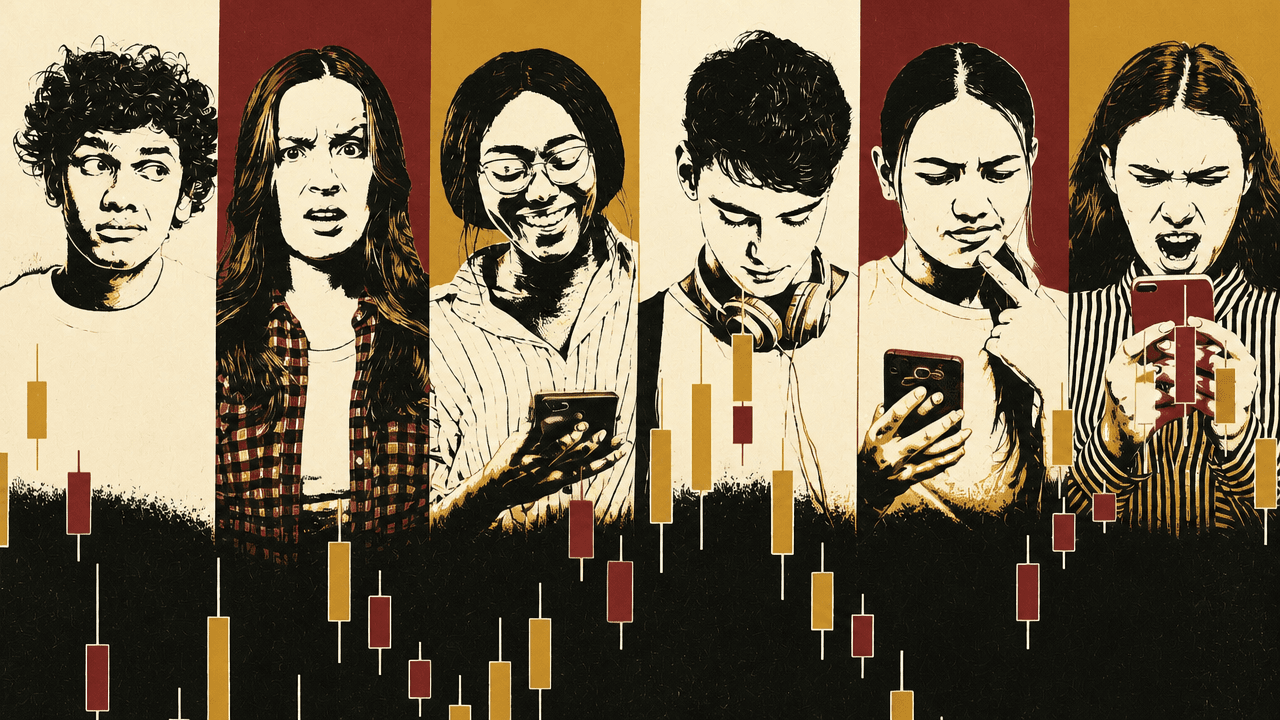
Bloomberg argues that young investors’ turn toward meme stocks, options, crypto and gambling-adjacent markets is less a simple taste for risk than a response to blocked financial milestones. Justina Lee, Allison Schrager, Charlie Wells and others frame Gen Z’s trading posture as shaped by unaffordable housing, weaker early-career prospects, social-media wealth cues and a long bull market that has made high-risk bets feel both accessible and necessary.
The risk is not just appetite; it is a response to blocked milestones
Young investors are not simply discovering leverage, options, crypto, meme stocks, sports betting, and prediction markets because the tools are available. The stronger claim in the source is that risk-taking has become a way to answer a darker financial premise: traditional routes to security look too slow, too expensive, or no longer available.
Justina Lee describes the relevant trading posture as the logic of “YOLO bets”: risky investments made with a “go big or go home” attitude. That posture is not presented as merely reckless. It is tied to a generation that came of age online during Covid, entered adulthood after repeated shocks, and now faces job-market and housing constraints that make conventional accumulation feel inadequate.
Allison Schrager frames the contradiction sharply. Gen Z may have more money in financial portfolios than prior generations at the same stage, she says, but they are also less likely to own a home. Surveys about retirement suggest they feel reasonably good about being on track, yet when Schrager asks about their overall financial situation, “they tend to feel pretty dark.”


The job-market pressure is part of that mood. A Federal Reserve Bank of New York chart shown in the source puts unemployment for all workers at 3% and unemployment for young workers, ages 22 to 27, around 7% through the first quarter of 2026. Schrager adds that for male college graduates in particular, the labor-market picture looks recession-like even while the overall economy appears to be in good shape.
Housing is the deeper constraint. Glenn Kelman says many Gen Z and millennial adults are ready to have children and get their own place, “and yet they can’t afford it.” Lee points to an academic paper from economists at Northwestern University and the University of Chicago that modeled what happens when people begin giving up on homeownership. The paper’s abstract, shown on screen, says the cohort born in the 1990s is projected to reach retirement with a homeownership rate roughly 9.6 percentage points lower than their parents’ generation. As perceived chances of owning a home fall, the model says households consume more relative to wealth, reduce work effort, and take on riskier investments.


That is the context for “financial nihilism,” a term Lee attributes to podcaster Demetri Kofinas. In her formulation, it is the belief that many long-term paths to financial security no longer work; under those circumstances, going for broke can appear rational as a way to meet financial goals.
| Generation | Share favoring speculative investments over traditional methods |
|---|---|
| Gen Z | 80% |
| Millennials | 75% |
| Gen X | 66% |
| Boomers | 51% |
The bull market taught young traders that playing can work
The source does not portray Gen Z risk-taking as emerging from a bear-market trauma. Lee says Gen Z investors have spent roughly the past two decades in a “pretty straightforward bull market.” A Bloomberg chart shown in the source tracks the S&P 500 from 2016 to 2026 and says money invested in the index 10 years earlier would have grown at an average of 15% a year, described in the narration as historically high.
Charlie Wells says the market did have a major correction, but recovered. That recovery “fostered this sense that they can win if they play the stock market.” The verb matters: for many young investors, markets are not only savings vehicles but interactive spaces where skill, timing, and nerve seem capable of changing life outcomes.
Preston Coots gives the first-person version of that logic. He says Gen Z is “constantly getting priced out of everything”: owning a home, having children, buying a wedding ring. Rent keeps rising, wages stagnate or fall, unemployment rises, and “the system doesn’t seem to be working for us.” In that setting, he says, there is a desire to “find your own way.”
Coots says his initial investment was $13,000 and that he made $109,000 from retail trading. He frames it not as pure gambling but as part of saving and creating a financial future. Yet he also describes the dissonance: people struggle every day to get by, while his own profits come from “pressing buttons on my phone.”
That dissonance runs through the examples shown on screen. Social media clips present trading as both ordinary and extraordinary: one creator says he will risk only $100 per trade; another says, “if you can scroll TikTok, you can trade”; trading-account screenshots show $232,000 and a cumulative profit-and-loss figure of +$16,362.61. The implication is not that every young trader is getting rich. It is that the visible culture of trading makes large gains feel socially proximate and technically accessible.
Wells argues that Gen Z is distinct because sophisticated trading techniques now circulate in places where earlier young investors would not have encountered them. A 20-year-old in 1990, 2000, or even 2010, he says, would not have been expected to know about or use these methods. The source illustrates that environment with r/wallstreetbets, trading YouTube channels, and smartphone apps sitting beside Instagram and TikTok.
Trading apps turned markets into entertainment, and options made the stakes larger
The source’s concern is not only that young investors take risk. It is that modern interfaces make risk feel continuous, social, and rewarding. Wells calls gamification one of the biggest themes in retail investing over the past decade. It activates the parts of the brain associated with winning, reinforces behavior, and makes buying a stock “fun.”
Charlie Wells compares the experience to social media. A user may be double-tapping on Instagram, opening TikTok, and then moving between those apps and an investment account. The source shows a phone screen with Instagram, TikTok, Robinhood, TradingView, and Trading 212 clustered together, visually placing trading inside the same behavioral loop as content consumption.
That loop now extends well beyond buying shares. Lee says retail activity has broadened into sports gambling and prediction markets. The narration emphasizes options as a central example: once the domain of hedge funds and professional trading desks, the US options market has seen volumes reach repeated records in recent years, driven in part by retail investors.
The source also states the standard academic warning about excessive trading: research has been consistently negative for individual traders. The reasons given are direct. Individuals trade too much, giving away gains through transaction costs, or they chase trends and buy assets near their peaks.
The boundary between investing and gambling is presented as increasingly blurred. The narration acknowledges that some would say there was never a clean separation, but offers a practical distinction: gambling more clearly has a winner and loser, while long-term equity investment can have positive externalities. Buying and holding stock can help a company invest in technology, hire workers, and grow the economy. Betting on a football game has no equally clear economic benefit.
The source shows that these categories now sit side by side on phones: Robinhood, Kalshi, DraftKings, TradingView, and Polymarket appear together, with markets on sports outcomes and future events. Younger investors are also more likely to hold alternative assets. A World Economic Forum chart shown in the source says crypto-dominated portfolios are more common among Gen Z and millennials than older generations.
| Generation | Share with crypto-dominated portfolios |
|---|---|
| Boomers | 14% |
| Gen X | 18% |
| Millennials | 26% |
| Gen Z | 35% |
The pattern is generational, but not universal
The source resists treating Gen Z as uniformly reckless. Schrager says each person has different risks they are comfortable with, while generations are shaped by the risk events they experience. She describes Gen Z as having an “odd dichotomy”: in some domains they are risk-averse — “they don’t drive, they don’t date, they don’t drink” — while in financial markets they can appear extremely risk-taking.
Allison Schrager ties that split to formative shocks: some members of Gen Z were children during the financial crisis, saw parents lose portfolios or homes, and then graduated or entered the labor force during the pandemic. The source’s argument is that these experiences do not produce a simple aversion to risk. They can produce selective risk-taking when the old bargain appears broken.
Geography complicates the picture further. The narration says investors in the US are “obviously risk hungry” and points to South Korea, where leveraged ETF trading is described as famous enough to attract concern. Europe is described as more muted, with households historically keeping more money in bank deposits or safer fixed-income investments; there, governments are trying to encourage more stock-market participation. In China, one study cited in the narration found Gen Z more risk-averse than other Chinese generations and more likely to invest in gold.
Preston Coots also complicates the caricature of young traders as unserious. His explanation is about savings, affordability, and a future that feels hard to secure through wages alone. The source nevertheless keeps the losses visible. Trading clips show a profit-and-loss swing from positive territory to losses in the thousands, a streamer reacting to an order fill with frustration, and another saying, “Bro, I lost a hundred fifty-two k.”
The final caution is against patronizing Gen Z. The source says this generation grew up with smartphones and with the ability to look up whatever they wanted and “do their own research.” They are young, starting out, investing amid visible wealth inequality, and surrounded by a culture in which risk has become more acceptable. Social media intensifies the pressure by making signs of wealth constant and immediate.
The resulting moment is a combination: an affordability crisis, a sense that conventional paths do not deliver quickly enough, highly accessible trading technology, and cultural permission to take bigger swings. The source’s central tension is that money is being made — but not consistently, not without leverage and losses, and not in a way that can be understood apart from the financial conditions that made the risk feel necessary.