The Athlete-Artist Divide Narrows Youth Development Too Early
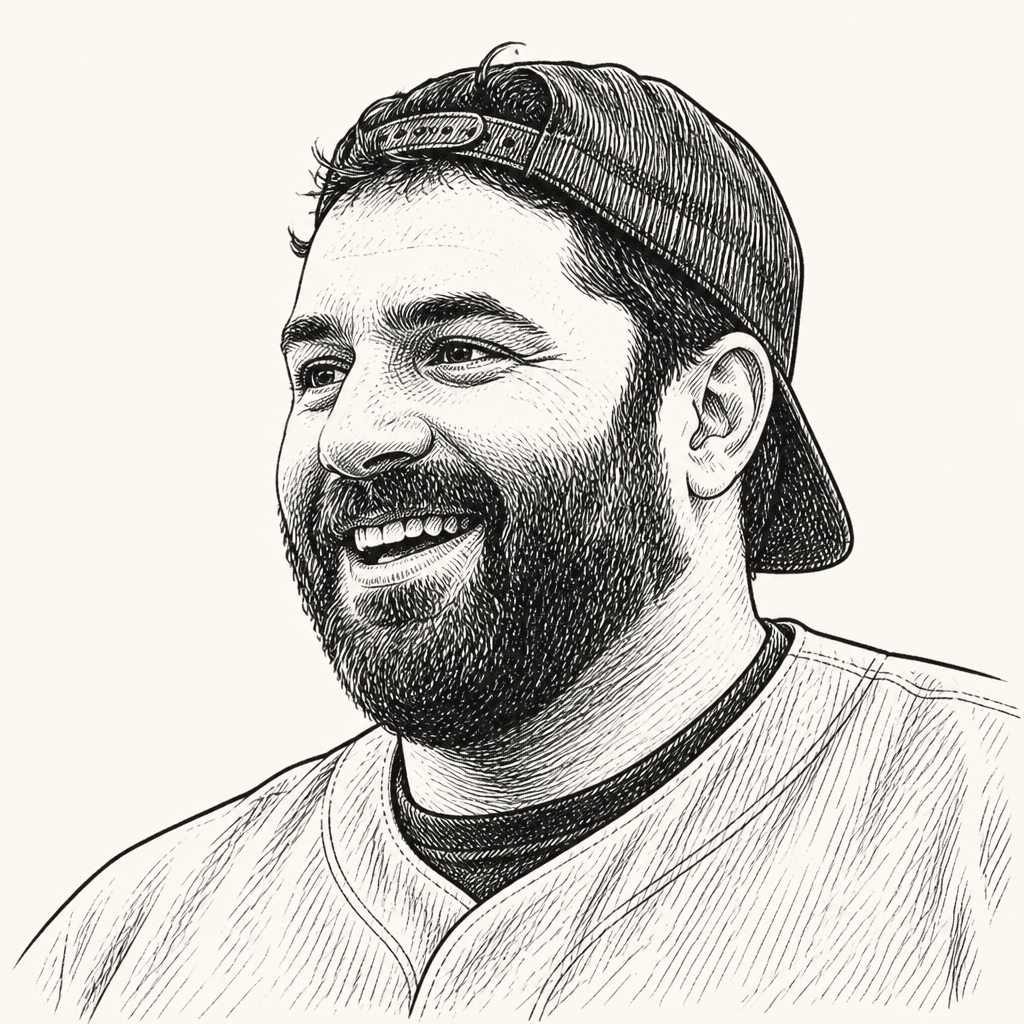
LJ Rader, founder of Art But Make It Sports, argues that children are pushed too early to choose between identities such as athlete and artist, and lose developmental range in the process. In a conversation moderated by LACMA curator Britt Salvesen, Rader uses his art-and-sports image pairings to make the case that both fields train attention, emotion, improvisation and tolerance for beginnerhood. Their shared point is practical rather than romantic: young people benefit when they are allowed to keep playing across more than one kind of practice.
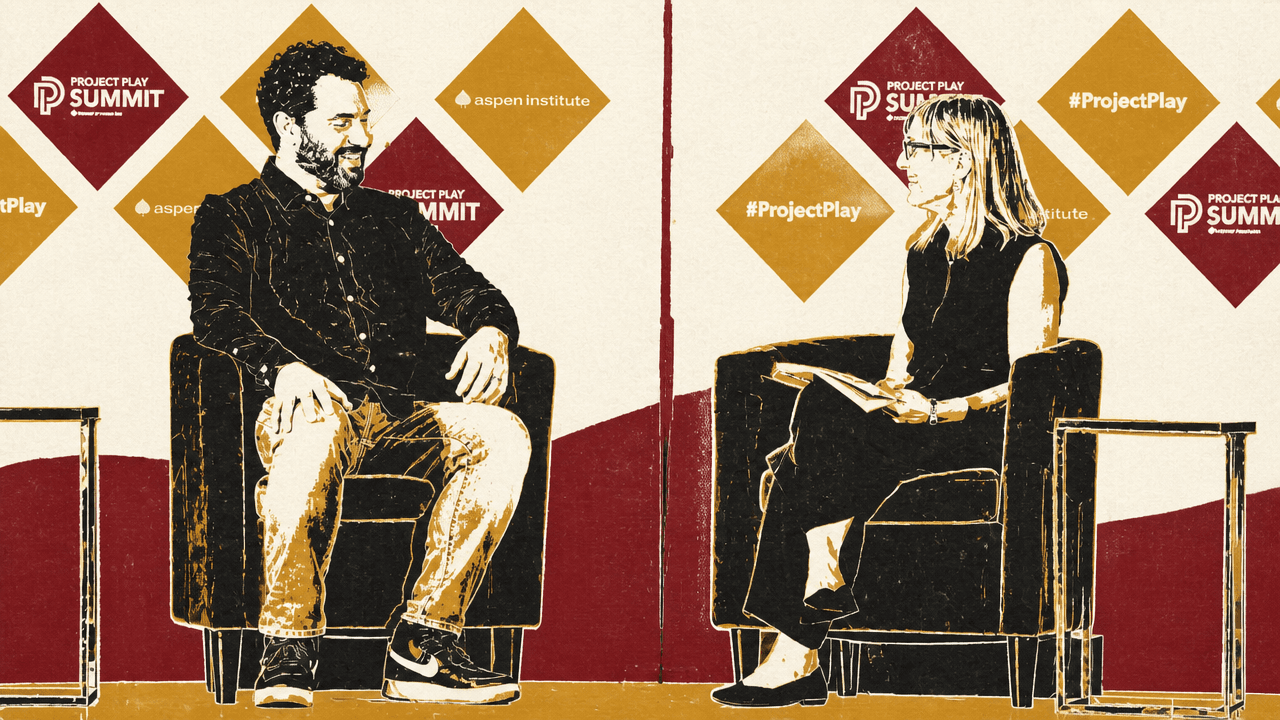
The choice between athlete and artist starts too early
LJ Rader described a pattern that begins early: young people are often encouraged, explicitly or implicitly, to sort themselves into one identity or another — athlete or arts kid. He said that sorting was familiar from his own childhood and reinforced by media, television, and movies. In his view, the result is a narrowing that can happen before children have had much chance to discover what they might become across different kinds of practice.
You sort of get pigeonholed into either you're an athlete or, you know, you're an arts kid and you don't really get a chance to cross.
Rader’s own route through that divide was partly accidental. His grandparents, he said, exposed him to art because they had once owned a parking garage in the Village whose artist tenants often lacked money and paid in artwork instead. Their home became a place where he encountered art naturally, not as a specialized track separate from sports. That mattered because, as he put it, children can be conditioned to “pick a side,” and the healthier alternative is to let them stay various for longer.
Britt Salvesen connected the same pressure to drawing. Children draw freely for pleasure until a point when self-consciousness enters: “I’m not good at it,” and then they stop. Rader answered by pointing to artists’ own development. The early pieces in an artist’s body of work often look nothing like the works for which the artist is later remembered. Medium, style, and confidence can shift. For Rader, that arc resembles athletic development: a growth process in which not getting it right the first time is normal, not disqualifying.
The same pressure shows up inside sports. Rader said that even apart from choosing between sports and art, children can feel pushed to choose a single sport early. He remembered feeling pressure to excel at one sport and then being steered toward specialization. Looking back, he joked that he was fortunate not to have been very good at any of them, because mediocrity across the board let him remain exposed to many sports. The point underneath the joke was that different sports teach different skills. Golf and tennis, as individual sports, require one set of capacities; team sports require another. Early narrowing can cost a child that range.
Salvesen framed beginnerhood itself as a useful skill. Rader is now building a new sports data company with a friend, and she noted that the experience puts him in the position of being a beginner again. Rader tied that to lessons from youth sports: teamwork, doing one’s role, and learning enough about a teammate’s responsibilities to collaborate. In the company, his partner is running the technology side while Rader is focused on strategy and product, but each must understand something of what the other does.
Rader and Salvesen did not argue that sports should become art class or that art should justify itself through athletic utility. They described a more practical developmental value: keeping children in contact with more than one kind of practice, including the experience of trying, failing, improvising, and building competence over time.
Art and sport meet first as movement, color, and emotion
Rader’s project, Art But Make It Sports, rests on a simple visual act: pairing sports images with works of art that echo them. Salvesen introduced him as the account’s founder and “one-man creator,” emphasizing that the work is “zero AI” and “all human made.” Rader said that if someone had never seen the account, looking it up would help contextualize the discussion. But his explanation of the account made clear that the pairings are not merely jokes or lookalikes. They depend on shared visual and emotional structures.
The parallels he named were direct: movement, color, and emotion. Sports images, especially the ones that circulate widely, tend to carry heightened feeling. They are the images that read instantly: a scream, a fall, a leap, teammates pressed together in celebration. Rader said those are also the qualities that often make art memorable or elevated. The most useful sports photograph for his purposes is not just any photograph from competition; it is one with enough expressive charge to meet an artwork on similar ground.
I think the best art or art that we elevate tends to have those same sort of emotions.
Salvesen added that innovation and technology belong in the comparison too, and that both art and sport span an unusual range of social life. Each has grassroots participation and professional industries. Each lives in institutions — the art world, the sports world — but also in daily life. A child drawing, a recreational game, a museum exhibition, a professional match, a broadcast image: all belong somewhere along the continuum.
Rader extended the comparison to process. Both artists and athletes must practice a craft, fail early attempts, and improvise. He stressed that some of the best artwork is not the execution of a fully known plan but the result of improvisation. The account’s pairings, in that sense, are not only about resemblance; they are exercises in seeing.
The on-screen examples made that claim concrete. One pairing placed a sports image of two female athletes in pink uniforms posing closely for a selfie beside a classical sculpture of three nude female figures standing together, identified visually as the Three Graces. Rader described the match not only as an individual comparison but as a way of noticing a recurring art-historical theme: figures bound by friendship, celebration, love, and bodily closeness. In sports, he said, the same theme appears in teammates celebrating. Salvesen noted that the pairing works in both directions. It brings an historic artwork into the present, but it also places a captured moment from the field within a much longer history of image making.
Another image shown paired a hockey player in a Bruins jersey, screaming with a bloody nose, with an artwork of a white hooded face opened in a scream. Rader said that screaming faces appear often in sports images, and that people frequently tag Edvard Munch’s “The Scream” in response. But for this example, he said, “The Scream” was not quite the right match. The image called instead to mind the artist Julio González, whose work Rader said he had first seen at the Whitney, especially in sculpture, though González also made drawings. The point of the pairing, Rader said, was less a deep layered interpretation than recognition of an artist’s style and an emotional correspondence.
Salvesen drew out the significance of that example: emotion and expression are difficult artistic problems, and sports sometimes generate them organically. The athlete is not posing for allegory. The photographer catches a moment. Rader’s work depends on noticing when that moment rhymes with a visual language developed elsewhere.
The account is human memory, not image generation
Because Art But Make It Sports looks like an uncanny matching engine, Rader said people often assume he must be using AI. He called that assumption “crazy” in one particular sense: the reason he still does the project is that the work keeps him sharp. Finding a pairing gives him what he described as a dopamine hit. The exercise would lose much of its point if outsourced.
His process, as he described it, is less straightforward than the account’s name suggests. “Art But Make It Sports” sounds as if he begins with a sports photograph and then searches for art to match it. But Rader said that for him it begins with art. He has banked many images he has taken, memorized them, and accumulated knowledge of art-historical themes and artists’ styles. When a sports image appears, he can retrieve a possible visual correspondence from that internal archive.
One shown pairing placed a soccer player in midair performing a bicycle kick beside a Renaissance-style painting of a figure descending upside down from the sky. Rader said the pairing was “not great” by his own editorial bar, but useful as an example of the account’s teaching function. It worked through composition and immediate visual evocation. A work that might have reached him in childhood through a “stale, dusty textbook” could be reintroduced through a contemporary sports image that resonates more directly with a young viewer.
Rader said educators and teachers have told him they use the account to introduce students to art and art history. His recently published book has produced a similar response: friends and others have sent him photographs of children reading it and engaging with it. He described that as a strong entry point for children who might not respond to a textbook-first approach.
Salvesen pointed out that the direction can reverse. The account can bring sports-minded students toward art history, but it can also increase visual literacy for reading sports media itself: photojournalism, photography, and broadcast imagery. Sports media has been Rader’s career, and Salvesen described it as a complex visual realm that benefits from different modes of analysis.
Rader said he is often asked whether he has photographed museum images that he has not yet used. He has an entire folder of them, waiting for the right sports moment. The criterion, again, is not merely shape. The images he is waiting to use have an emotion he expects will someday appear in a sports context. He mentioned being a Knicks fan and being excited about the previous night’s game, but because it was such a blowout, he said, there was nothing to pull from. The archive is ready; the sports world has to produce the moment.
A child’s first material may be cottage cheese
When Salvesen asked how Rader hopes to guide his young son along these dual paths, he answered with a domestic example rather than a program. His son had recently taken cottage cheese, put it on his tray, and moved it around with his hand. Rader’s response was, “Alright, he’s an artist already.”
The anecdote became a way to talk about adult reactions to art. Rader noted that people sometimes go to museums and say, “Oh, I think I could do that,” or “a kid could do that.” Some kinds of art, he said, invite that response. But with his son, the practical answer is not to police the boundary between art and mess. It is to encourage him from the beginning not to assume he must choose among interests too quickly.
Music has emerged in their home in the same open-ended way. Rader said neither he nor his wife is especially into music, but they have a record player and his parents’ old vinyl collection in a console at ground level. Since his son began crawling, he has crawled over, pulled out vinyl, and made them play a new record. If music becomes the path he wants to follow, Rader said, the task is to encourage him.
Salvesen joked that a drum kit might be in Rader’s future. Rader replied that their 90- or 95-year-old neighbor might not appreciate it — though, he added, maybe at that point she could not really hear it. The exchange was light, but it illustrated the broader theme: youth development here is not presented as a managed pipeline into excellence. It is a household stance toward exploration. Children make marks, sounds, and motions before they know what category any of it belongs to.
That stance also resists the idea that formal training is the only legitimate entry point. Rader said he does not have an art background, and he sees that as part of what is exciting. A child does not need to be formally taught everything in advance. People can learn on their own and take unusual routes into both sports and art. His own project is an example of that: it draws on museum looking, sports media, memory, fandom, and pattern recognition, rather than a conventional art-historical credential.
Play remains valuable when it is not the job
Rader’s professional life sits mostly in sports, not art. Salvesen introduced his background at NBC Sports, where he won an Emmy, and his later roles on the product team at DraftKings and as head of the broadcast product group at Sportradar. She also noted that he and a friend had recently started a statistical data company focused initially on women’s volleyball, with hopes of expanding to other sports that receive less attention from large data companies.
Against that professional backdrop, Rader’s account occupies a different category. Asked about the horizon for Art But Make It Sports now that the book and museum talks have expanded its audience, he said the most exciting thing is that he has not made it his full-time work. It remains a hobby. People reach out, and he enjoys certain engagements, but his preferred path is “whatever happens happens.” Meanwhile, he is spending much of his time building the sports data company from scratch.
Salvesen closed by saying it is good to have something that is play “on the side,” because that belongs to the idea of Project Play itself. Rader’s case gives that point a concrete form. His art-sports pairings have led to a large audience, a book, museum appearances, classroom use, and public questions about AI and authorship. He still describes the practice as fun, sharpening, and personally rewarding.
The account may be public and useful to teachers, and it may lead to invitations and conversations, but Rader still described it as something other than his main job: a hobby, a way to stay sharp, and a project whose future he is comfortable leaving open.