Meeting Rising Power Demand Requires More Than Building Generation
 Malachi Blankenship
 Sid McAnnally
 Lorence Kim
 Kirk Siegler
 Mark YatesThe Aspen InstituteFriday, October 23, 202612 min read
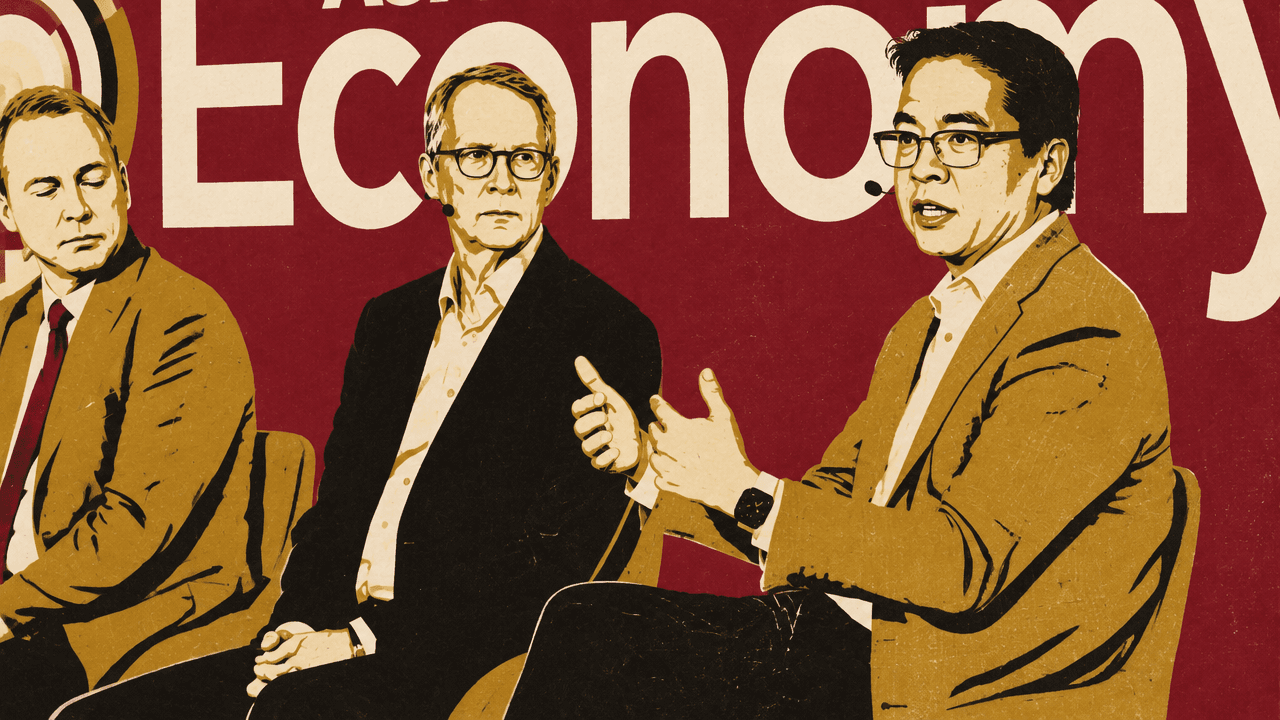
At Aspen Ideas: Economy in Tulsa, ONE Gas CEO Sid McAnnally argued that meeting rising electricity demand requires treating energy sources as complements, not rivals—and distinguishing generation from the infrastructure needed to deliver power affordably and reliably. Commonwealth Fusion Systems CFO Lorence Kim and Cornerstone Government Affairs principal Mark Yates added that the choices involve more than technology: grid connections, local economic benefits and policy stability will shape which projects get built and who benefits.
More generation does not solve the problem of getting power to customers
The energy challenge is not only how to generate more electricity. New power has to move from where it is produced to where it is needed, connect to a grid that can accommodate it, and reach customers at a price they can afford. Those steps involve different parts of the energy system, and treating them as one problem can obscure where delays and costs arise.
Sid McAnnally described three linked parts: generation, transportation and delivery. Generation can come from natural gas, coal, nuclear, renewables or, potentially, fusion. The energy then travels through a system to where it is needed, before a delivery network brings it to the end user. McAnnally called the distinctions “boring,” but argued that people need this context to understand what a proposed project can—and cannot—do.
Demand was rising before data centers became a major focus, McAnnally said. Onshoring, advanced manufacturing, Bitcoin mining and electric vehicles were already adding to it. Data centers brought a new scale of demand, while coal plants were coming off the grid and their generation had to be replaced. That replacement requirement exists even before new loads are added.
McAnnally said natural-gas-fired electricity and natural gas supplied behind the meter had often been available ways to meet new demand. He expected them to remain important in the foreseeable future because building new generation takes time.
Management is about right now and leadership is about the future.
He used that distinction to frame the need to balance current reliability and affordability with decisions about the energy system’s future.
Even when a project can generate power, it may not be able to connect quickly. Commonwealth Fusion Systems CFO Lorence Kim said the company had submitted an interconnection application to PJM earlier in the year. PJM is a regional transmission organization managing the grids of 13 states. McAnnally said that a project five years away from going live could still be in the queue, and that the queue included proposals that may never be built. Developers can hold a place for speculative projects, he said, so the list does not show how much of its projected demand is certain.
McAnnally also described a change in how electric companies handle proposed connections: before undertaking engineering work to assess what a project would require, companies had begun asking applicants to pay as much as $1 million. In his account, the charge is for beginning that engineering assessment. The example illustrates the work—and cost—that can arise between an investment plan and electricity delivered to a customer.
Fusion brings the distinction between a possible source of power and an operating power plant into sharp focus. Kim explained that fission releases energy by splitting atoms, while fusion releases energy by putting atoms together. Fusion powers the sun and other stars; the engineering challenge is to produce and contain the process on Earth. Commonwealth Fusion is building SPARC, a tokamak facility in Devens, Massachusetts. Kim said it was expected to turn on the following year, with the aim of demonstrating net fusion energy in a commercially relevant form.
Kim also described a separate project: a 400-megawatt plant planned for Richmond, Virginia, in partnership with Dominion Energy. He compared its output to the needs of a medium-sized city. When moderator Kirk Siegler suggested roughly 300,000 to 400,000 homes, Kim agreed.


Fusion’s prospects also depend on a policy environment that can support development over the long term. Kim said bipartisan support for the technology had been real and remained real. Commonwealth Fusion’s technology began at MIT, he said, and the company had spent eight years building around it, raising about $4 billion to pursue the project. For Kim, the company’s progress reflected American innovation: the capacity of markets and talent to advance a new technology. He described fusion as an emerging industry whose potential lay further ahead, rather than as a source already supplying the grid.
The need to connect new sources is not unique to fusion. Speaking for ONE Gas and as chairman of the board of the American Gas Association, McAnnally rejected the idea that renewables are the gas industry’s enemy. He said the grid was not built with large amounts of renewables, batteries at scale or fusion in mind, and that it would have to change to accommodate them. The costs of those upgrades can reach consumers through their bills. That makes affordability part of the infrastructure question: a source’s potential output does not, by itself, determine the cost of integrating and delivering it.
Oklahoma offers an example of a changing mix. Mark Yates said the state’s power generation averaged about 45% natural gas and 45% wind, with smaller amounts of coal and hydroelectric power. In the Southwest Power Pool, the regional transmission organization covering 14 states from the Red River to Canada, Yates said less wind was planned and utility-scale solar and storage were attracting development interest. He reported more than 17,000 megawatts of utility-scale solar in the queue, while noting that not all queued projects would be built.


The resources have different operating characteristics. Wind does not blow all the time; solar is unavailable at night and can contribute less on a rainy day. Yates said solar could help meet peak demand on hot August days, while natural gas could provide a source that comes on when wind is not blowing. He also said that adding resources requires system upgrades.
McAnnally described the energy mix as changing throughout the day, with different sources contributing to the electricity used by a home or business. He praised Oklahoma for adding renewables without abandoning the existing system that has supported reliability for consumers and industry. The state’s changing mix, in his account, reflects combining resources rather than treating them as winners and losers.
A project’s local value depends on where its jobs and revenue land
Energy projects can create economic value in several places: at the facility, in its supply chain, through taxes and lease payments, or in the manufacturing of equipment. Those benefits are not interchangeable. The number of permanent jobs at a project site does not capture all of them, but tax revenue and lease payments do not answer every question about employment either.
The distinction matters in communities built around extractive industries. As coal becomes less central, residents may hear that new energy projects bring construction jobs but employ only a handful of people once they are operating. Kim said fusion would involve a different kind of work from a project based primarily on extracting fuel. In his description, fusion is a technology built around a capital asset: the machine that contains the process. Commonwealth Fusion employs 1,300 people, including engineers, technicians and welders, and Kim said the company had about 1,300 suppliers. He expected a scaled fusion sector to create manufacturing work beyond the company itself.
Kim described fusion as 200 million times more energy-dense than burning fossil fuels. He presented the comparison as a difference in the process, not a judgment about which source should be used. His argument about jobs was that building fusion machines and their supply chains could make the sector manufacturing-driven. He said retraining would be needed, but saw the long timelines of energy development as an opportunity to prepare people as the industry grew.
Yates agreed that a utility-scale wind or solar project would not create the job numbers associated with some older industries. He emphasized other local effects: landowner lease payments and property taxes. A large project in a rural Oklahoma county can be one of its largest taxpayers, he said, with revenue flowing to schools and county infrastructure.
A smaller permanent workforce may also avoid putting sudden pressure on local services. Yates offered the example of a project bringing 200 people to a town of 1,500. In some places, he said, accommodating that workforce could strain affordable housing and schools. He argued that projects with fewer permanent jobs can still suit rural communities by bringing capital investment, tax revenue and lease payments without creating the same immediate demands on infrastructure.
Kim raised a different question: where the manufacturing value lands. He said solar had become much cheaper as photovoltaic technology advanced, but that much of its economic benefit had gone upstream, including to China, or to project developers. He asked where the manufacturing layer had gone and whether more of it could be located in the United States as new industries develop. Installing a technology in a community, in this account, does not guarantee that the associated supply-chain work or economic value will stay there.
McAnnally said domestic manufacturing was beginning to accompany energy investment, citing fabrication associated with fusion projects and new turbine companies being built in the United States. He characterized this as an early-stage movement toward high-skill, well-compensated work. The scale and location of that work depend on what is built, where suppliers are located and how much manufacturing happens domestically.
Workforce development is part of the same question. McAnnally said it was difficult to make the case for innovation while arguing against public or private research and development or the role of higher education. He described reducing research investment as potentially short-sighted when the goal is to build future technologies.
Kim, who said he had come to energy from biotech, recalled meeting people who had studied nuclear physics but found few fusion jobs outside national laboratories. He saw an opportunity for a growing industry to give people drawn to fusion a path into the field. The prospect of harnessing the sun’s power, he said, could attract students in a way that had not previously been matched by a broad set of career options.
The speakers emphasized different local benefits: Yates focused on public revenue and the fit with rural infrastructure, while Kim focused on where manufacturing and supply-chain value accrue. Neither measure stands in for the others.
Long-lived investments require planning without false certainty
Energy companies may be responding to demand growing now, while building infrastructure expected to last for decades. At the same time, the technologies driving demand—and the amount of energy they require—can change. The challenge is to plan for long-lived assets without treating forecasts as certainties.
An audience member asked how to reconcile projections for 2030 and 2035 with investments that may last 50 years or more. If semiconductors become more efficient, the questioner asked, could data centers need less power than expected, leaving communities with capacity built for demand that had faded?
Kim said efficiency gains can be understood in two ways: as a reason for total demand to fall, or as a way to do more with the technology. He argued that the second outcome has generally prevailed. When semiconductors become cheaper and more power-efficient, people find more uses for them, he said, so aggregate demand can still rise.
McAnnally described the uncertainty from the perspective of someone building data centers. A facility can take two or three years to construct, he said, and the builder may not know what chip technology will look like by the time it is finished. He connected the question to the Jevons paradox: efficiency improvements can lead to increased overall use. But he stressed that uncertainty remains and that decision-makers should not speak as though there is clarity where there is none. Flexibility, he said, will have to be built into the system.
That uncertainty sits alongside the different time horizons of energy planning. Yates said companies are trying to deploy capital and look three, five or ten years ahead, while some assets are planned to operate for 20, 30 or 40 years. He described changing federal, state and local rules as a source of uncertainty for that investment. In his view, both parties have treated energy as a “political football.” Companies considering generation, transmission lines or pipelines need stability and certainty as they decide where to put capital.
Siegler described one example of policy affecting investment timing. Earlier in the year, he had visited a rooftop-solar project near Denver Airport, where a food bank was expanding in anticipation of greater demand for its services while also trying to control energy costs. He said the prospect that Inflation Reduction Act tax credits were about to go away had contributed to a rush of rooftop solar in Colorado. For the food bank, the investment was tied to managing operating costs as it prepared to expand.
The uncertainty also raises the question of what government should do. An audience member asked about people moving between public service and private industry, and about the government’s role in permitting projects. Yates said calls to “get government out of the way” can sound to communities like a promise to run roughshod over the public. He argued for both speed and a healthy dialogue about projects, including community engagement. Those conversations take time, he said, even as the need to build is pressing.
McAnnally said government has a role in innovation and in regulation. He pointed to bipartisan support for a permitting bill led by Senator Armstrong, whom he described as a subject-matter expert on the issue. The question, in McAnnally’s framing, is whether the permitting system serves the energy system—including renewables and new technologies—and protects consumers, customers and citizens.
He also said regulation was not working well and that policy issues had increasingly become litigation issues. After spending 20 years as a lawyer, he said, he was not criticizing lawyers; rather, he argued that courts were not designed to resolve policy questions. He called for discussion about whether regulation does what it is meant to do and whether it facilitates the development the country wants to see while protecting the public.
Yates argued that speed matters, but also that industry needs to convey factual information about projects, their opportunities and their effects. He said misinformation and disinformation, together with the pace of development, made it difficult for the industry to stay ahead of the public-education curve. Change to a landscape or community can be unsettling, he said, especially when people lack good information. Engagement is part of how projects can move forward responsibly.
McAnnally’s view of research funding connected government’s role to the long horizon of innovation. He said it was hard to argue for innovation while opposing investment in research and development, including the role of higher education. Kim offered a complementary account of the people such investment can draw into an industry: fusion had inspired people to study nuclear physics, but the field had not offered many jobs beyond national laboratories. A future market could turn that interest into a wider set of opportunities.
The speakers described constraints that make planning difficult: generation takes time to develop, grid connections can take years, local effects vary, and technology can change before long-lived assets are finished. Their case for a less oppositional conversation was not that every proposal should proceed. It was that affordability, reliability, innovation, infrastructure and community concerns must be considered together.