Universal Child Accounts Need Progressive Deposits to Narrow Wealth Gaps
 Joanna Smith-Ramani
 Kwame Owusu-KesseRay BosharaThe Aspen InstituteSunday, October 18, 20268 min read
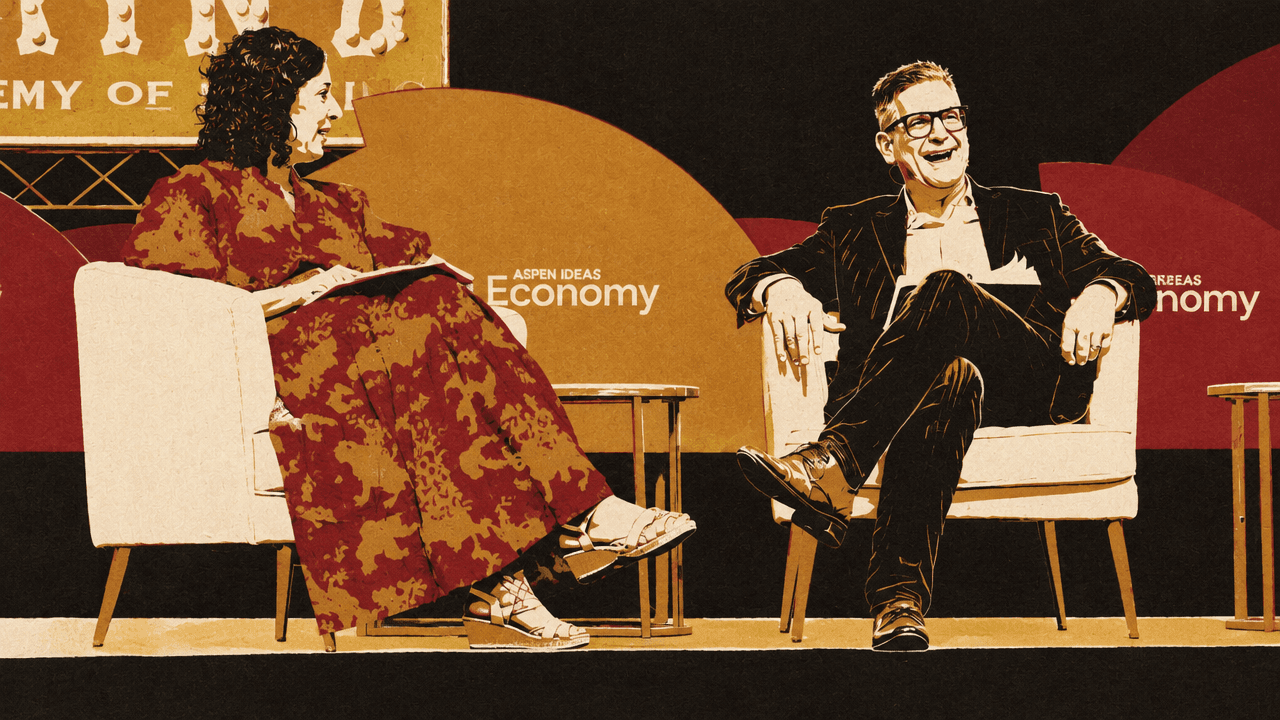
At Aspen Ideas: Economy, Ray Boshara of the Aspen Institute Financial Security Program and Kwame Owusu-Kesse, CEO of Harlem Children’s Zone, argue that Trump Accounts can make investment in children part of the social contract—but that a universal account alone will not deliver economic mobility. They call for sustained, better-targeted deposits and protections for young adults, alongside education and other assets that help children build on the initial seed.
A child’s wealth account changes who is invited into the economy
Trump Accounts make wealth part of the social contract for children, Ray Boshara said. He described them as “a front-loaded traditional IRA.” The accounts are seeded with $1,000, he said, and that seed is in place for four years. Boshara said 70 million children now have a universal lifelong investment account. Joanna Smith-Ramani characterized the arrangement as historic, saying that children now have universal access to capital markets in a way adults do not.
Wealth is now part of the social contract for kids.
For Kwame Owusu-Kesse, the significance is not only financial. A universal investment says that a child is worth investing in before anyone knows their ZIP code, their parents’ circumstances, or what they will become. That message, he argued, expands the question of who gets to participate in the American economy. The account signals that a child’s potential merits investment before their background or future is known.
Boshara traced the idea through a long history rather than to a single policy moment. He pointed to Thomas Paine in 1797, then to Michael Sherraden’s 1991 book Assets and the Poor, which put wealth alongside income in thinking about how low-income people move forward. He said Melvin Oliver, Tom Shapiro, Derek Hamilton, and Sandy Darity extended that work to race and the modern understanding of the racial wealth gap.
On Capitol Hill, Boshara said, proposals for accounts at birth began largely as retirement-focused ideas in the late 1990s. In the mid-2000s, proposals came from Democrats including Chuck Schumer, Hillary Clinton, Cory Booker, and Bob Casey, as well as Republicans including Rick Santorum, Jeff Sessions, and Ted Cruz. He called the idea unusually bipartisan.
Smith-Ramani added that policy proposals were preceded by pilots around the country testing savings and investment accounts for children. Those pilots, she said, were also a way of telling children that people cared about them and believed in them. The federal account turns decades of work into national infrastructure. Boshara described Trump Accounts as one of three early-wealth strategies now in place: child savings accounts, about 10 million of them built on 529 platforms; baby bonds, which are more explicitly focused on the racial wealth gap; and Trump Accounts. Smith-Ramani called the possibility of combining them a “capital stack” for a child.
The infrastructure matters, but its design is still open
Owusu-Kesse welcomed the federal government’s universal investment and the infrastructure built to make it possible. He urged supporters not to let criticism of the policy drown out the opportunity to improve it and make its impact endure. He wants the initial $1,000 seed to continue beyond its current four-year duration. Boshara clarified that the $1,000 seed is currently provided for four years; separately, he said the pilot should be extended beyond 2028. These are distinct proposals: one would continue the seed contribution beyond its present four-year period, while the other would continue the pilot beyond 2028.
Owusu-Kesse also wants targeting to use census tracts rather than ZIP codes. He described these changes as opportunities to improve the policy, not reasons to dismiss the platform now in place. Its creation, he said, gives people from different sectors a chance to work together on investment in the country’s future.
Boshara named two features he sees as especially promising. First, he said, the accounts open stock-market investment to children. Recalling figures he cited at the time of the remarks, he said the stock market had returned 14% so far that year, 17% in 2023, and 10% over 30 years. He contrasted those figures with what he said his team documented at the St. Louis Fed: declining and often riskier returns to home ownership and post-secondary education. He also said the stock market is now the largest driver of the racial wealth gap. Properly designed, he argued, Trump Accounts could help narrow that gap.
Second, Boshara said, a feature baked into the law is the possibility of multiple investors contributing to a child’s future. He named families, employers, foundations, nonprofits, and governments at every level as potential investors. He described the Dow contribution of $6.25 billion as part of that broader investment and said Micron was “teed up” to make an investment. The point is not only that multiple contributors can add money to an individual account; in his view, their participation can turn an individual asset account into a shared community asset.
Smith-Ramani emphasized that the work necessarily involves both public and private participants. She named BNY and Robinhood as companies involved and treated their participation as an invitation to other sectors to consider their role. The account infrastructure, she argued, creates a platform on which different organizations can contribute to young people’s futures. The panelists presented that cross-sector involvement as part of the policy’s potential, not as a substitute for public investment.
Boshara also identified two changes needed to realize the accounts’ potential: extend the pilot beyond 2028 and make larger deposits for children from low-income families. He raised a further concern: children should not lose safety-net protections at 18 because they saved into or withdrew from a Trump Account.
Those design questions matter because a universal seed alone does not address differences in family wealth. Smith-Ramani noted that both Boshara’s call for progressive deposits and Owusu-Kesse’s interest in more precise geographic targeting aim to ensure that children with the least private wealth gain from the policy. For the panelists, the account is a foundation to build on—not a complete answer.
A balance is not the same as economic mobility
Owusu-Kesse argued that success cannot be measured by whether an account is opened or its initial seed is claimed. That would leave much of the potential impact unrealized. The Harlem Children’s Zone has launched Wealth Builds, an economic mobility initiative that combines financial education and assets with the organization’s cradle-to-career infrastructure.
Financial education matters, he said, but it cannot do its work without assets to apply that knowledge to. Young people served by the Harlem Children’s Zone can still be “one emergency away from financial ruin.” The goal is therefore not an account in isolation but a portfolio of assets: 529 college savings accounts, Trump Accounts, baby bonds, stipends, and scholarships. “I want our young people to have everything,” he said, describing the aim as a broad portfolio rather than a preference for one asset type.
Owusu-Kesse said the first phase of Wealth Builds raised $125 million. The aim for the second phase is to raise billions of dollars for millions of young people across the country. Smith-Ramani described the national account infrastructure as necessary but insufficient: without the shared platform, local efforts such as Wealth Builds would not have the same universal opportunity to build on. Having the plumbing in place makes a wider range of community investments possible, but it does not by itself ensure that young people accumulate assets or know how to use them.
The distinction between a financial instrument and its wider effects also shaped Boshara’s account of evidence from SEED OK in Oklahoma. Boshara said experimental evidence from the program showed five outcomes when children had assets in their names: greater future orientation, more hope for the future, a stronger college-bound identity, better mental-health outcomes for mothers, and narrower college-enrollment gaps. His argument was that the effects of assets extend beyond the account balance.
Boshara’s point was that children’s accounts can affect expectations and identity as well as finances. He hopes that, if the accounts succeed, “inequality of outcomes in one generation does not become inequality of opportunity in the next.” Too many children, he said, grow up in households with no wealth to pass on, perpetuating disadvantage. Accounts create an opportunity to interrupt that cycle and renew economic opportunity with each generation.
Future deposits could come from more than the initial seed
Looking toward a generation in which children have accounts, Boshara suggested considering new sources of deposits, including wealth generated by artificial intelligence and wealth from the great transfer. He raised them as possible sources for future contributions, not as funds already committed to the accounts. That prospect fits with his broader emphasis on making the account a shared investment: the initial federal seed could be joined by contributions from families, employers, foundations, nonprofits, governments, and other private-sector participants.
The question of where future contributions might come from sits alongside the panelists’ concerns about how they are distributed. Boshara called for progressive deposits, with more going to low-income children, and for the pilot to continue beyond 2028. Owusu-Kesse called for the $1,000 seed to continue beyond its current four-year period and for targeting to be more precise. Together, these proposals address different parts of the design: the duration of the initial seed, the duration of the pilot, and the distribution of additional deposits.
Preparing children means investing earlier—and treating them as partners
Asked what should come next, Boshara offered a simple principle: earlier is better. He argued that investment in children should extend beyond wealth to reading, early education, child care, and health care. He pointed to Rx Kids in Michigan, which he described as an upfront cash payment to parents with a young child, followed by monthly payments for a few years. That support, he said, helps families through the early years and gives children a better chance of success.
Smith-Ramani connected that kind of direct support to long-term assets: families’ immediate financial stress can be addressed while a child’s Trump Account is invested for the future. Boshara called the combination a natural basis for bipartisan agreement. His point was that early investment should not stop at a savings account; it can also include practical support for families during a child’s early years.
Owusu-Kesse framed the next investment around uncertainty. As a father, he said, he wants his own children prepared for a future he cannot predict; he sees no reason to expect less for other young people. That means equipping them with discernment, social connections and networks, and skills that help them adapt.
It also means changing who helps design the solutions. Young people, Owusu-Kesse argued, should be treated as partners, not as people to be spoken down to or merely brought along. Because they are closest to the problems, he said, they are also closest to the solutions. Smith-Ramani agreed that working in partnership could change the solutions themselves.
The proposals the speakers raised extend beyond opening accounts: sustained and better-targeted deposits, protections for young adults, practical financial support for families, and a role for young people in shaping solutions. Their case is that a universal account can establish a foundation, but its effect depends on what is built around it and who takes part in building it.