Culture Care Offers an Alternative to the Zero-Sum Logic of Culture War
 Laura HinsonMakoto Fujimura
 Syed YaqeenThe Aspen InstituteTuesday, September 29, 202612 min read
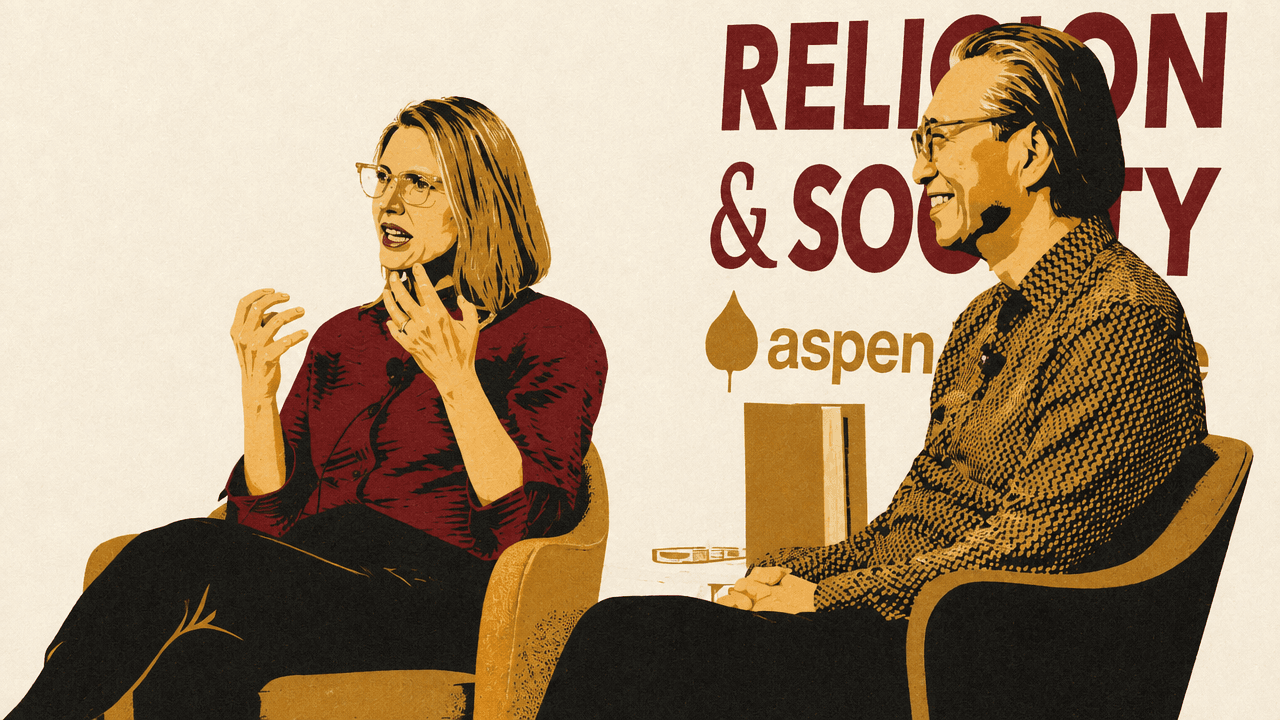
Artist Makoto Fujimura argues that culture should be tended rather than treated as territory in a fight for power—a practice he calls culture care. In a conversation with documentary filmmaker Laura Waters Hinson, the two consider how art and film can make room for complexity. Hinson describes the challenge of making a documentary about missionary Elisabeth Elliot that neither reduces her to a hero nor turns her into an indictment.
Culture care rejects the logic of winning
Makoto Fujimura describes “culture care” as a way to look at culture through its fruitfulness rather than through power, prestige or attention. Its alternative is to treat culture not as territory to fight over, but as a garden or ecosystem to tend.
He developed the idea, he said, as an antidote to culture war. Culture war assumes scarcity: one side’s gain must be another’s loss. That zero-sum logic creates a “we-versus-them” mentality. If a group wins by demonizing the opposition, Fujimura argued, it can end up shrinking the cultural ground it claims to defend. The conflict poisons the soil both sides stand on. It also creates false binaries, in which one camp becomes the problem and the other must defend its turf. People may find themselves defending positions they had not expected to defend because earlier victories have hardened the boundaries of the fight.
Fujimura said he began articulating culture care as an artist in the 1990s. He described speaking with sociologist James Davison Hunter, who coined the term “culture wars,” and encouraging artists to act as carers and stewards of culture. He also pointed to Wendell Berry’s attention to the relationship between land and culture, calling Berry a kind of father of culture care. The governing image is not a battlefield but a living system that people have to tend.
That does not make art harmless. Fujimura described it as a precarious practice: art can heal or open a portal to something new, but it can also become an idol. He invoked the biblical example of the bronze serpent lifted up by Moses to heal people, which later became an object of idolatry in Hezekiah’s time. A person placed on a pedestal as someone to emulate can also become an idol. For Fujimura, artists have to attend to both possibilities.
The tension between tending and fighting runs through Laura Hinson’s documentary about Elisabeth Elliot. The film’s challenge, Hinson said, is to tell a story that does not become either a defense or an indictment of a person whom some viewers revere and others distrust.
Elliot went to Ecuador as a missionary in the 1950s with her husband, Jim, and several other missionary families. After Jim and four other men were killed while trying to make contact with the Waorani, the story became international news. Two years later, Elliot went into the jungle with her three-year-old daughter and lived for several years with the people who had killed her husband. Hinson described the story’s spread through Life magazine as an early viral event. Elliot later became a prominent evangelical writer. In the United States, she was known for books about womanhood, marriage, submission, complementarianism and abstinence. Hinson described her as a grandmother of the purity-culture movement.
Hinson grew up knowing Elliot’s name, but also had skeptical views of her later work. She sees Elliot as complicated: heroic in some respects, while also making decisions Hinson disagrees with and that some people regard as harmful. The film, which had not yet premiered when the conversation was recorded, aims to tell that story honestly and make it legible beyond evangelical audiences through themes of suffering and the complexity of human life. Hinson said its world premiere was scheduled for the Austin Film Festival the following month.
Hinson wondered whether a film that is not a straightforward hero portrait would reach the millions who see Elliot as a hero, and whether people on opposing sides could listen to someone’s experience rather than retreat into their camps. She did not claim to have solved the problem. For her, the challenge is to make room for a personal experience without turning it into a simple argument for or against Elliot.
Fujimura connected that filmmaking challenge to the pressures artists face when they work with material that is “beautiful and messy and complex.” Institutions and the demands of distribution can press that material toward a single angle; a film needs to be seen, and that need can encourage a simplified framing. For Fujimura, Hinson’s work also records a moment when people are being forced to reconsider how they understand themselves and others. He described that reexamination as painful.
Nuance asks viewers to stay with competing truths
Laura Hinson said she almost needs nuance “like oxygen” as an artist. A nuanced story gives something and critiques something; it makes a subject harder to sort. That complexity can unsettle audiences who would rather know whether a person or decision is good or bad. Yet, she argued, the ability to hold two opposed things as true can bring a story closer to reality. There is, for her, a freedom in accepting that a person can be loved and criticized, or admired in one respect and troubling in another.
Makoto Fujimura sees that openness as part of art’s work. The aim, he said, is to tell the truth in a way that can land differently with different people, rather than narrowing a story to one interpretation. A work can give different viewers different points of entry.
He compared that experience to jazz. A concert made up of different instruments and musical traditions depends on musicians attending to one another and to the audience, responding in real time. They need not agree on much beyond their shared commitment to the music. Their interdependence produces something that could not exist in quite the same way outside that moment. Fujimura extended the analogy to liberal democracy, describing it as an experiment in bringing diversity and interdependence together to create something. Pigeonholing people or demonizing another side, he warned, costs everyone part of themselves.
Hinson brought a study to the conversation that she described as a survey of 15 studies about facts in political discourse. She said it found that people on opposing sides of issues tend to respect others’ moral beliefs more when those beliefs are supported by personal experience, particularly when harm is involved. In moral disagreements, she said, subjective experiences can feel more true. For Hinson, that was a reason to tell true stories and create spaces where people can encounter them—not because a story dissolves disagreement, but because it can give people a way to listen across it.
An audience member who said they practice an Indigenous spiritual tradition described an immediate, unsettled response to the film’s trailer. They wondered whether Elliot’s husband had been killed and she had then gone to convert the people responsible. After that first reaction, they became curious: the film, they said, might teach them something and let them see more than one perspective. The response made concrete the problem Hinson had raised. A viewer can bring strong assumptions to a story, but an account that leaves room for complexity may also give that viewer a reason to keep watching.
The problem of how a person’s story is understood also surfaced in Hinson’s earlier film about Lilias Trotter, a British artist who left London for missionary work in Algeria. Fujimura said he first encountered Trotter through Hinson’s film. The art critic John Ruskin had singled her out as a rising artist, but she left that career behind. From the outside, Fujimura said, the decision could look impulsive; within a Christian understanding, it could be understood as pilgrimage or obedience. Trotter’s sacrifice, and its effects, became visible over time.
For Hinson, only small paintings of desert landscapes and Trotter’s writings remain as a record of the artistic life she might have had. One of Trotter’s recurring images was the dandelion. Fujimura saw that image not simply as a symbol of renunciation, but as part of a life that carried beauty into a different form. In his telling, Trotter did not abandon the sublime when she left the art world: she brought it with her in her sketches, writing and service to people. He compared her life to a dandelion seed scattered without expectation of return, but leaving a mark nonetheless.
Fujimura said a person’s story takes time to be seen from multiple angles: not only from a public pedestal, but through the people who knew the person and the effects of that life. That approach offers no simple verdict on Elliot. It gives the story room to contain both the reasons people admire her and the choices that trouble others.
Tradition carries histories into new work
A question from Aysha Imam, founder and executive director of Read Society for the Sacred Arts, brought the discussion from storytelling to the traditions artists work within. Imam described artists as “activators” who can help make meaning for others. Her organization focuses on traditional art and the artistic and spiritual lineages that sustain it. She described gatherings at Dar al Islam in New Mexico, where artists and musicians meet spiritual seekers in a setting of sacred architecture and landscape. Such spaces, she said, can make room for nuance, listening and the experience of how one person’s work affects another.
Makoto Fujimura spoke about working in Nihonga, a Japanese painting practice that uses mineral pigments and materials including gold. When he began showing work in New York in the 1990s, the technique was unfamiliar to much of the art world. Some people told him not to use gold because of its associations with imperialism. Fujimura’s response was that he was working within a Japanese tradition of using gold, including techniques developed centuries earlier. The material could not be reduced to a single political association without losing the history and practice he was bringing into the work.
His installation Jacob’s Ladder, at Capitol Turnaround, uses roughly 150 layers of minerals on handmade paper. Fujimura said the paper was produced by a maker who died in the 1990s and who had made the largest handmade paper in Japan; that kind of paper is no longer made. He approaches it as a sacred object, both in honor of the paper-maker and as a way to carry the past into something new. To work with a tradition, in this sense, is neither to freeze it nor to use it as decoration. It is to inhabit it carefully enough to make a new point of contact with other people.
The need to slow down interpretation matters especially when a work carries cultural histories that a viewer may not immediately know. Fujimura said that film, like painting, can bring people into the space of another person or place. That act requires attention to the past, traditions and languages involved, and to what it means to represent them from an outsider’s position. Hinson added that nuanced storytelling can hold two perspectives that are simultaneously true and opposed. The tension, she said, can be part of the mystery rather than something to resolve.
An audience member who makes paper asked Fujimura whether touching the paper he paints on felt like touching an ancestor. Fujimura answered with a description of how it is made. Japanese paper is formed by lifting fibers from water; on a large sheet, about a dozen people may work around the vat, moving the fibers until they mix. Unlike paper made by compressing layers, it is formed in one lift. The process requires particular knowledge from the paper master, and the resulting sheet can be exceptionally smooth on one side.
Fujimura said the process has become more difficult because rising water temperatures have made the fibers behave unevenly. When he stretches the paper, he notices its aroma and feels that he does not deserve the beauty in front of him, even as he prepares to paint on it. He also described learning that Japanese papermakers descended from Korean makers taken to Japan. He spoke of two nations at war, and of one culture being ransacked and occupied by violence, while holding in view the delicate paper made through that history.
He challenged the assumption that paper is fragile. Fujimura said the Declaration of Independence is written on the same type of paper he uses. The paper is pH neutral and can be safer for long-term preservation than canvas, which can trap moisture under varnish and develop mold. Paper can also be mended. He added that Japan’s parliament still uses paper to document its proceedings.
For Fujimura, stretching the paper means encountering the work of generations of artisans and continuing it. Papermakers cultivated mulberry bushes for particular kinds of paper; he said three generations of makers contributed to producing the material. He described the medium as a way of bringing something sacred into the world. Film, too, can capture something profound and mysterious—sometimes in ways that surprise even the filmmakers.
The market can shape the work without defining it
Laura Hinson asked Makoto Fujimura how an artist can remain confident when marketing people push for a different direction. He did not offer a formula. When he paints, he said, he is focused on doing the work he feels called to do.
Fujimura recalled a line attributed to the painter Philip Guston, who told graduate students that famous artists—Picasso, Matisse, da Vinci—show up in the room while you are painting. One by one, they leave. Then, Guston said, your real work begins: you have to ask who you are and how you dare make something new. Fujimura added the next step: “when you leave the room,” the work begins. He takes that as a question about the artist’s ego. The work cannot be governed by the gallery, the market or even the artist’s self-image; it has to be about the work itself.
He offered the cover of his book Art Is as a small example of the push and pull. The book designer at Yale Press took a tiny dandelion drawing from the chapter on Trotter and proposed putting it on the cover. Fujimura initially resisted. The designer also wanted to use a small bee drawing and writing Fujimura called nearly illegible—choices that seemed to him almost anti-marketing. Fujimura said the cover later won an AIGA award, which he described as the “Academy Award of book design,” selected from 50 covers out of 50,000 books. He found the result gratifying because the design captured something of Trotter and of the tension between art and the market.
Fujimura was careful to say that nothing is wrong with marketing departments: artists need people to help their work reach an audience. The cover’s success did not make his initial resistance a rule; it showed how a designer’s judgment could lead to a choice he would not have made himself.
Long projects need a precise opening
Laura Hinson said that, in filmmaking, the first discipline in a long-term project is to identify its central question. Film students, she said, often find many interesting dimensions and try to include them all. The result could become a nine-hour series. A filmmaker or photographer has to decide what the work is interrogating and what journey it is following. Tangents and supporting stories can muddy that journey until the audience loses interest.
Makoto Fujimura offered a different but related discipline from his ongoing series on the Psalms. He is making one large painting a month, one for each of the 150 Psalms, using a limited palette: sumi ink, oyster-shell white, and sometimes gold, silver or platinum. He said he had completed about 80 and expected the project to take at least 14 or 15 years. It was not designed for an exhibition; the structure gives him an excuse to spend time with each Psalm and meditate on it.
For ambitious work, Fujimura advises artists to find a “pinhole”: a narrow, precise opening through which the larger subject can be approached. He likened it to a pinhole camera, where light passes through a small aperture and projects an image upside down. The opening has to be sharp enough for the image to come into focus; the artist also has to accept that the resulting view may not look familiar to the audience. If the artist remains faithful to the craft, Fujimura said, the viewer may learn to focus on that opening too—and turn their head to see.