Career Pauses and Caregiving Are Reshaping How Employers Define Ambition


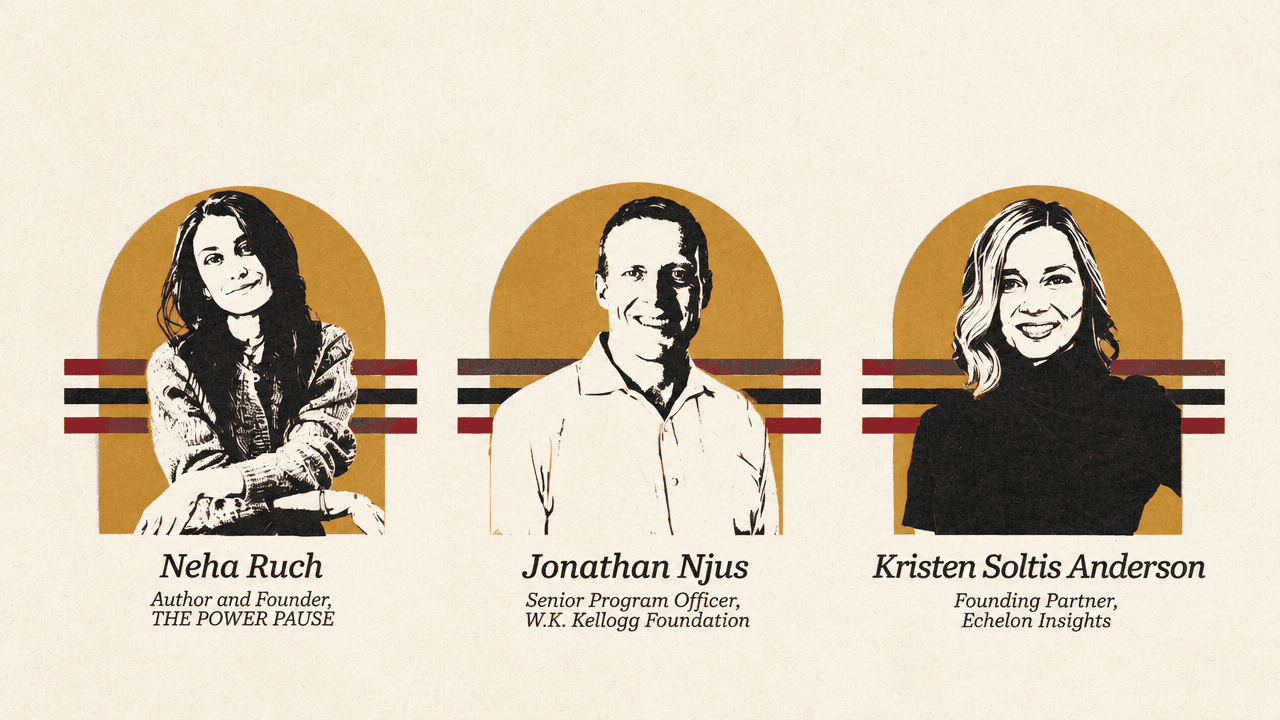
At the WIN Summit in New York, author and Power Pause founder Neha Ruch argued that parents need a broader definition of ambition—one that allows people to change their hours or pause paid work without being treated as having given up on their careers. She said employers must make work compatible with caregiving across different jobs and stages of life, while recognizing that flexibility and leave are not equally accessible to all workers. W.K. Kellogg Foundation program officer Jonathan Njus added that policies need a culture of visible support, including fathers who take leave and care for their children.
Ambition needs a middle ground between “working mom” and “stay-at-home mom”
Neha Ruch says she had her first child just after business school, when she was in what looked on paper like her dream job. She had spent years pursuing conventional markers of ambition. After becoming a mother, she wanted more time at home—and found that the available story about women who did that was that they had given up.

That picture did not fit her experience. The cultural backdrop, she recalled, was the “Lean In” movement and the girlboss era, with little representation of women who wanted to remain ambitious and connected to their professional identities while making room for family life or other priorities. Ruch began working to make that middle ground visible: a life in which ambition could continue even when the amount or shape of paid work changed.
Research she later commissioned with Proof Insights suggested how durable the stereotypes remained. In a 2023 survey, respondents associated “stay-at-home mom” with June Cleaver, the fictional 1950s television character, while “working mom” brought to mind Sheryl Sandberg, Michelle Obama and Beyoncé. For Ruch, the contrast was too stark to describe the lives she saw around her. It set up an overly simple choice between a woman who had stepped away from ambition and a woman whose career was her defining identity.
The same research pointed to considerable movement between work arrangements. Ruch said one in three women working outside the home were considering a pause, and one in two were considering reducing their hours. Among women who were already on pause, 90 percent aimed to return to the workforce. She argued that these shifts do not necessarily mean women have abandoned professional identities or ambitions. Many continue pursuing personal, creative and professional growth in ways that do not fit a simple division between working mothers and stay-at-home mothers.
The challenge, as Ruch framed it, is to make it possible to dial work down and later dial it up again without shame or penalty. Career and family life, she said, are fluid: people’s time and focus change, sometimes substantially, over the course of a working life.
A pause is not equally available to every family
Neha Ruch acknowledged that deliberately reshaping a career depends in part on economic circumstances. Some parents can afford to step away from paid work; others cannot forgo their income. She said one in three women have to pause their careers because of the cost of childcare, while other women cannot afford to pause at all. Between those situations are many families whose choices are constrained but not identical.
A broader story about caregiving can still help change the systems families encounter, she argued. When people with economic power describe how work and family actually coexist in their lives—including the childcare and other support that make their arrangements possible—they help reveal what different families need. Ruch did not suggest that a high-profile person’s flexibility is automatically available to every worker. Her point was that a fuller account of how people manage care can make the support behind that arrangement visible, and help clarify what employers and institutions must provide.
The practical form of flexibility will vary. A parent in an hourly job may not be able to work from home, so remote work is not a meaningful substitute for flexibility in every role. A predictable schedule can make it possible to arrange childcare and know when a shift begins and ends. Reliable, affordable childcare matters too: without it, a schedule that is predictable on paper may still leave a parent without dependable care. For workers who cannot simply reduce their hours or forgo income, the question is how to make work and caregiving compatible within the constraints of the job.
For Ruch, the underlying principle is that caregiving does not erase a person’s ability to work. It adds experience to a person’s working life. That principle should apply across income levels and occupations, even as the supports required to make work and care coexist differ.
Jonathan Njus made a related point about access to leave. He recalled figures he had cited showing that nine in ten high-income earners have access to paid sick leave, compared with four in ten low-income earners who do not. He argued that philanthropy can help push for policies that extend access to different forms of leave, including parental, medical, safe and caregiving leave. The issue, in his account, is not only whether a workplace offers a policy, but whether workers across income levels can rely on leave when they need it.


Njus pointed to a W.K. Kellogg Foundation-funded effort in New Mexico, where New Mexico Voices for Children and a coalition pushed for the Healthy Workplaces Act. As he described it, the law requires employers to provide all workers in the state with 64 hours, or six days, of paid leave. He presented that kind of policy change as one way to address unequal access rather than treating flexibility as a benefit available mainly to high earners. The example also gives a concrete form to philanthropy’s role in the panel’s discussion: supporting coalitions seeking changes in policy, alongside efforts to shift workplace culture.
Fathers need time—and visible permission—to care
Jonathan Njus’s argument for men’s involvement began with regret. He is the father of four daughters, and the longest leave he took after any of their births was one month, for his fourth child; some of that time was vacation and some unpaid. Looking back, he wished he had spent more time building a deeper bond with his daughters. He said he shared the experience not to invite sympathy, but to point to a cultural problem: men may want more time with their children and may not get it.
Njus described fatherhood as a more important part of many men’s identities than workplaces or cultural expectations have assumed. He cited a survey of 1,300 fathers conducted by Parents Together, a group whose dads initiative is intended to engage more men in this work. When asked how they identified themselves, respondents listed “dad” second, he said. Many fathers want to provide emotional support as well as financial support, but need time and policies that let them do so.
For Njus, formal policies are not enough if organizational culture makes them difficult to use. He urged senior leaders, middle managers and frontline supervisors—especially men—to model taking leave and making use of flexibility. That signals that care is part of what an organization values, rather than an exception or a liability for an employee’s career. A policy that exists without visible use may not reassure workers that taking leave is accepted.
He called this “caring masculinity”: a way of understanding men not only through expectations about how they should act, but through who they are and who they want to be. “Real men are good dads,” he said, adding that being a good father requires both work and time. Employers, in his view, have a role in making that time possible. Men who take up care can also serve as allies and advocates for women having more time to care.
Njus also connected caregiving to leadership. At the foundation, he said, qualities associated with creating an agile organization include listening, building trust, openness and competence in handling conflict. He sees those capacities as relevant to parenting as well. Becoming a better parent, he said, has made him a better leader; the skills developed in one setting can carry into the other. Employers should treat leave not simply as time away from work, but as an experience that may strengthen the person returning to it.
Caregiving runs through a career, not just one leave
The panel questioned the idea that caregiving can be handled as a single interruption early in a parent’s working life. Kristen Anderson noted that care also arises when workers are supporting their own parents, and that it can return at different stages. Jonathan Njus said he had thought of caregiving as having two phases until research on young adult children made him reconsider. His oldest daughter was starting college, and he concluded that parenting—and the need to care—does not simply end.


Njus argued that employers should think about the employee life cycle alongside the parental life cycle. A young parent may need a period of leave, flexible start and finish times, or less travel. Needs can change later, as a parent becomes able to take on more travel and responsibility. The point is not that every employee needs the same arrangement throughout a career, but that work can respond to different phases rather than treating leave as a one-time event.
Neha Ruch described a shift in the question employers need to ask. For years, she said, the effort was to make the existing workplace function better for women. She argued that the task now is to redesign work to accommodate real life. The pandemic made it harder to keep work and home separate, and made caregiving’s demands more visible: raising children takes time, physical presence, emotional energy and mental space.
That recognition leaves organizations in a “messy in between,” Ruch said, where people are trying out different arrangements rather than relying on a single established model. She gave the example of a woman in her community who wanted more time with her child. Through her network, she found someone at HSBC with a two-day workweek arrangement, obtained a template and used it to make a proposal to her own manager. The example was not a ready-made policy for every role; it showed how one worker could use another person’s arrangement as a practical starting point for a conversation with management.
For Ruch, the example showed the value of people sharing models that employees can adapt and managers can consider. Managers need to be open to new proposals, and workers need enough transparency to learn what arrangements have worked elsewhere. Informal networks can help make possible options legible, but Ruch also argued for more durable pathways within organizations.
She said organizations could explore job-sharing arrangements that let senior leaders reduce their hours without discarding years of experience or moving into a lower-level role. Return-to-work fellowships and other genuine on-ramps could help people reconnect with work after a pause. These options matter because flexibility limited to less senior positions can force people to choose between time for family and the experience or responsibility they have built. Ruch’s question was how to preserve that experience while changing the arrangement around it.
She sees philanthropy as one source of support for testing these arrangements. Rather than assuming there is one proven model, philanthropic capital can help fund experimentation and learning. The point is to test different approaches and learn which ones work, not to treat an untested proposal as a settled solution.
A career shift should add to experience, not erase it
Neha Ruch’s longer view of work treats career pauses and shifts as ordinary parts of a working life, not evidence that ambition has disappeared. People are living and working longer, she said, while careers and childcare can both be demanding. A pause or change in hours can reflect a shift in where someone’s time and energy need to go—not a permanent loss of professional capacity.
She rejected the idea that prior experience vanishes when someone steps away. A person who spent 20 years as a brand marketer, she said, still has that experience after a period focused elsewhere. They may also return with added perspective, agility, patience, communication skills, creativity and leadership experience. Employers should ask how someone grew during that time and how the experience contributes to the organization, rather than treating the period as an empty gap on a résumé.
Jonathan Njus’s account of leave and leadership points toward the same broader change: care should not be treated as a private detour from work, or as a responsibility that falls only on women. In his view, employers have to pair policies with a culture in which men and women can use them without penalty. In Ruch’s, organizations need to make room for the varied ways people combine work and care across a long career. Both arguments place responsibility not only on individual parents to make work fit, but on employers and institutions to change what a workable career can look like.