Civic Learning Is Career Preparation When Students Practice Agency
 Elizabeth Roy
 Jennifer Tran
 Braden Chapman
 Elizabeth ZamudioThe Aspen InstituteWednesday, May 20, 202617 min read
The Aspen Education & Society Program’s final Redefining Student Engagement session argued that civic learning and career readiness are not competing priorities but overlapping forms of preparation. Elizabeth Zamudio, Elizabeth Clay Roy, Jennifer Tran and Braden Chapman made the case that students develop the skills schools and employers say they value — communication, collaboration, problem-solving, perspective taking and civil disagreement — when they have real agency in schools, supported channels to influence decisions, and families and institutions that treat youth voice as part of civic life.
Agency means students can affect the systems they experience every day
A fifth grader in a large urban public school district notices that the playground water fountains have not worked for months. Other students quietly bring plastic water bottles from home. This student’s family cannot afford to do that. A slide put the question plainly: “What do you do?”
The most likely answer, Jennifer Tran said, is that the student does nothing. The point was not apathy. It was the absence of credible agency. A slide attributed on-screen to CIRCLE 2025 stated that only about 33% of young people report having meaningful input in decisions at their schools. Tran’s interpretation was that most students do not believe they can meaningfully influence school decisions, so everyday problems often go unraised — especially by a fifth grader whose civic agency has not yet been developed.
A second possible answer was that the student tells a trusted adult: a teacher, playground supervisor, or other staff member. Tran called that more plausible, but still unlikely. A slide attributed on-screen to CIRCLE 2024 stated that less than two in five young people ages 18 to 34 recalled having experiences in class, student groups, or with school leaders where their voice and opinion mattered while they were in high school.
The ideal answer was different: the student has enough authentic agency at school to act. In that version, students have repeatedly experienced adults encouraging them to raise concerns, listening to their perspectives, acting on their feedback, and giving them opportunities to participate in decisions that affect them. Tran argued that in such a school, the water fountains probably would not remain broken for months. The problem might persist for a week before a student speaks up, brings it to an adult or administrator, and works through proper channels.
The slide made the change visible by crossing out “months” in the original scenario and replacing it with “a week.” That edit captured the larger claim: agency is not merely a student’s confidence to complain. It is a school condition in which student concern can travel through a real channel quickly enough to change the system.
That example drew a sharper distinction than “student voice” often carries. Agency was not occasional choice inside adult-designed options. It was part of a school’s operating system. Students see parts of school life that adults may never fully picture. A fifth grader may use a playground water fountain every day; a teacher or administrator may never touch it. If students have a real feedback channel, their proximity to daily problems becomes a source of institutional improvement.
A slide attributed on-screen to NCEE placed student agency next to a continuous improvement cycle — focus, discover, design, deliver — and described schools with agency as places where students help the system improve because they are part of the feedback loop. Tran named structures that can give students meaningful influence: student board members, student advisory councils, participatory budgeting processes that let students allocate resources, and student roundtables with administrators and decision-makers. The reinforcing practices were just as important: consistent engagement from school and district governing bodies, formal mechanisms for student feedback to influence decisions, and transparent follow-up showing how student input shaped outcomes.
When an audience member asked for an operational definition of agency, noting that it is too often reduced to narrow student choice or student voice, Tran offered her own: students’ ability to co-create and co-make decisions alongside adults about their school site or issues they care about. That form of agency, she said, exists only when adults and people in power give students a share of decision-making power — taking some of that power away from themselves and giving it to the collective.
Civic learning is workforce preparation, not a competing priority
Elizabeth Zamudio opened with a premise that shaped the rest of the discussion: student engagement is not separate from civic preparation, career readiness, or family engagement. It is the condition that makes those aims plausible. Young people show up, she said, when they feel “seen, supported, and motivated,” and that happens through schools, communities, and families that give them real opportunities to practice participation.
The opening slide asked how young people can be prepared both for “meaningful participation in democracy” and “success in the modern workforce.” Zamudio named the overlap directly. Communication across difference, collaboration toward shared goals, navigating complex systems, advocating for a position, and contributing to solutions are essential in democracy and in work. Civics and career readiness, she said, are not detours from student engagement; they are “the destination.”
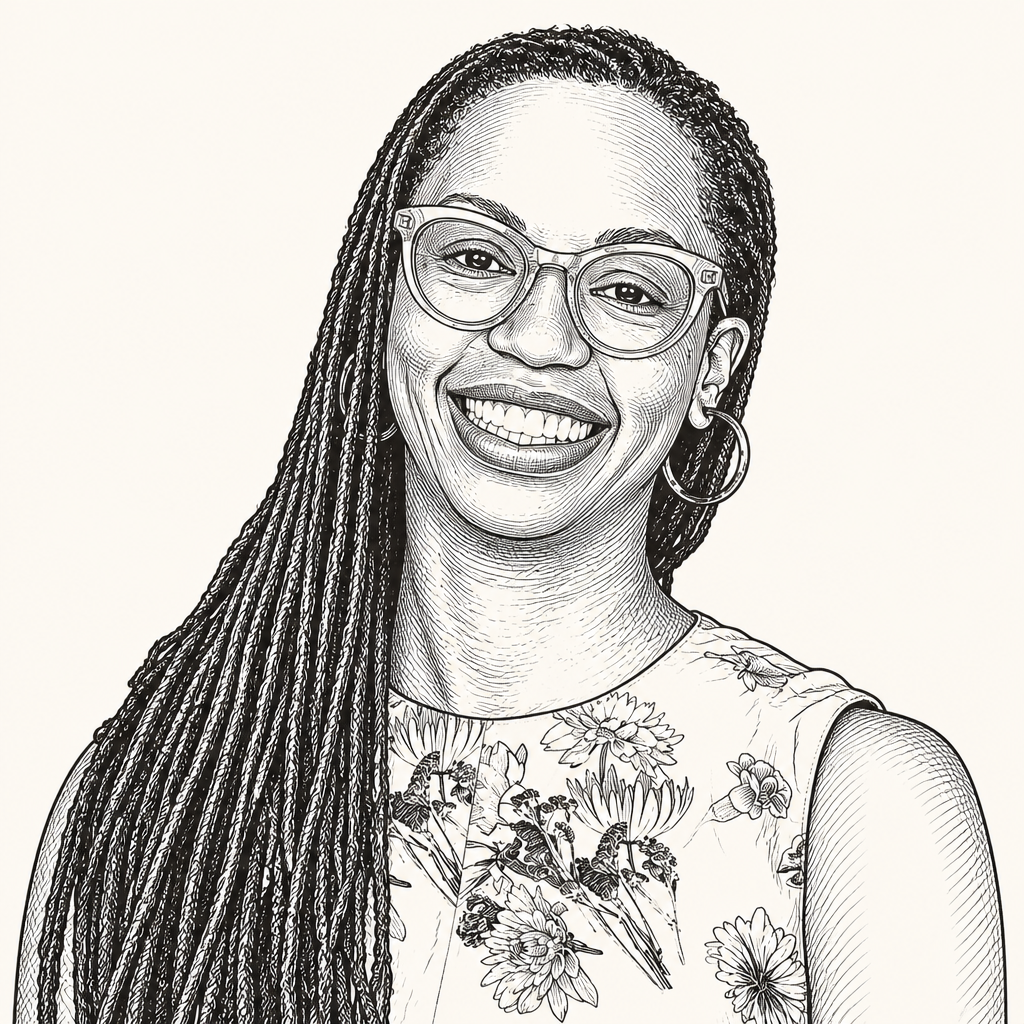
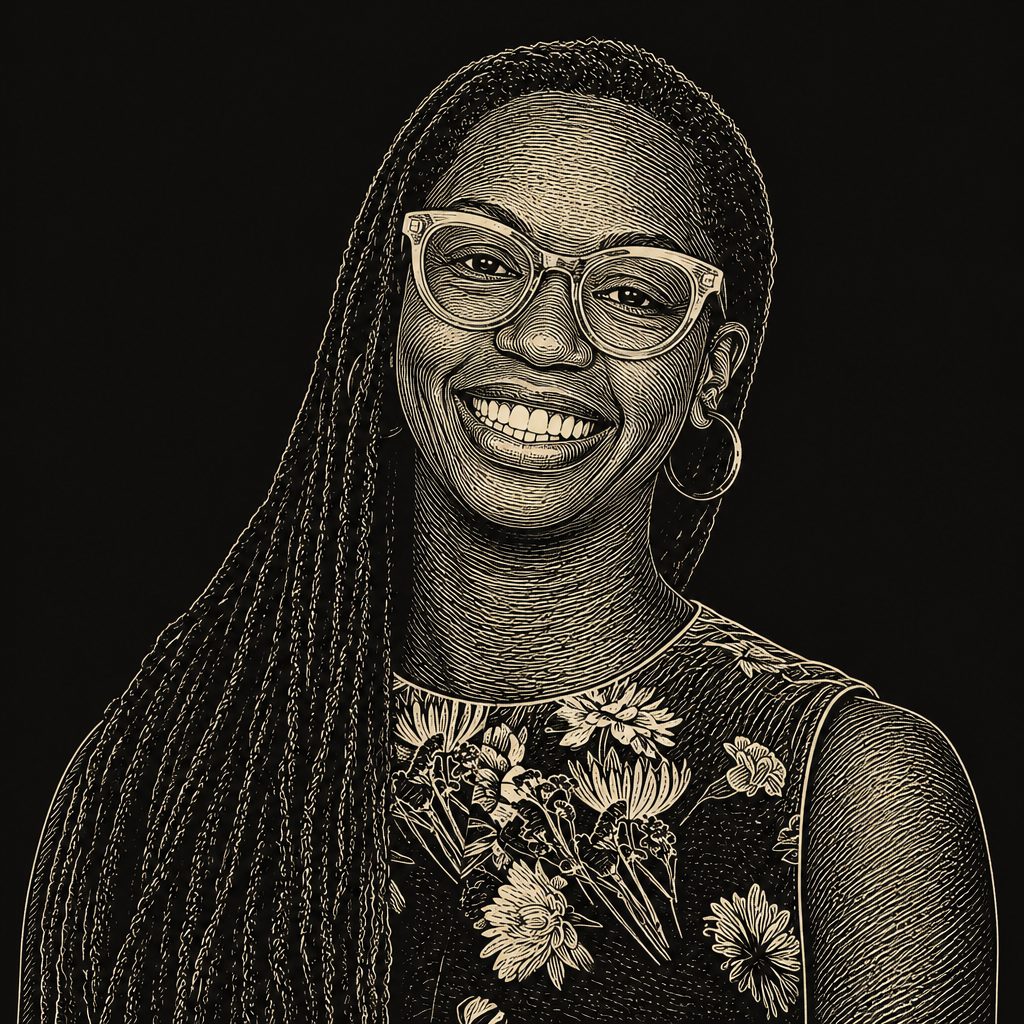
Elizabeth Roy gave the most developed version of that claim. As CEO of Generation Citizen, she described experiential civic learning as education that teaches civic skills alongside civic knowledge. The modern civics classroom, in her account, is not only where students learn the three branches of government or how a bill becomes law. It is where students learn to identify issues in their communities, research them, understand decision-makers, communicate with stakeholders, and pursue change.
Her analogy was practical. Science students need labs because they have to connect what they know with what they can do. Drivers do not become competent by reading a manual alone; Roy said “you don’t learn to drive a car effectively just by reading the state driver’s manual,” even though the manual is essential. They need time in the driver’s seat, with support. Civic learning, she argued, should work the same way. Students should learn how government works while trying to solve problems that matter to them.
The report she used as the foundation for her presentation was Experiential Civic Learning for American Democracy: A Portrait of the Field, published in May 2025 by the Task Force on the Value of Experiential Civic Learning. The report’s cover appeared on screen with a QR code and a list of task force authors, including Danielle Allen, Michael Rebell, Robert Burton, Joshua Dunn, Harvard Green, Audrey Homwsen, Rachel Humphrey, Mary Jayne, Hannah Kurisman, John Rose, and Elizabeth Clay Roy.
Roy emphasized that the report was intentionally co-authored by a diverse coalition of scholars, educators, and practitioners. Its core idea, as she presented it, was that experiential civics asks students to become “community problem solvers” while also learning how government and civic institutions function.
The skills doing the most work are communication, perspective taking, and civil disagreement
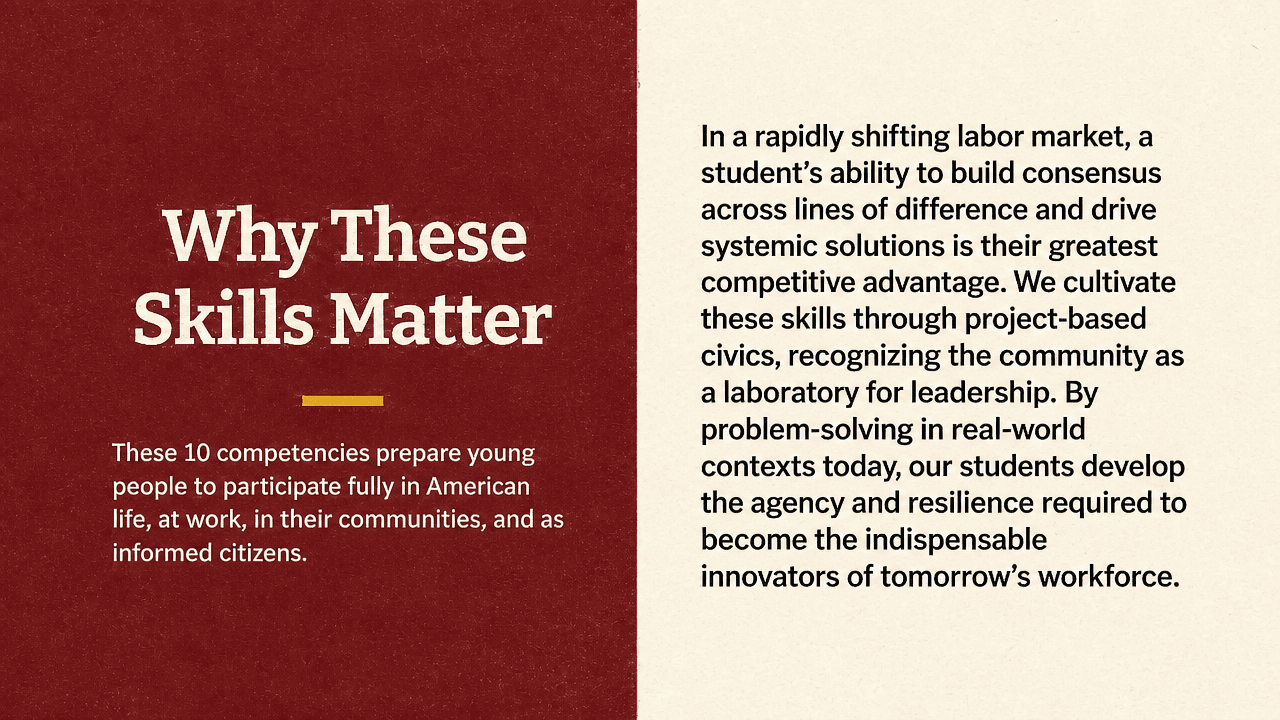
Roy’s presentation identified ten competencies that she said students learn through strong civics instruction and that also matter in careers, communities, and adult life. The slide introducing them described the list as “10 Career Skills Students Learn in Civics Class,” with the subtitle: “Essential civic competencies that prepare young people to thrive in their careers, communities, and democracy.”
The ten competencies were critical thinking, effective communication, community engagement, collaboration, problem-solving, perspective taking, structuring agendas and running meetings, negotiation and compromise, digital competence, and civil disagreement. The full list matters because Roy’s claim depended on civic learning being concrete. But the examples she developed most fully centered on three clusters: communication, perspective taking, and the ability to work through disagreement.
| Competency | How it was defined in the presentation | Why it mattered |
|---|---|---|
| Critical thinking | Analyzing information and arguments to make informed decisions | Problem-solving, strategic planning, leadership, and sound personal decision-making |
| Effective communication | Expressing ideas clearly and listening actively, including public speaking and debate | Interviews, presentations, relationships, advocacy, and conflict navigation |
| Community engagement | Participating in local activities and understanding community needs | Networks, initiative, leadership experience, belonging, and local problem-solving |
| Collaboration | Working with others to achieve common goals | Teamwork in jobs, family relationships, community involvement, and shared objectives |
| Problem-solving | Identifying issues and developing solutions | Innovation, entrepreneurship, overcoming obstacles, and creating positive change |
| Perspective taking | Seeking and inhabiting alternative perspectives | Stakeholder awareness, empathy, reduced conflict, and stronger relationships |
| Structuring agendas and running meetings | Shaping a deliberative process and driving toward resolution | Leadership, organization, volunteer leadership, community organizing, and family decision-making |
| Negotiation and compromise | Working through conflicting interests to resolution | Sales, management, contracts, partnerships, and community decisions |
| Digital competence | Using digital tools to navigate information, communicate, and protect oneself | Modern work, misinformation, scams, privacy, and connection |
| Civil disagreement | Engaging charitably across different values and views to find shared solutions | Productive debate, diverse teams, maintaining relationships, and common ground |
Communication, for Roy, was not just a presentation skill or a writing assignment. In a Generation Citizen example from East Bronx Academy for the Future in New York, students identified transparency around law enforcement as a critical community issue. Inspired by legislation they had seen in California, they drafted model legislation for New York that would require visible identification for immigration enforcement officers, limit the use of masks and face coverings, protect sensitive locations, and safeguard peaceful protest.
The students had to practice different kinds of communication for different audiences. Roy said they wrote pages of dense legislative language, the kind that might be put before a governor. They also wrote community-facing language, including a bilingual “know your rights” document in English and Spanish that could be distributed locally. They practiced verbal communication for meetings with legislative aides and for a community civics day showcase, followed by email follow-up.
The work moved students beyond “writing a paper for their teacher” or presenting at the front of class. Because they were working on an issue they cared about, they had a reason to do high-stakes writing, public speaking, advocacy, and follow-through.
Perspective taking was equally procedural. Students preparing for a 15- or 20-minute meeting with a stakeholder need to decide what outcome they are seeking and how to use the time. Students researching an issue need to hear not only from peers who experience the problem, but also from people who hold institutional or opposing perspectives: a local police department, a business improvement district, an elected official, or another decision-maker.
Roy described two classes in rural Oklahoma. One group focused on local homelessness; another focused on street safety. In both cases, students researched local budgets before presenting solutions to officials. The homelessness group developed a staffing idea related to the public works department. The street-safety group proposed placing a stop sign at an intersection near their school. Roy’s emphasis was that the students did not come to officials only with passion. They also came with some understanding of budget constraints and the perspective of the people responsible for public decisions.
That transfers directly into work, Roy argued. A student who can think about a public official’s constraints can also think about what an interviewer is looking for, what a customer needs, what a constituent is experiencing, or what a client sees from the other side of an interaction.
Digital competence and civil disagreement completed the list. Digital competence was defined as using digital tools to navigate the information landscape, communicate, and protect oneself from misuse of those tools. Roy acknowledged that young people often have native facility with digital tools, but she said the media landscape is moving quickly enough that students need explicit support in digital media competence, particularly around civic media.
Civil disagreement, she said, is “no small skill these days,” and young people do not always see adults model it well. Her example came from students in Lawrence, Massachusetts, who initially disagreed about the most pressing concerns in their community. Over several classes, they had to come to consensus on the issue they would pursue. Instead of treating the choice as winner-take-all, they worked to ensure that the class’s different concerns were heard and reflected in the solution.
Families were treated as civic infrastructure, not background support
Family engagement was not presented as a sentimental add-on to school-based civics. Families help shape whether young people understand civic life as something that belongs to them.
Roy said the research she was drawing on shows that young people are more likely to grow into civically engaged adults when they experience civic life early as relational, meaningful, and connected to belonging. She attributed that pattern to adolescent development research, including longitudinal research that, in her account, links parent connectedness, shared activities, and adult civic engagement. She also named faith communities as places where young people can test and bring forward their voices, especially when those spaces connect individual experience to collective responsibility.
But Roy cautioned that influence is not only one-way. She referred to research from “a couple of years ago” finding that civic engagement and youth voter engagement efforts aimed at young people increased not only whether those young people voted, but also, in some communities, the likelihood that their parents voted. She said that effect appeared particularly in African-American communities. Her point was that youth voice sits inside a broader civic ecosystem and can affect adults as well as be shaped by them.
Zamudio, speaking from the work of UnidosUS with Latino families, described civic engagement beyond voting. Families are encouraged to participate at whatever level feels comfortable: volunteering at school, joining parent-teacher organizations, attending a city council meeting, or going as a group to a school board meeting. The group element mattered. Going together can make formal civic spaces feel less intimidating; families may attend first simply to listen, observe, and understand how systems work.
She described a “trickle-down effect” in which young people see families participating, but also affirmed Roy’s point that the effect is bidirectional. Students who attend civic engagement summits can prompt families to want to learn more. Ideally, that creates dinner-table conversations about what they saw, what they thought, and what civic action might mean.
Roy’s guidance to parents was concrete. With schools, parents can ask what real-world projects, service-learning experiences, or community problem-solving opportunities happen during the school day. They can ask how schools teach communication, collaboration, problem-solving, and civil disagreement through practice. They can encourage school boards and administrators to invest in experiential civic learning. They can also volunteer their professional knowledge, workplace access, mentorship, or project opportunities.
At home, Roy emphasized modeling the skills that may not be visible on social media or television: civil disagreement, respectful discussion across viewpoints, open-ended questioning, and recognition of problem-solving and teamwork as career skills rather than merely character traits. In communities, families can look for youth advisory boards, civic organizations, service groups, mentors, and local problems their children care about.
When asked later for “human” advice rather than a policy ask, Roy returned to her own upbringing. She said she grew up in a house where the Shirley Chisholm line — “service is the rent we pay for the privilege of living on earth” — was lived as an expectation. But her parents did not prescribe which issues should matter to her. They prescribed that something should matter, and that it should matter beyond herself.
Her advice to families was to create “side-by-side” conversations rather than lectures. Sitting in a car, on a park bench, or outside together, a parent can look at the world with a child, offer observations, and then listen for what the child sees. An 11-year-old and a parent in their 40s may look at the same park, street, or world and notice different things. That difference is not a problem to correct; it is an opening to discover what is “lighting them up.”
Student representatives argued that lived experience is legitimate, but not sufficient without institutional support
Jennifer Tran brought the perspective of a former student school board member and co-founder of the National Student Board Member Association, a professional development organization for students serving on school boards. She described growing up in Southern California’s Little Saigon as a low-income, first-generation daughter of Vietnamese immigrants. She was also dyslexic and deeply involved in music, choir, and musical theater — not the profile she associated with “traditionally” academically oriented students.
Her first path into education policy came through the Music Honor Society, where she advocated for quality performing arts education and for students in the performing arts to be valued as much as other students. That background shaped the advocacy she brought to her school board term.
Tran also challenged a narrower view of student leadership. Students do bring their own identities and lived experiences, she said, but they also bring the voices of peers and communities they represent. Drawing on AP Government language, she described student board members as often closer to the “delegate” model of representation than the “trustee” model. They may not have the same expertise as adult officials, but their legitimacy comes from lived experience and from the experiences of the peers they represent.
That legitimacy, however, depends on institutional support. In response to a question about what stops young people from engaging more, Tran said support systems and connections matter. Passion and grit are not enough for student school board members if adults do not create conditions for them to function. Do they have meetings with the superintendent? Do adult board members support them? Can they access district staff to complete tasks in the same manner as adult peers?
Her conclusion was that civic participation should not depend on whether an individual student happens to find unusually supportive adults. Schools and districts need to institutionalize best practices so that the quality of student civic action is not limited by the support tools adults decide, ad hoc, to provide.
Braden Chapman described a different entry point. He grew up in a small town in Southern Indiana where, by his account, many people looked, talked, and thought like him. Moving to Indiana University Bloomington meant entering a large state university with students from across the country and world. He wanted to engage constructively across difference, but did not feel that K-12 schooling had equipped him with those skills.


BridgeUSA became the space where he practiced them. As a Chapter Development Lead, he works with student chapter leaders across more than 40 universities directly and a network of 125 chapters. His emphasis was on navigating disagreement toward productive ends. Conversations across difference, he argued, “have to go somewhere”; they need to point toward collaborative solutions.
He also stressed institutional navigation. As a student chapter leader, it was not enough to have a group of students talking about issues. If they wanted to get anything done, they had to work with university administration, staff, faculty, and the political life of the campus. Civic success required respect, charity, and the ability to operate inside systems.
For both Tran and Chapman, family support took the form of encouragement without substitution. Chapman said his family did not push him into civics, but they cheered him on and enabled opportunities. In high school, when there was a shortage of poll workers in his area, he signed up to help run the polls even though he was not yet old enough to vote. His parents supported his participation, as they did with conferences and committees, including physically getting him to places before he could drive.
Tran said her immigrant parents often did not understand the systems she was navigating or the interests she pursued, whether music, musical theater, or education policy. But they supported the fact that she had a passion and wanted to pursue it. Most important, she said, they never spoke for her. They encouraged her to do research, find the right channels, and advocate for herself.
Her advice to parents was concise: be an advocate for your child’s voice, not a substitute for it.
The through line from middle school to higher education depends on access, not just aspiration
The question of continuity kept returning: how civic learning in middle school, high school, postsecondary education, and career preparation connect.
Elizabeth Roy pointed to two bodies of work. First, she named Dr. Joe Kahne’s research on civic and workforce skills developed through experiential civics. Second, she pointed to the C3 Framework in social studies — the College, Career, and Civic Life Framework — as a K-12 structure that, in her account, has given sustained attention to student preparation across those domains. In her view, the C3 movement recognizes that skills like the ten she listed are part of 21st-century readiness.
An audience question asked about the through line from middle school civic courses and service learning to higher education, and whether these areas had become bifurcated. Roy agreed that communication and collaboration start early — at home, in Pre-K, and across school — but she focused on prioritization under limited resources.
She said few people oppose students developing communication, collaboration, civic, and community problem-solving skills. The problem is not conceptual agreement. It is whether schools have the time, resources, and incentives to prioritize experiential learning.
Roy also named inequity directly. Across American schools, she said, students do not have equal access to experiential learning. Some students get project-based learning, field trips, rich mentoring, and professional exposure; others may be confined more tightly to core tested subjects. The work of the experiential civic learning task force, as she described it, is partly about expanding access to the kind of project-based learning whose value is already recognized, especially in less wealthy districts.
That access gap can continue into postsecondary education. What is available at a two-year or a community college may differ from what is available at a state university, and both may differ from private four-year institutions. Roy argued for more attention at every level of education to young people’s development of civic and career skills.
But she warned against pushing hands-on learning too late. One risk in aligning secondary and postsecondary education, she said, is deciding that students should focus on academic skills in K-12 and wait until postsecondary education to do hands-on learning. That would fail students who do not go directly to postsecondary education after high school. Her view was that rigorous, hands-on civic learning needs to be built “all the way up,” not reserved for later.
The STEM thread entered through chat and Q&A. Zamudio noted interest in interdisciplinary connections between STEM and civic engagement. Roy said she shared the excitement around STEM, but her answer resisted a zero-sum framing. Schools need enough time in the day and year for high-quality civics education and STEM learning. Civic and career readiness, in this account, are not detours from academic preparation; they are part of the preparation.
For students, the first civic act can be local and specific
When asked what concrete advice they would give students who want to increase civic engagement, Braden Chapman and Jennifer Tran kept the scale intentionally local.
Chapman’s advice was to take initiative because “nobody is going to do it for you.” Schools often run the same way for years. If students want something to change or want more voice, they need to advocate for themselves and peers. His practical advice was to get friends involved and find a few adult champions who will come alongside them and support their voice. The policy issue itself mattered less than building a small coalition with persistence.
Tran advised students to start with something that shapes daily life. Civic engagement does not need to begin in Washington, D.C., or a state capital. It can begin in a school district or city, with issues such as transportation, education, or mental health. Students can ask who makes decisions about the things affecting them, how those decisions are made, and how their voices can be heard.
She also emphasized that lived experience is a form of experience. For students interested in school board politics or education, she described the path as moving “from the classroom to the boardroom.” The student’s proximity to the classroom is not a deficit to overcome; it is the basis for advocacy.
That view echoed the water-fountain scenario. Civic agency begins not with abstract knowledge of institutions but with a problem students can see, a relationship that makes speaking up possible, and a channel through which student input can shape decisions. Without those channels, the likely response is silence. With them, a broken fountain becomes a lesson in public systems, resource allocation, adult accountability, and student power.