Girls’ Sports Gains Depend on Systems That Prevent Female Athlete Injuries

Kate Ackerman, co-founder and director of the Women’s Health, Sports & Performance Institute, argues that expanding girls’ access to sport is insufficient if the systems around them are not built to keep them healthy. In her Play Talk presentation, she says injury prevention, trained coaches, appropriate medical support, nutrition and mental health resources, and faster translation of female-specific research are prerequisites for girls and women to receive the lifelong benefits sports can offer.
Participation gains only matter if girls can stay healthy enough to benefit
Kathryn Ackerman begins from a premise that is hard to dispute in youth sports: getting children active produces benefits that extend far beyond the field. The figures she shows in the presentation link physical activity in childhood with lower obesity risk, higher test scores, less smoking, drug use, pregnancy and risky sex, higher college attendance, lower depression and self-derogation, higher self-esteem, higher annual earnings, lower health costs, greater productivity, reduced disability and lower risk of major chronic disease. The point is not simply that sport is good. It is that physical activity can shape a whole life trajectory and, through active adults raising active children, an intergenerational one.


For girls and women, Ackerman argues, the stakes are especially visible. A slide attributed to womeninsport.org and Project Play states that 80% of female Fortune 500 executives played competitive sports, 94% of female executives played a sport, and 61% of female executives say sports contributed to their success. She pairs that with academic effects — up to 40% higher test scores and higher graduation rates — and with the less easily quantified lessons of sport: leadership, learning from mistakes, handling pressure, and pushing physical boundaries.
That promise has expanded substantially since Title IX. Ackerman notes that since the 1972 legislation, more than 3 million additional high school girls and 200,000 additional college women have opportunities to play sports each year. Today, she says, 44% of sport opportunities go to girls and women.
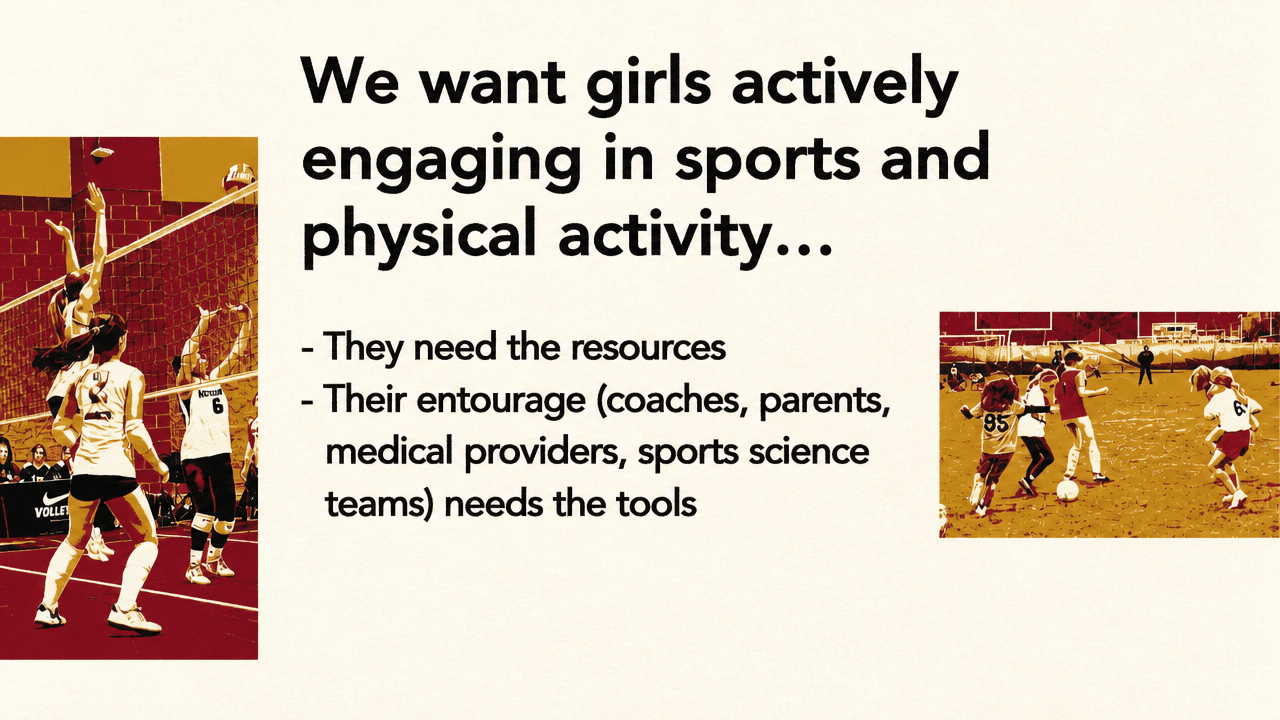
But access is not the same thing as support. Ackerman’s central claim is that if girls are going to be encouraged into sport, the surrounding system has to be designed to keep them healthy enough to stay there. Facilities, safe spaces, playing surfaces, protocols, athletic trainers, mental health support, nutrition education, recovery support, and developmentally appropriate coaching are not ancillary. They are part of whether girls can participate safely.
She is explicit about what the current failure can look like: girls becoming the afterthought. The athletic trainer is available only after the football team has finished. Practice times and surfaces vary. Injury-prevention protocols are not in place early. Coaches are asked to navigate menstrual dysfunction, menstrual cycles and performance, birth-control questions, puberty, fertility, pregnancy, postpartum return, menopause, nutrition, and mental health without necessarily having the training to do so.
Ackerman does not argue that every coach should become a medical expert. She argues that coaches need enough education to respond appropriately and connect athletes and families to credible resources. Girls are already hearing claims on TikTok and Instagram, she says. They need real answers.
The injury burden is visible, while the research pipeline is thin and slow
Ackerman’s most concrete example is ACL injury. Female athletes, she says, are probably two to eight times more likely than male athletes to suffer ACL injuries. She does not present ACL injury as the only concern. The list also includes knee pain, patellofemoral pain, hypermobility, concussions in comparable sports, bone stress injuries, low bone mineral density, body dysmorphia, low energy availability, disordered eating, eating disorders, and relative energy deficiency in sport.
The consequence, in her framing, is not that girls are fragile. It is that the system has to pay attention to the ways girls and women can be affected differently. “That sounds pretty bleak,” she says, but the reason to name these risks is to address them.
The research gap is part of the problem. A slide from Ackerman’s presentation states that less than 10% of sports and exercise science research has focused solely on girls and women. For Ackerman, that mismatch is stark: the field knows some injuries and health issues affect girls differently, yet the research base dedicated specifically to girls and women remains small.
The translation gap compounds it. Ackerman says it takes about 17 years for research to translate into real-world clinical practice. That means knowledge that exists in sports science may not reach athletes, parents, and coaches in time to affect daily decisions.
Her critique is therefore both scientific and operational. Research has under-centered girls and women, and the knowledge that does exist moves too slowly into the environments where injuries are prevented or compounded: practices, training rooms, clinics, homes, and return-to-play decisions.
An ACL tear can become a life-course injury
Ackerman uses a hypothetical female high school athlete to show how the current standard of care can fail even when each step looks familiar. At age 16, the athlete tears her ACL. She has an ACL reconstruction. She rehabs, returns tentatively to her sport, and at age 18 tears it again. The second injury pushes beyond anatomy: she is depressed, outside her friend group, misses a scholarship, develops disordered eating, and quits competitive sports. By age 35, after two reconstructions, she develops knee osteoarthritis.
Ackerman says she sees this pattern “all the time in clinic.” The example matters because it reframes an ACL tear from an isolated sports injury into a possible cascade: surgery, re-injury, mental health consequences, social disconnection, educational or scholarship loss, disordered eating, exit from sport, and later joint disease.
The alternative she proposes is not a single intervention. It is a different system around the athlete. Prevention would begin before injury through coach education, evidence-based training, technology, and female-specific equipment. Ackerman gives one pointed example: female-specific cleats have only begun appearing in recent years. In her framing, even basic equipment design is only now beginning to reflect female athletes’ needs.
If injury occurs, she argues for new surgical approaches aimed at reducing malalignment and later osteoarthritis risk, along with biomechanical assessment to support safe return to sport and prevent future injury. The care model would also include nutritional and hormonal education, and interdisciplinary support for psychological resilience.
The desired endpoint is not merely “return to play.” It is a lifelong athlete. As Ackerman puts it, “This is the future that I personally would like to see.”
The institute is designed to move research, education, and care into one system
Ackerman closes by describing the Women’s Health, Sports & Performance Institute as an attempt to accelerate that future. She says the institute, launched in Boston with more than $50 million in support, is part of the Wu Tsai Human Performance Alliance and involves Clara and Joe Tsai, along with Dave and Jane Ott. Its work combines research, education, care, and athletic training “under one roof” at Boston Landing, while also pursuing collaborative care globally.
The institute’s research agenda matches the gaps Ackerman identifies: effects across the lifespan, mental health, relative energy deficiency in sport, injury prevention and recovery, sex and menstrual cycle effects on sports performance strategies, intersections of race, gender, sexual orientation and class, pregnancy and postpartum, and the span from childhood through menopause.
Her stated vision is broad: girls and women of all ages should be able to participate, compete, perform, and lead in all aspects of human endeavor with optimal health and performance. But the practical theory is specific. The field needs to shorten the distance between research and the people making decisions for athletes every day. It needs collaborations outside what Ackerman calls “ivory towers.” And it needs to treat female athlete health not as a niche concern, but as a prerequisite for making the benefits of sport real.