Open-Ended Play Depends on Constraints, Not Unlimited Freedom
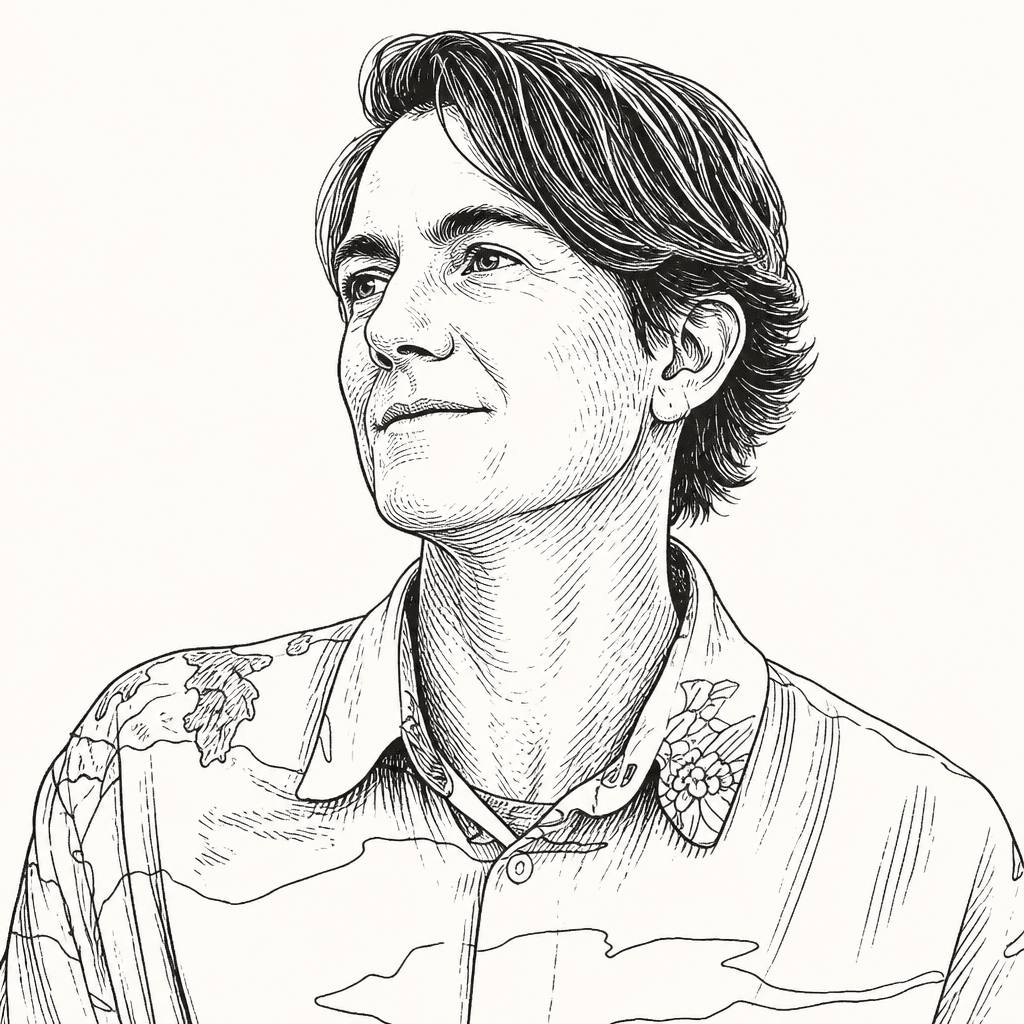
Toy designer Cas Holman argues that play is not a break from serious work but a designed condition for learning, collaboration, and problem-solving. In an Aspen Ideas: Health workshop built around her Rigamajig construction system, Holman makes the case for open-ended play: environments with enough constraint to prompt action and enough ambiguity to let children and adults discover what they are making, rather than execute a prescribed outcome.

Open-ended play is not the absence of design
Cas Holman describes her work as toy invention, playground design, and advocacy for “open-ended free play for humans of all ages.” The important distinction in her account is not between play and seriousness, or between children and adults. It is between activities that prescribe an outcome and activities that create conditions for people to discover one.
Holman’s examples make clear that open-ended play is designed, not merely permitted. In “Traces of Play,” an installation at the Queens Museum, she built abstract mark-making tools for children and families. The tools were intentionally difficult to control. That mattered: if the child could not reliably command the mark, the child was relieved of the pressure to make something beautiful. The emphasis shifted from product to process.
Holman tied that design choice to a developmental observation. Around age eight, she said, drawing often shifts from something children love doing to something they do for an outcome. She added, with a joke that also carried the point, that the same shift can happen “around the age of eight o’clock” for adults. Much of her design work asks how people can be present in process and “disconnect from the outcome.”
The installation also required bodies and collaboration. Children used large drawing pads that rolled and moved. Some tools required two people to work. The result was not just an art activity but a system in which making marks involved balance, movement, negotiation, and shared control.
That same logic appeared in “Wobbly World,” a toddler play space at Liberty Science Center designed around balance. Holman argued that balance is not simply stasis. It is a constant adjustment. Designed during the pandemic, the project became, in her framing, a way to help children become more comfortable with uncertainty. In open-ended play, there are no instructions, no failure, and no certainty. There is “only figure it out.”
Rigamajig, the building system used in the workshop, extends that idea into a more explicitly constructive form. Holman described it as a hands-on learning material used in schools and children’s museums for STEM and STEAM work. Teachers, she said, increasingly use it for impulse control, negotiation, and conflict resolution. The reason is straightforward: when conflict happens inside play, children are motivated to solve it because they want to return to playing.
She also emphasized its use in special education and inclusive classrooms. The New York Department of Education’s District 75 schools, the city’s special education schools, are using Rigamajig across all of their schools, she said. Because the system is open-ended, teachers can determine what they need it to do. Holman’s slide described the principle as “designing for others to design.”
That phrase captures a central claim running through her examples. Open-ended play is not a blank field. It is an environment built with enough ambiguity to let people make meaning, enough constraint to invite action, and enough material affordance to let different kinds of people contribute.
Adults often need play, but not necessarily adult playgrounds
When people asked Holman, “What about adults?,” her first answer was not that adults simply need more toys. She said she initially thought adults needed therapy. She did not believe that even a strong design team could necessarily make “a beautiful adult playground” that would work.
The problem is that adults are comfortable with many structured play-like activities—sports, puzzles, games—because those activities tell participants what to do and how to do it. The kind of play Holman is interested in is different. It is free play: generative rather than consumptive, not waiting to be entertained, not following a predetermined set of instructions, and not measured primarily by an outcome.
So there's this kind of generative play that I'm after, that's a little bit less consumptive, we're not consuming or waiting to be entertained.
Her book, Playful, grew out of that question. She described it as drawing on research in psychology, neuroscience, human development, childhood play, and adult creativity, along with what she learned in 13 years as an art professor. Her adult students had usually come through highly structured school systems and were often not comfortable “embracing possibility and stepping into the unknown.” In retrospect, she realized she had been helping adults play for years.
One idea from the book is the “play voice.” Holman suggested that people frequently suppress an internal prompt toward exploratory action. In the workshop room, the Rigamajig materials were already on the tables. She imagined that some participants had wanted to touch the rope, spin a nut and bolt, or inspect the pieces before she gave permission. That impulse was the play voice. The voice saying, “No, it’s not time yet; people are watching; I should be paying attention,” was the adult voice.
Holman said she began listening for the prompts she ignored and imagined “the diary of my dejected play voice.” A slide showed comic panels with captions including, “It was a grassy slope. What more could you want?” and “The dog you didn’t play with.” The device was humorous, but the point was plain: adult life can train people to override small invitations to curiosity, movement, and contact.
Holman also argued that adult play needs its own language. In early childhood work, there is a taxonomy of play types used by researchers and practitioners to observe and discuss children’s play. Children themselves do not care what type of play they are doing, but the shared language helps adults support it. Holman found that applying children’s categories directly to adults did not work. “Risky play” for a five-year-old might be jumping off a stage or wandering away from a beach blanket. For an adult, she suggested, risky play might be singing in line at the grocery store.
Her slide on “Adult Play Types: A Taxonomy” made the claim visually as well as verbally. The visible examples included meditative play, constructive play, directed play, problem-solving play, and attention play. Holman did not walk through the table item by item, but she used it to mark a gap: adult play cannot be discussed only by importing childhood categories. The adult version has to account for what adults experience as socially exposed, generative, quiet, concentrated, structured, or open-ended.
That was also why Holman resisted a narrow image of play as noisy, exuberant motion. She said people may assume play looks like “running and leaping and laughing out loud,” but play can also be concentrated and quiet. A person can look serious while doing it. Her word for the broader capacity was “playful”: a mindset or approach that can be brought to many activities, not only to games, toys, or recreation.
A playful mindset begins by naming a problem by function
Holman’s method for moving adults toward play begins with a design exercise she calls “name by function.” The exercise is meant to disrupt inherited assumptions about what problem is actually being solved.
She used the example of a to-go coffee mug. If a design student is asked to make a better coffee mug, the object has already constrained the problem. Holman asked whether the real need is another refined vessel, or whether the deeper questions are why someone is drinking coffee at 4 p.m., why they are still working, whether they need a nap, or whether the workday should be shorter.
The method is to walk the object back to its function. Instead of asking how to design a coffee mug, ask how to move liquids. The answer set becomes much larger: a hose, an inclined plane, a cloud, a mouth, an air blower, or, in her favorite example, the gravitational pull of the moon. The same move can be applied to cars. Instead of assuming the task is to design more cars, one can ask how to move people: horses, moving sidewalks, personal flotation devices, rivers, and other systems enter the frame.
In the workshop, Holman applied the exercise to time. The slide behind her showed a hand-drawn clock crossed out in red, with the prompt: “Think of/imagine ways to measure time.” The crossed-out clock was load-bearing: it told the room not to improve the familiar instrument, but to suspend it. The answers included hair growth, giggles, birds at 5 a.m., fingernail growth, songs, a hungry dog, changing light, shadows, journaling, flow, biological needs, and the bodily need to stand up.
Holman used those answers to question the clock as a system. Time, she said, is abstract to her, and she does not think she will ever understand “this system that we have designed for it.” She asked whether time is accumulated or spread out before us, whether time is lost, and what happens when time is monetized.
Her claim about monetized time was one of the workshop’s sharpest adult-facing arguments.
This idea that time is money, I think has a huge impact on our ability to play because we prioritize things that relate to money.
If something takes time and is not tied to a capitalist pursuit, it can seem not worth doing. Holman said she does quantify play’s value in her book, but she also insisted that value should not be the only defense. People do not eat only for nutrition; they also eat because food is delicious, social, joyful, and connective.
The exercise thus had two functions at once. It demonstrated a design technique for reframing a problem. It also exposed how adult life narrows what counts as worthwhile time. A crossed-out clock and a table full of ropes, planks, bolts, brackets, and pulleys became a way to ask what else time could be, besides a number on a face or a unit converted into money.
The twelve-minute constraint forced action before analysis
Holman asked participants to form groups of three and build a way to measure time using Rigamajig Jr. materials on the tables. They could trade, barter, and take materials from other tables. She gave them 12 minutes, with warnings near the end. “You can’t do it wrong,” she told them.
The time limit was not incidental. When a participant later said it would have been nice to return to the builds repeatedly with breaks in between, Holman explained that the constraint was deliberate.
The time is very specific. And this is part of what I have learned in helping not only my art students but also adults play is that constraints are extremely useful. And often essential.
Even an open-ended prompt is itself a constraint. The unusual duration mattered too: 12 minutes is less familiar than 15 or 30. Participants could not comfortably plan for it. If she had given them a half hour or an hour, Holman said, they likely would have talked longer and tried to design before building. With 12 minutes, they had to start playing. They learned the system through action: how pieces lined up, how brackets worked, how one part became an axle. She described this as a kind of trick. They did not get to assess the situation and then play; they had to play in order to figure out what they were doing.
The resulting devices showed the range of interpretation Holman was trying to invite without requiring a comprehensive inventory of every build. One group built “Thirst for Knowledge, the Aspen Anti-Drought Time Machine,” a lever system that would pour water into a bucket and, in practice, onto the floor. Its makers joked that spilled water would return to nature. Holman responded that eventually something would grow.
Another group made “Edgar Allan Poe,” a pendulum over a pit. Its presenter called it an asymptote: continually resolving but never resolved, and therefore “a measure of infinity.” A group named “Matilda” built a birdlike windmill-pendulum meant to use wind as an indicator of time and time of day. Another transformed the grandfather clock into a “grandson clock,” then the “grand fun clock,” using weights and the idea of an automaton.
Several groups gravitated toward marks, slopes, and gravity. “Mark” used a person pulling continuously while a pen attached to a hair clip made marks on paper; time was counted by the marks. “The Angulator” used slope angle and gravity, replacing seconds with “a duration of existence” based on how long something took to slide down at different angles. Holman noticed the social implication: among friends and family, people might come to know which angle others worked with and adapt their own angle accordingly.
Other devices measured time through social ritual or perception. “Harold” was a sundial whose “real message” was being in the moment: whatever time Harold told you was correct, and if you forgot, that was fine. “The Dinner Invitation” measured days by untying one knot each morning until dinner, hours by candles burning down during the meal, and seconds by the duration of dinner games. “The Garden of Time” used seasonal change, flowers, life, death, decay, and the time it took to recognize that the object resembled Snoopy.
The builds did not converge on a better clock. They produced mechanical approximations, jokes, rituals, metaphors, failures, and naming systems. The prompt made room for engineering, storytelling, physics, social convention, bodily humor, and aesthetic noticing inside the same activity.
Round tables and unfamiliar parts changed how people met
In the discussion afterward, one participant observed that in most lectures people sit facing forward, attending to the speaker and screen. In this workshop, people turned toward one another, laughed, talked, and integrated one another’s thoughts. That, the participant said, was part of the play.
Holman connected the observation to design. She thinks about “postures of learning.” Chairs lined up facing a teacher create a dynamic in which the teacher is expert and children learn. But, she argued, that is not actually how people learn. People are constructivist learners. Round tables allow children—and, in this case, adults—to learn from one another and do things collaboratively.
Another participant connected the play activity to networking. Building together provided a different way to get to know strangers and reduced the pressure of initiating conversation directly. Holman agreed that play can be non-hierarchical. But she stressed that materials matter.
Rigamajig looks like an engineering kit, but it is unfamiliar to most people. That unfamiliarity reduces one kind of hierarchy. Lego, by contrast, can create expertise differences: people who know Lego may take over; people near a “Lego person” may defer. Rigamajig’s relative unfamiliarity lets more people enter without already knowing who the expert is.
The parts themselves also support different modes of contribution. Some pieces serve mechanical purposes, but they also carry storytelling possibilities. A curved piece can be an S-hook, a snake, a tail, or a river. A larger form might be a wing, a mountain, or a cloud. Holman said this is intentional. It allows the engineer, the storyteller, the person focused on beauty, the person focused on stability, and the project manager watching the time to all become useful.
She made the same point about inclusive classrooms. Teachers in special education settings, she said, have told her that non-verbal children can be hard for peers to know. When Rigamajig comes out, those children may “shine,” and other students suddenly get to see who that person is. Holman framed that as something play can do: it can let people show parts of themselves that ordinary settings may not make visible.
Steve Burns offered a related observation from his own behavior. Before the session formally began, he said, he was “free playing” with the materials in a way that was about form, not purpose. Once Holman gave the prompt to measure time, his play style changed. He began thinking about consistent increments and repeatability. The prompt made him feel like a different person.
And then you were like, measure time. And I totally changed. I like found a whole different playstyle.
Holman did not treat that as a failure of play. She saw it as a useful observation about how constraints and instructions alter what kind of play becomes available. The same materials supported exploratory form-making and problem-oriented measurement. The person did not stop playing; the prompt changed the mode.
Permission and invitation are different design tools
A participant asked about “permission signals”: the materials on the tables, Holman’s tool belt, and the other subtle markers that made the workshop feel different from a lecture. If constraints shape play, the participant asked, is there an inverse category of signals that tell adults they are allowed to behave differently?
Cas Holman distinguished permission from invitation. Permission may come from the framing, the room, the introduction, and the fact that the facilitator says play is allowed. But an invitation is built into the material situation. If Rigamajig pieces were simply laid out, that might be permission. If Holman connected two pieces and left others nearby, that partial assembly would invite people to add to it. It would be the play equivalent of a squiggle on a blank page.
She used drawing to explain the difference. If she handed out blank paper and said “draw something,” many adults would freeze. If she put a squiggle on the page first, the squiggle would become an invitation. It could be continued into a snake, a river, an X, or something else. The initial mark reduces the terror of pure openness without dictating the result.
Holman connected this to an earlier project, Imagination Playground, which she said she worked on with an architect in New York City. The project used large blue foam blocks based on standard kindergarten and preschool building blocks. Those blocks are abstract, and children familiar with block play understand that one object can represent many things: a car, a mask, a whale, or whatever the play requires. But not all children had grown up with blocks. During play-testing, some children did not know how to engage with the giant abstract forms.
Holman’s response was to add more invitational elements: chutes, channels, and curved forms that suggested water or movement. Children who had not engaged with the fully abstract blocks gravitated to those pieces. The added identity was enough to get them started.
This introduced a design tension. The more identity a toy has, the more it can invite use; but identity can also constrain imagination. If a form is green, Holman said, it becomes less likely to be a cloud and more likely to be a hill. Shape, color, and implied function all operate as constraints. Good play design calibrates those constraints rather than eliminating them.
For adults, the same calibration is often necessary. Holman said she would ideally say only “let’s play” and have everyone begin, but adults are often intimidated by open-ended beginnings. As a facilitator, she described herself as a kind of “play whisperer,” trying to locate how much structure a group needs.
She situated boredom in the same territory. Boredom, in her view, can be the transition between one activity and the next—the moment when a person is done with something and does not yet know what they need. If that moment is filled immediately by a phone or a structured activity, the person may lose the chance to ask, “What do I need, and how will I get that for myself?”