A $40 Billion Youth Sports Market Lacks Basic Child Safeguards


Tom Farrey of the Aspen Institute’s Sports & Society Program argues that youth sports need a basic governance layer if they are to deliver on their civic and developmental promise. In a conversation moderated by Chuck Todd, Farrey makes the case for registration, safety standards, abuse reporting, school-based support and a children’s rights framework, while Todd frames youth sports as one of the few remaining local institutions that still brings divided communities together. Their shared premise is that more participation is not enough if the system remains privatized, fragmented and weakly accountable.
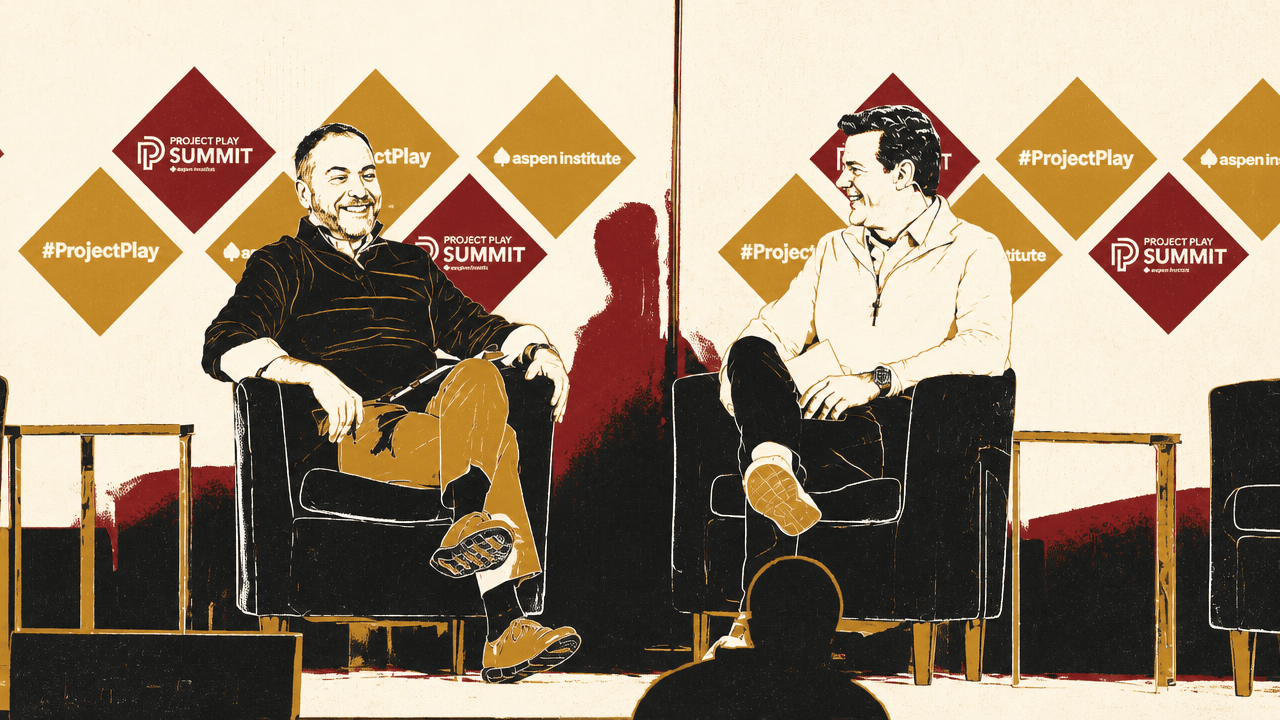
Youth sports are being asked to do more than produce athletes
Chuck Todd framed youth sports as one of the few remaining civic spaces where Americans who otherwise live in separate political and social worlds still show up together. Sports, he said, are “a common language,” especially in the United States, and youth fields and gyms are among the rare places where “red America and blue America” still meet in ordinary life.


Todd connected that observation to two larger problems: the collapse of local community institutions, including local news, and the country’s polarization. In his view, youth sports matter because they already organize families around a shared local interest. Parents care about their children. Communities care about their teams. Advertisers, in his argument, are comfortable around children’s activities, and the parents of children are often in the demographic local advertisers want to reach.
That led Todd to a provocative claim: youth sports could help rebuild local news.
He was not arguing for sports coverage as a nostalgia play. He described youth sports as a service layer for communities. A local news platform, he said, could become “the home for youth sports” by organizing schedules, streaming games for working parents who cannot get there, and making it possible for grandparents and extended family to watch. He spoke from the experience of trying to follow his own children’s games while stuck at work, when streaming was just beginning to emerge.
Tom Farrey accepted the civic promise but pressed on the risk. If local news and other commercial actors begin paying closer attention to youth sports, he asked, how do they avoid turning six-year-olds into content for adults’ benefit? His concern was not that youth sports should be invisible, but that the experience should remain the child’s, not become another extractive market.


Todd’s answer was that the distinction lies in whether the platform is serving families and communities rather than manufacturing content out of children. The useful version, in his view, gives working parents and extended family access to a child’s game and helps the community organize around something it already values.
The larger civic theory was broader than media. Todd argued that sports have often broken social barriers before other parts of society were ready. He also described sports as a temporary equalizer across class: for an hour, children from different family circumstances can play on the same team. That does not eliminate inequality, but it creates a shared setting in which children and parents encounter one another.
Farrey captured the underlying progression: learning to solve small problems together, such as how to score a goal, can be preparation for solving larger problems later in life.
The privatization of play is narrowing the promise
The same system Todd praised as a community builder is also, in his words, being privatized. He called out the “AAU-ification” of youth sports: private coaching, travel teams, and a widening divide between children who make selective teams and children who do not.
Todd described the effect through his own family. One child made a travel team; one did not. When friends moved into the travel track, the child left behind lost interest in playing recreationally because the social world of the sport had moved elsewhere. The issue, as Todd presented it, was not simply whether elite teams exist. It was that the movement of children and families into travel teams can weaken the recreational setting for those who remain.
That is the tension at the center of the model. Youth sports can be an equalizer, but the current marketplace often sorts children by family capacity to pay, travel, train privately, and navigate a competitive youth ecosystem. Todd said he understands why parents feel pressure to chase opportunity. He suggested participation may keep rising because the path to college support through sports feels more plausible than it once did.
His example was deliberately surprising: a friend’s child receiving NIL money for beach volleyball at the University of Central Arkansas. Farrey interrupted to underline the oddity of the combination — NIL money, beach volleyball, Central Arkansas — and Todd used it to show how broad the perceived opportunity landscape has become.
The example mattered because it showed how financial incentives, at least in Todd’s account, are reaching beyond the most obvious revenue sports and famous programs. Even if most children will not receive college money through sports, the belief that more pathways exist can intensify the pressure to specialize and pay for access.
Farrey did not dispute the market’s size. He put a number on it: according to Aspen Institute research he cited, parents spend north of $40 billion a year on youth sports in the United States. He said that is twice the amount of money flowing through the NFL or any other professional league.
That scale is central to Farrey’s argument for governance. The United States, he said, has the largest sports marketplace in the world by far, but unlike other countries, it lacks a ministry of sport, department of sport, or comparable coordinating entity. Todd added that the United States is unusual globally in how little government is involved in youth sports.
Farrey was careful not to turn that into a blanket endorsement of more government. He said Aspen’s team, including Ashley Huffman, has studied leading sports systems around the world and how governance works in different countries. His proposal was not a heavy-handed federal takeover. It was a baseline of organization, visibility, and safety.
Farrey’s minimum governance demand is registration, not control
Farrey’s clearest policy position was that every youth sports organization serving children in the United States should be required to register somewhere. He said he made that argument in testimony before Congress in December.
The rationale was basic: if an organization is serving kids, the system should know it exists. Farrey suggested registration could sit with the U.S. Center for SafeSport, the U.S. Olympic Committee, or some quasi-governmental body. The purpose would be to create a base layer of information and accountability: who is operating, whether coaches have background checks, and whether they have completed abuse-prevention training.
Todd compared that expectation to other child-serving sectors. Teachers and daycares have to go through vetting. Farrey’s point was that many youth sports coaches do not pass through any comparable system.
Farrey also argued that registration has to offer youth sports providers a benefit, not only impose a burden. He proposed using a portion of federal sports betting excise tax revenue — he cited $400 million flowing into the Treasury — to cover the cost of criminal background checks, abuse training, and related safeguards. If registration lowers costs, improves safety, and connects local providers to best practices, he suggested, it becomes more viable and less punitive.
The coordination argument extended beyond abuse prevention. Farrey used volleyball as an example: if local volleyball providers are registered, USA Volleyball can communicate with them about best practices and athlete development. In that version, governance creates channels for information and standards without dictating every local decision.
Todd tested the practical stakes with a simple scenario: a parent believes a coach is abusing children. What are they supposed to do now?
Farrey said they should have somewhere to report it. In his view, the U.S. Center for SafeSport should have the resources to investigate or direct the matter to the proper body. The coach should receive due process. But if wrongdoing is found, Farrey said, that coach should end up in a database and should not be able to move to another club outside the Olympic movement and continue coaching children.
That is the failure mode Farrey’s registration proposal is designed to prevent: a fragmented marketplace where a coach excluded from one affiliated setting can simply reappear elsewhere because no common system knows enough to stop it.
School sports belong in child development, not the extracurricular margin
Todd raised a second institutional pressure: school funding. As resources shrink, districts cut extracurricular activities, including sports. Todd said studies show that taking away sports opportunities can stunt development and growth. He asked how to reverse that trend.
Farrey’s answer was to move sports out of the “extra-curricular” category. He pointed to “stacks and stacks of literature” showing that children whose bodies are in motion — and especially children solving problems in a social environment — do better in life. He said they do better in school, experience lower mental-health rates, get pregnant less often, and take drugs less often.
His conclusion was that schools claiming to support whole-child development should treat sports as co-curricular.
Todd agreed immediately and went further. He said sports participation “almost should be mandatory,” citing his own children’s school, where each student was required to participate in one sport each semester. He said he loved the policy. In his view, few experiences develop teamwork more than playing sports: interacting with others, learning to lose, and understanding how to function in a group.
The “learning how to lose” point carried civic weight. Todd joked away the political implication by saying he was talking about Boston Celtics fans, but the underlying claim was clear: youth sports are not only about movement or competition. They are settings where children practice limits, disappointment, cooperation, and social adjustment.
Farrey’s policy framing and Todd’s civic framing met here. If sports contribute to health, academic development, mental health, and social behavior, treating them as optional add-ons makes them vulnerable in budget fights precisely when children may need them most.
The youth sports recovery is real, but Farrey treats 63 percent as the floor
Farrey closed with data that he presented as good news for the room: organized youth sports participation has recovered from its pandemic decline and, by the measure he showed, is now roughly back to its 2017 level.
The chart he displayed used the National Survey of Children’s Health and measured the percentage of young people ages 6 to 17 who played on a sports team or took lessons after school or on weekends. The series began at 58.4% in 2017, fell to 57.1% in 2018 and 55.1% in 2019, then continued down through the pandemic to 48.5% in 2021. It then rose each year shown, reaching 58.0% in 2024.
| Year | Youth sports participation |
|---|---|
| 2017 | 58.4% |
| 2018 | 57.1% |
| 2019 | 55.1% |
| 2020 | 53.0% |
| 2021 | 48.5% |
| 2022 | 53.8% |
| 2023 | 55.4% |
| 2024 | 58.0% |
Farrey described the pandemic low as “not good,” especially given the earlier discussion about sports as a setting for cohesion and development. But he attributed the rebound to two forces: parents coming out of the pandemic with a stronger appreciation that they did not want children stuck on the couch, and innovation during COVID in how programs reached kids.
He emphasized the contrast with other child indicators. Academic achievement and mental health, he said, have declined, and children are struggling. Youth sports participation, by this measure, is moving upward.
The chart’s source line identified the National Survey of Children’s Health, Maternal and Child Health Bureau, Health Resources and Services Administration, U.S. Department of Health and Human Services. The visual also included a caveat about a change in state and ethnicity sampling methods beginning in 2022; its wording was internally awkward, but the warning was that later data are not directly comparable with earlier data. Farrey nevertheless treated the direction as meaningful and encouraging.
His challenge to the Project Play audience was to reach 63% participation by 2030. He described that not as an outer limit but as a minimum, saying Aspen’s research shows the share of children who want to play sports, if offered in the right way, is significantly higher than 63%.
If more children want to play than currently do, Farrey’s target implies that the participation gap is not only about demand. It is also about whether sports are offered in ways children and families can actually use.
The proposed building code is a rights framework for children
Farrey named the ethical pressure directly: this is a rapidly commercializing space, with children potentially turned into content and their data becoming valuable. He said ethical and moral considerations have to be applied to the evolving youth sports market.
That is why, he said, Project Play has pushed a Bill of Rights. He called it “a minimum building code for youth sports.” The specific contents of that Bill of Rights were not detailed here, but Farrey’s framing made clear that he sees it as a baseline for judging programs and products.
“It is a minimum building code for youth sports,” Farrey said.
Farrey’s hope was that the Bill of Rights could become a common language across programs and products. If providers filter decisions through those ideas, he argued, the field can begin to create more consistency in children’s sports environments.
That consistency is the through line connecting the discussion’s major claims. Todd sees youth sports as a civic commons that can rebuild community, reduce polarization, and perhaps support local news. Farrey accepts the promise but insists that the underlying system needs guardrails: registration, safety checks, abuse reporting, coordination, and a rights-based language that protects children from becoming instruments of adult ambition or commercial opportunity.
The optimism was real, but it was conditional. Youth sports participation is recovering. The market is large. New actors are entering. Families remain deeply invested. But Farrey and Todd both described a system whose benefits are not automatic. Without attention to access, privatization, safety, school support, and children’s rights, the same forces driving growth can narrow the very civic and developmental promise that makes youth sports worth defending.