Safadi Says Regional Security Requires Palestinian Statehood and Sovereign Borders

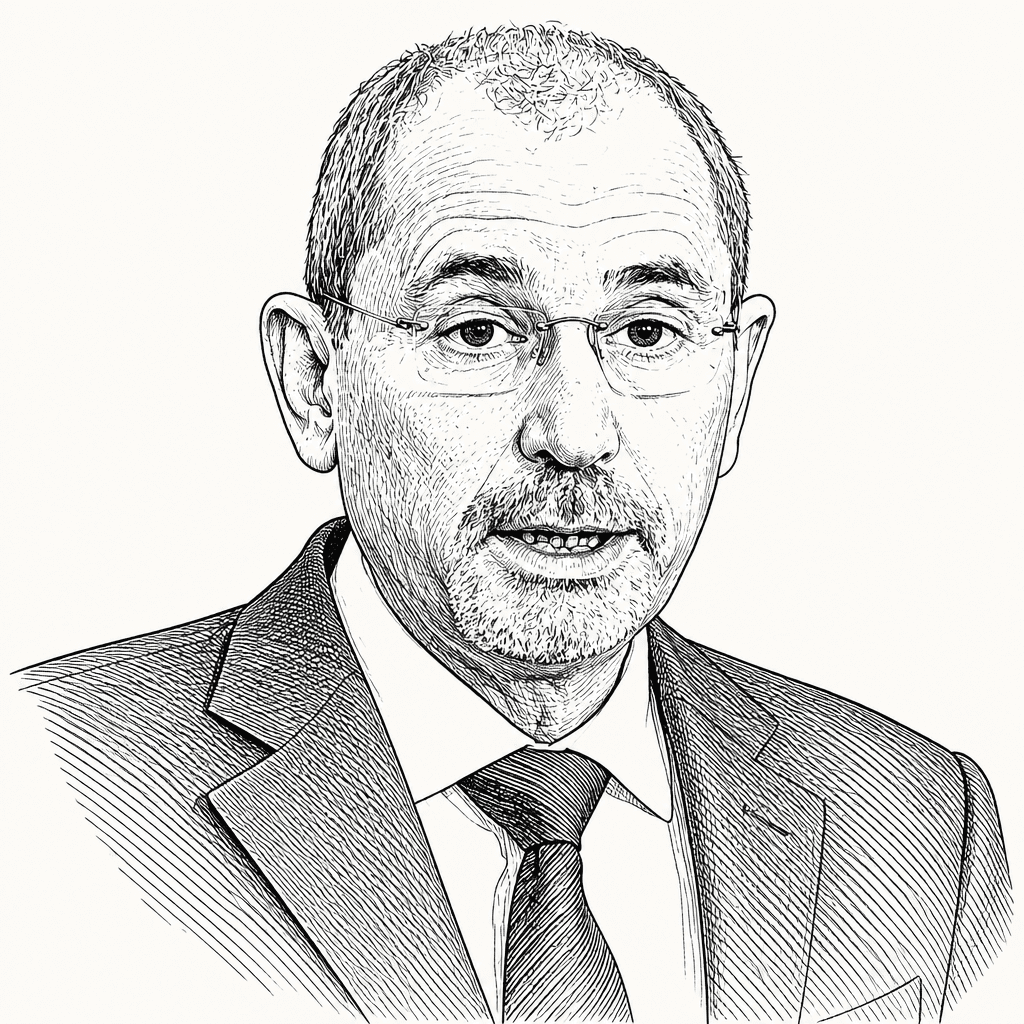
Jordanian Deputy Prime Minister and Foreign Minister Ayman Safadi argues that the region’s wars cannot be contained through ceasefires or military arrangements alone: durable security requires respect for state sovereignty, lawful access to shipping and humanitarian aid, and a political path to Palestinian statehood. In a conversation moderated by NBC’s Andrea Mitchell, Safadi says Jordan supports diplomacy with Iran, a gradual restoration of Lebanon’s state control over weapons, and Gaza aid access independent of stalled governance plans, while warning that Israeli settlement expansion is closing off the two-state solution.

Safadi treats sovereignty, lawful access and Palestinian statehood as tests of regional order
Ayman Safadi framed Jordan’s position around a linked set of demands: states must control their own territory, shipping and humanitarian aid must move under international law, and regional security cannot be separated from a political settlement for Palestinians. A ceasefire matters, in his view, but only if it begins a wider arrangement rather than freezes the conditions that produced the conflict.
Safadi rejected Iran’s characterization of U.S. personnel in Jordan as occupants of American “bases.” Jordan hosts American troops under a long-standing defense agreement, he said, rooted in military cooperation that includes the fight against ISIS and governed in a way that “fully respects our sovereignty.” That distinction matters to Amman because Safadi sees no basis for attacks on Jordanian territory: Jordan is not a party to the conflict, he said, yet Iran began striking Jordan and Gulf countries within two hours of the start of hostilities.
Jordan’s immediate objective is to stop the war and restore a political process. Safadi referred to an MOU that, in his account, provided for a ceasefire and 60 days of negotiations on two immediate matters: nuclear weapons and the Strait of Hormuz. The ceasefire and the memorandum should be respected, he said, and negotiations should begin “in earnest.”
All issues that are sources of threat must be put on the table, must be negotiated towards an outcome that will be in the interest of regional and global security and stability.
The two immediate files cannot, by themselves, produce durable stability, Safadi argued. He said a broader settlement must address Iran’s intervention in other states’ affairs, armed proxies operating outside state control, and commitments to sovereignty and nonaggression. Jordan and other regional states want good relations with Iran, he said, but regard noninterference and respect for state sovereignty as prerequisites.
Safadi did not engage the merits of particular reported U.S. military options, including possible attacks on Iranian territory. His position was that the region had entered a war it had sought to avoid, and now had to find a way out that produced sustainable security rather than merely a pause in fighting.
The Strait of Hormuz is central to that argument. Safadi said its closure was already harming the global economy and had no legal justification. Iran should not be allowed to disrupt shipping, impose tolls, or treat its geography as a basis for controlling international commerce, he said. The objective should be a return to the prior condition: free shipping passage under international law.
Jordan and other regional states, Safadi said, have been responding to continued attacks while pressing for diplomacy. They have the right to defend their people, territory, and sovereignty, he said, and will do what is necessary to do so. Yet he presented that defensive posture as compatible with patience and a continued search for a diplomatic exit.
Asked whether the conflict had weakened Arab faith in the United States as a security guarantor, Safadi declined that premise. The United States remains a “great partner” whose historical relationships with regional allies are strong enough, he said, to withstand recurring challenges and permit candid discussions of mutual interests.
Lebanon cannot regain a state monopoly on arms through war
Safadi’s position on Lebanon begins with a trade-off: the Lebanese state must ultimately control weapons, but a military effort to disarm Hezbollah could destroy the state it is meant to strengthen. He said no party other than the Lebanese government should have access to or control of weapons, and that the Lebanese army should become the country’s sole owner and controller of weaponry. Yet he said he did not believe a military option should be on the table because it would lead to Lebanon’s destruction and risk another civil war.
Andrea Mitchell pressed Safadi on conflicting interpretations of Israeli withdrawal obligations and the condition that Hezbollah disarm. His answer was that Lebanon requires several things at once: Israeli withdrawal from occupied Lebanese territory in line with UN Security Council Resolution 1701 and other relevant resolutions; restored Lebanese sovereignty; support for the government and armed forces; and an eventual state monopoly on weapons.


Safadi argued that those goals cannot be achieved by force alone. The alternative to a forced disarmament campaign is a comprehensive strategy—political, economic, social, and military—designed to expand the state’s control gradually while addressing the fallout of recent fighting. It must be realistic about what can and cannot be done, he said, consider the cost of competing options, and build the conditions in which the state can exert full authority.
There is no short-term answer to that. There are no quick answers to that. But I think if the end game is clear, we have to look at how do we get there.
That strategy also depends on dealing with Lebanon’s humanitarian and institutional crisis. Safadi said more than 1 million displaced people need support now and eventually must be able to return to villages, many of which have been destroyed. Lebanon’s armed forces need equipment and empowerment to take on the role expected of them. Rebuilding state institutions, he argued, is part of the security strategy: it is how the government can recover control over the country.
Safadi’s broader objection was to “power politics” as a model for the region. Force can impose a temporary reality, he said, but it does not create long-term stability. In Lebanon, he envisaged a formula in which Israel withdraws, the Lebanese army controls the border, and neither side poses a threat to the other. The question is not whether the Lebanese government should regain full control, he said, but how to reach that end without collapsing the country in the process.
Gaza’s governance plan is stalled; Jordan says humanitarian access is being denied
Safadi described Gaza as “a very ugly, inhumane reality” and separated two failures that, he argued, should not be treated as one. The first is a stalled political and security architecture. The second is the immediate denial of humanitarian access, which he said cannot wait for the more difficult questions of governance and force deployment to be resolved.
He said Arab states had supported President Trump’s 20-point Gaza plan nearly a year earlier because it was, in his view, the only proposal capable of stopping the massacre. Jordan still supports implementing the plan in full. Yet its essential mechanisms have not been put into operation, Safadi said: the Palestinian police force has not assumed control; an international stabilization force has neither been formed nor deployed; and the Palestinian National Committee has not arrived in Gaza.
That institutional paralysis does not, Safadi said, excuse withholding food and medical assistance. Whatever the eventual governing or security arrangement, aid should not be contingent on resolving it. Jordan has aid, trucks, and the capacity to resume its prior humanitarian role, he said, but Israel is not permitting it to do so. International relief intended for Gaza has been sitting in Jordanian storage and expiring.
The fact is we have aid. The fact is we have trucks to carry it. The fact is Jordan has been and will continue to be ready to provide that aid. We're not sending that aid because Israel is not allowing us to do so.
The limited aid currently leaving Jordan, Safadi said, amounts to roughly 20 to 30 World Food Programme trucks a week. It moves through what he called a difficult “back-to-back” process: a truck reaches the border, unloads into another truck, and encounters bureaucratic hurdles. Jordan could restore the larger volumes it sent previously, he said, if Israeli policy allowed it.
Safadi described a prior incident as the act of an individual with no organizational links, said Jordan had investigated it thoroughly, and said Jordan, with U.S. participation, reassessed border procedures afterward. The incident was unfortunate, he said, but cannot justify blocking aid.
Jordan’s medical assistance faces similar constraints, Safadi said. His Majesty had committed to treat no fewer than 200,000 children, and Jordan has treated many. But teams prepared to receive patients have sometimes been stopped at the last minute by COGAT, he said. Another difficulty is the uncertain return of patients to Gaza after treatment: mothers and children may travel to Jordan while relatives remain in Gaza, only to find they cannot return.
Safadi presented humanitarian access as a question that should be resolved now. Whatever disagreements remain about security arrangements, governance, or force deployment, he said, there is no argument for preventing people from receiving food and medical care.
Settlement expansion, Safadi argues, forecloses the political settlement Israel needs
Safadi’s most expansive warning concerned the West Bank. He argued that Israeli measures there are not only worsening present conditions but also undermining the possibility of a just and lasting settlement in which Palestinians live in dignity in their own state and Israel lives securely, accepted and normalized in the region.
He cited what he described as a rapid acceleration of settlements, land annexation, legislative changes making annexation easier, and encroachments on Muslim and Christian holy sites. Jordan follows the latter closely, he noted, because His Majesty is the historical custodian of those sites. Safadi said the scale of settlement activity authorized, built, or allowed in the past two years exceeded what had been done over 30 years.
For Safadi, the consequence is practical as well as political. The two-state solution remains the only route he identified for Palestinian freedom and statehood and for Israel to live securely and at peace with the region. If the Israeli government rejects it, he said, it must offer an alternative that accounts for the roughly 5 million Palestinians living in Gaza and the West Bank. He said he hears no such plan—only measures that make a negotiated peace more difficult.
We want peace, we have a plan to achieve that peace—what is the Israeli plan from this current government?
That challenge also governed his answer on the Abraham Accords. Regional normalization cannot substitute for Palestinian freedom and statehood, he argued; it depends on a political future in which Israel is secure, accepted, and at peace with the region. Safadi said the current Israeli government’s military successes must be weighed against what he described as reputational damage, declining standing, and the erosion of 30 years of effort to persuade both societies that peace is possible.
A West Bank explosion, he warned, would undo efforts to calm Gaza. He urged leaders not to deepen the trauma of October 7 or the trauma that followed in Gaza through hatred and dehumanization. Leadership, he said, means making the future less vulnerable to a repetition of those traumas.
Safadi also rejected Israeli claims of a threat emanating from Jordan. He said an assessment of the Jordan-Israel border would show that Jordan is protecting it, that most smuggling operations originate from Israel into Jordan rather than the reverse, and that Jordan has carried out much of the successful work to stop them. He interpreted the portrayal of Jordan as a threat as part of a strategy of perpetual conflict: keeping people fearful rather than building the conditions for peace.