Colorado River Negotiations Turn on Who Bears the Shortfall
 Thomas Buschatzke
 Anne Castle
 Bidtah Becker
 Jeff Lukas
 Jeff KightlingerThe Aspen InstituteWednesday, July 29, 202612 min read
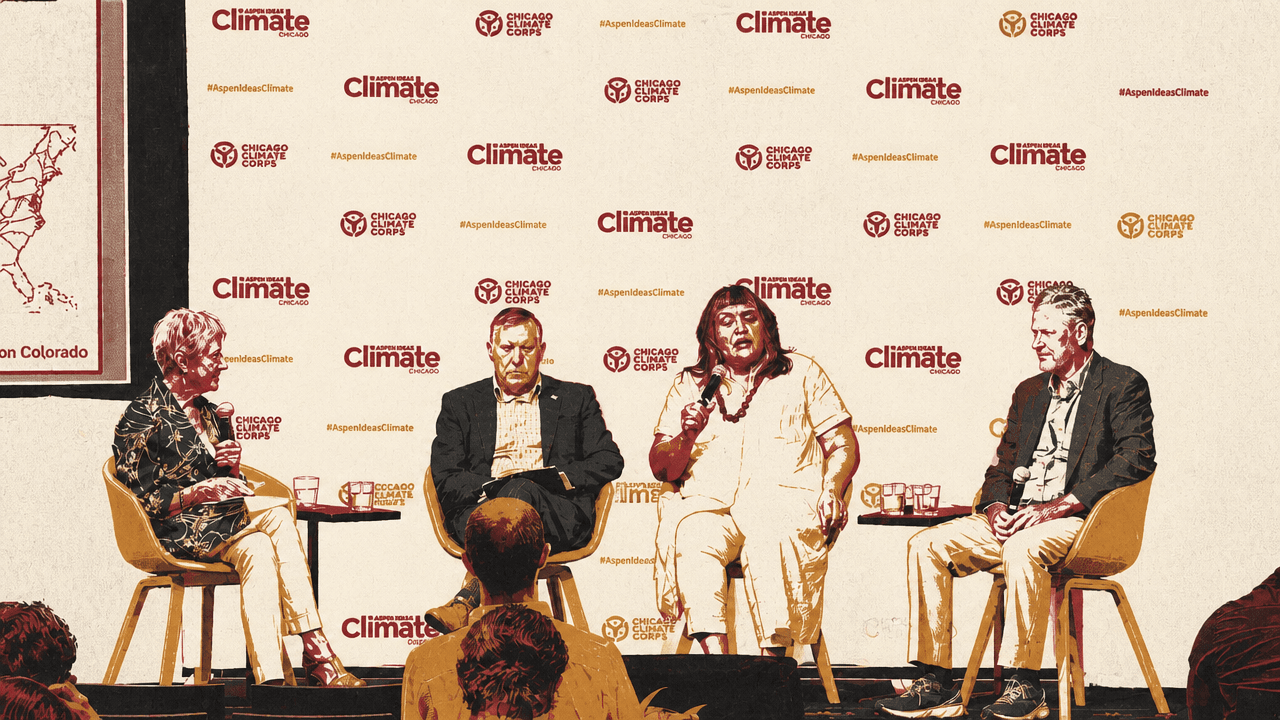
Colorado River demand has exceeded natural supply for roughly 26 years, drawing down Lakes Mead and Powell as warming reduces runoff even in years of average precipitation, according to Anne Castle and Arizona water director Tom Buschatzke. With current operating rules expiring and no seven-state agreement in place, the basin must decide how to bring use closer to supply—and the article argues that decision cannot be treated as an acre-foot accounting exercise alone. It also bears on tribal access to water rights that have not been developed and on how communities can withstand the economic transition where agricultural use is permanently retired.
The river’s savings account is being spent down
The Colorado River’s central problem is no longer difficult to state: the basin has used more water than nature has supplied for most of this century, and the difference has been drawn from storage in Lakes Mead and Powell. Those reservoirs—the two largest in the United States—have functioned as a savings account, allowing demand to exceed annual inflow. But the account is being depleted.
Anne Castle described natural supply as declining over time, particularly in the 21st century. Use rose through much of the 20th century as agriculture, cities, and other development expanded; it has declined in recent decades, but not enough to meet reduced supply. For roughly 26 years, demand has exceeded supply.


| Source visual | What it establishes |
|---|---|
| Supply and use history | Natural supply trends downward, especially in the 21st century, while use remains above supply despite recent reductions. |
| Combined storage in Lakes Mead and Powell | Storage fell sharply early in the century, remained uneven for a period, and has declined again since 2020. |
| Storage history with agreements marked | Successive operating agreements and conservation efforts have reduced pressure but have not restored a balance between supply and demand. |
Combined storage in Lakes Mead and Powell fell sharply early in the century, leveled off unevenly for a period, and has declined again since 2020. Castle said that extending the storage record into the current and following year would put it below any previous low point.
The basin is not a closed watershed whose consequences stop at its boundaries. Colorado River water is diverted to communities and agricultural areas outside the geographic basin, while the river’s seven states are divided between the Upper Basin—Colorado, New Mexico, Utah, and Wyoming—and the Lower Basin—Arizona, California, and Nevada. Mexico is also part of the system.
For Thomas Buschatzke, Arizona’s dependence makes the river a national economic issue as well as a state one. About four million people in Arizona rely on Colorado River water, he said. Phoenix alone gets roughly half of its supply from it. Buschatzke said that 85% to 90% of the lettuce, spinach, and broccoli eaten from November through April comes from Arizona. Defense manufacturing and expanding semiconductor production also depend on the river, he said.
But the resource is not simply diminishing because precipitation has disappeared. Buschatzke stressed that managers can see approximately normal precipitation and still receive far less runoff. Over roughly the last decade, he said, periods with “100% kind of normal average precipitation” have yielded only about 60% runoff, as drier soils and earlier-growing vegetation take up water before it reaches streams and reservoirs.
This is not a cyclical drought where we’re going to get out of this because of Mother Nature.
The question therefore is not whether use must fall. Castle rejected pipelines from other watersheds and “magic technologies” as solutions to the basin’s imbalance. Cities, farms, tribes, industry, recreation, and ecosystems all have stakes in the river, and many have legally recognized rights. The governing conflict is who uses less water, and by how much.
Repeated conservation has kept the system from failing, not restored its balance
The Colorado River states have not simply watched storage decline. Since 2001, operating rules, conservation programs, directives, and negotiated arrangements have repeatedly sought to reduce demand: Interim Surplus Guidelines in 2001, Interim Guidelines in 2007, and the Drought Contingency Plan in 2019 among them. Each helped, Castle said. None eliminated the gap between supply and use.
The increasingly dense sequence of interventions tracks a more urgent reality: reservoir storage has continued to fall despite the agreements.
| Year | Agreement or operating effort |
|---|---|
| 2001 | Interim Surplus Guidelines |
| 2007 | Interim Guidelines |
| 2019 | Drought Contingency Plan |
| 2026 | Guidelines scheduled to expire or be replaced |
Buschatzke pointed to the Lower Basin’s recent reductions as evidence that conservation has been consequential even if it has not been sufficient. Arizona, California, and Nevada collectively reduced demand by 5.5 million acre-feet from 2014 to 2025, he said. Along with contributions from Mexico, those actions helped maintain Lake Mead’s elevation.
Without that conservation, Buschatzke said, Lake Mead would be approaching “dead pool”—an elevation at which water remaining in the reservoir could no longer be moved downstream. He said Arizona provided 65% of the conservation he described, with the Gila River Indian Community accounting for half of Arizona’s share.
That history informs Arizona’s position in the current negotiations. Under the priority system governing use, Buschatzke said, about half of Arizona’s Colorado River use could disappear while California’s continued. The prospect has shaped the state’s water planning for decades.
Municipal users have also cut consumption. Jeff Lukas said per-capita municipal use has fallen significantly across the West over the last 30 to 40 years. In Colorado, Arizona, New Mexico, and Utah, cities typically use 20% to 30% less water per person than they once did, he said. Growth has absorbed much of the benefit, however, and municipal conservation cannot by itself resolve the basin-wide shortfall.
Lukas used Colorado’s Front Range to show how widely the river’s problem extends. Communities from Cheyenne to Pueblo typically get 20% to 50% of their municipal supply from Colorado River water, he said. A resident may experience local drought restrictions without connecting the water from the tap to the headwaters of the Colorado River and to users downstream.
The river also has needs that do not fit neatly into a state-by-state allocation. Buschatzke described Glen Canyon Dam as a “plug”: if Lake Powell falls below certain elevations, either no water can move through the dam or only a sharply reduced volume can pass. He warned that such an outcome would be devastating for the Grand Canyon.
The unresolved question is where the cuts fall
The operating arrangements built up over the past quarter-century expire this year. The basin has spent several years trying to replace them with a durable post-2026 regime, but it has not reached a long-term seven-state agreement. Castle said a two-year arrangement might emerge shortly; no long-term deal had been reached.
The central dispute is not whether use must decline. It is how reductions should be distributed between the Upper and Lower Basins, what legal authorities govern that distribution, and whether an arrangement can be accepted by the states required to live under it.
Buschatzke said negotiations had run for three and a half years without producing a seven-state agreement, and that the federal government would act whether or not all seven states agreed. Arizona’s position is that a durable arrangement for the whole system must include reductions in the Upper Basin, where water reaches Lake Powell. The Upper and Lower Basins disagree about that premise.
The three Lower Basin states submitted a proposal on May 1 to reduce their water use by 2.5 million acre-feet over two years and add 700,000 acre-feet of conservation in Lake Mead to support its elevation. They also sought to move water from reservoirs above Lake Powell into Lake Powell. Buschatzke estimated those Upper Basin reservoirs hold perhaps four million acre-feet.
Buschatzke presented the Lower Basin proposal as an effort to make protection of Lake Powell—and the risk of severely reduced releases through Glen Canyon Dam—a system-wide responsibility rather than one carried only by Arizona, California, and Nevada. But the water held above Lake Powell is contested. He said Arizona has a 50,000-acre-foot Upper Basin allocation and characterized the water at issue as Arizona and tribal water, not water belonging to Colorado, New Mexico, Utah, or Wyoming.
Castle cautioned that there could be a difference of opinion about that characterization because the century-old compact divided the river between the Upper and Lower Basins. Becker, for her part, stated the Navajo position directly: “We think it’s our water. We think it’s Navajo water.” The disagreement is not only about moving stored water; it includes competing accounts of which basin or sovereign has a claim to it.
Buschatzke said the federal government had indicated it might require the Lower Basin to reduce use by three million acre-feet annually in years three through 10, with no reductions in the Upper Basin. In Arizona’s view, that would place a system-wide burden principally on the Lower Basin. Under what he called a strict reading of the law, Buschatzke said, the Central Arizona Project could go dry. Since the project delivers about half of Arizona’s Colorado River water, Phoenix could lose half of its supply.
Arizona does not want litigation, he said, but would reserve its right to litigate if necessary. He said no one wants the U.S. Supreme Court—“nine black robes”—to run the river. Even a three-million-acre-foot annual reduction might not be enough, he added. A Bureau of Reclamation commissioner testified in June 2022, “if I got that date right,” that four million acre-feet might be needed; tree-ring records of very low flows also suggest reductions of that scale could become necessary.
Tribal water claims concern access that has never been built
Bidtah Becker began from a different problem than preserving existing use. Some tribal communities hold rights to Colorado River water but lack the infrastructure, settlement, or access needed to use it.


The Navajo Nation spans Arizona, New Mexico, and Utah. Becker stressed that Navajo sovereignty predates the sovereignty of the overlapping states. Navajo lands are also the only tribal lands in the Upper Basin, she said. The nearby Hopi Tribe and San Juan Southern Paiute Tribe are part of the pending settlement; Becker noted that the San Juan Southern Paiute has no land base yet.
Castle described the proposed settlement for the Navajo Nation, Hopi Tribe, and San Juan Southern Paiute Tribe as the largest Indian water-rights settlement in history. It remains pending in Congress amid the basin’s broader allocation conflict. Becker said that, for the settlement to move through Congress, all seven basin states have to agree.
The settlement’s purpose includes delivering clean drinking water to communities that lack it. Becker described one proposed source: water formerly used by the Navajo Generating Station, a coal-fired plant near Lake Powell that shut down in 2019. The plant had used up to 34,000 acre-feet annually, she said. The proposal is to direct that water to drinking-water systems on the reservation.
Becker connected that proposal to the plant’s regional history. The generating station was supplied by a single-source coal mine on Navajo and Hopi land, used Navajo and Hopi coal and workers, and powered Southwestern non-Indian communities, including Las Vegas, Los Angeles, Phoenix, and Tucson, she said. “Not a single electron” from those two power plants went to the Navajo Nation, she added. In the year the Navajo Generating Station closed, Becker said enrollment in a school district near the mine fell 17%.
Negotiators had once expected to settle some tribal claims using Lower Basin water connected to the Central Arizona Project, Becker said. But water associated with the Gila River Indian Community and other users was committed to Lower Basin conservation, narrowing that option. The tribes turned toward Upper Basin water instead.
That turn brought the settlement directly into the larger Upper–Lower Basin conflict. Becker said the water is especially secure because it comes “off the top”: though system volumes are declining, the amount sought is small relative to the whole system. The tribes also want to lease some of that water into the Lower Basin on a short-term basis to generate revenue for operating and maintaining drinking-water systems.
But the proposed water’s legal characterization remains contested. Buschatzke’s view was that it is Arizona’s 50,000-acre-foot Upper Basin allocation, available for Arizona and tribal use rather than belonging to the four Upper Basin states. Castle pointed to the compact’s division between basins as the reason the designation is sensitive. Becker’s position was that it is Navajo water.
The disagreement matters because the Upper Basin states’ assent is necessary for the settlement’s path through Congress, according to Becker. She said those states’ concerns about the Upper Basin designation are among the reasons they have not agreed. Still, she remained emphatically hopeful: the volume is small, she said, and the benefit of providing clean drinking water outweighs the negative.
Becker also described surface water as more climate-resilient than continued groundwater depletion, even as river supplies diminish. Revenue from short-term leases, in her account, would help sustain systems designed to provide reliable drinking water rather than merely construct them.
A water cut is an economic transition, not an accounting adjustment
Becker rejected the idea that a water crisis can be separated from an economic crisis. “Water is life,” she said, in the sense of both public health and economic survival. But she also argued that basin discussions can focus too narrowly on water volumes when they should pay more attention to capital: where it moves, where it has failed to move, and what investment is available to communities changing under pressure.
The date at which a crisis begins depends on who is speaking. Becker pointed to a county south of Phoenix where, she said, half of agricultural producers had already shut down. For Navajo households that lack access to clean drinking water in their homes, the crisis began much earlier than the present negotiations. A corporation evaluating quarterly returns, a reservoir manager looking at decades of storage, and a household without clean drinking water at home are living on different timelines.
Jeff Kightlinger identified the central institutional problem that follows from treating agricultural reductions as a simple volume exercise: the basin does not yet know how to permanently retire agricultural water use and fallow fields without damaging agriculture-dependent communities.
What we don't have a good sense of in the basin or in the West generally is how to gracefully retire agricultural use to permanently fallow fields without causing harm to communities.
That question concerns more than compensation for a farmer who gives up water in a particular year. It concerns what replaces the employment, local spending, school enrollment, and tax base tied to irrigated agriculture—and who governs the transition once fewer farms are drawing from the river. Kightlinger said there are strategies being used now, but no settled model for a graceful transition that leaves fewer “straws in the river” without hollowing out the places that depended on them.
Municipal cuts will not solve that problem on their own. Buschatzke said eliminating all municipal water use in the basin would still not close the gap because agriculture uses so much water. Yet agricultural users often hold senior rights, while cities often hold junior rights that can be cut first. Calls to reduce farm use therefore trigger legal and political conflict as well as questions of conservation.
Buschatzke drew a sharp distinction between voluntary transfers and mandatory reductions. Phoenix was built on about 240,000 acres of farmland, he said, and only a few thousand acres remain. That conversion largely happened through voluntary market transfers after World War II. More recently, some farmers have voluntarily and with compensation conserved water in Lake Mead. The debate changes, he said, when farmers are forced to reduce use or believe they are being shamed into it.
Becker’s answer was that transition planning must be hyper-local. A community’s options may depend on whether farm families have successors, whether younger generations want to remain, what work exists beyond agriculture, and what forms of capital can support a different local economy. She said agricultural-to-urban transfers appeared more common when she began this work in the early 2000s, often when children or grandchildren did not plan to take over farms; that movement later stopped, for reasons she suspected were cultural as well as economic.
Her reference to data centers was an illustration rather than a basin-wide prescription. They may be a good answer for some rural communities, Becker said, even though the proposition is controversial. Likewise, a climate credential can lead toward different forms of work in different places: wildfire and utility work near the Four Corners, policy work in Denver. Investments meant to accompany agricultural retirement cannot be designed only around acre-feet. They have to account for local labor markets, infrastructure, culture, and whether a community can retain the services that make continued residence possible.