Water Makes Climate Risk a Fight Over Access and Control
 Melissa Roberts
 Ryan Strode
 Alaina Harkness
 Michelle Parker
 Colette BattleThe Aspen InstituteWednesday, July 29, 202611 min read
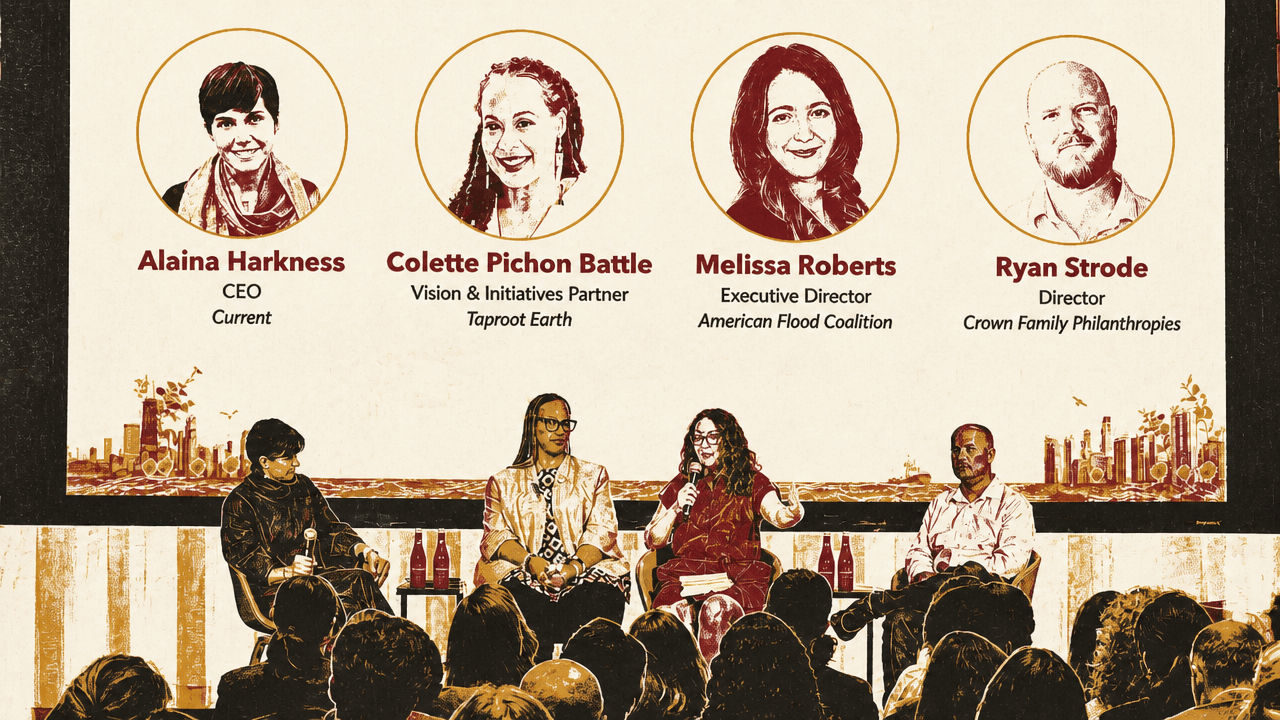
Water is where climate risk becomes an immediate political question: who absorbs flood losses, controls public systems, pays for resilience, and decides how a shared supply is used. In this Aspen Ideas: Climate discussion, organizers and water-policy advocates Alaina Harkness, Melissa Roberts, Colette Battle, and Ryan Strode argue that water can unite people across political divides because its consequences are felt in homes and communities—but that durable resilience depends on local authority, public investment, and organizing that turns opposition into a plan for stewardship.
Climate risk becomes real when water forces an allocation decision
Water makes climate risk legible because it arrives as an immediate question of allocation: who is protected from flooding, who can afford rising insurance or repair bills, who controls a water system, and whose use of a shared supply will be constrained when conditions change.
That conflict is easy to miss when water is treated as a background utility or a narrow environmental category. Alaina Harkness framed it as a common but often invisible thread through climate conversations: water is necessary for human life and for the economy, but its value is not always reflected in investment or governance. The numbers she cited point to that gap.


| Measure | Value Harkness cited |
|---|---|
| Global total addressable market for water-energy nexus technologies by 2030 | $250 billion |
| PFAS market | $4.2 billion |
| Nutrient-recovery market | $6.8 billion |
| Share of climate-tech investment flowing to water solutions | 3% |
Harkness also cited Value of Water polling in which 92% of Americans agreed that access to clean, fresh water is an important priority. The shared priority does not settle the terms of access, cost, or use. It does, however, create a language that can connect people who may disagree on climate policy, development, or politics more broadly.
Melissa Roberts described flooding as a “kitchen table issue.” A household that did not know it was vulnerable can suddenly have several inches of water in its basement and a $20,000 bill it cannot pay. A homeowner can receive an insurance bill that is 18% higher than before. Mold can follow when remediation is unaffordable. Those are the problems residents bring to mayors in grocery stores.

Roberts’s coalition-building approach begins with that material experience. The American Flood Coalition invites people confronting flooding to work together even if they disagree about why the flooding is happening, what role government should play, or what broader political commitments they hold. Her question is whether organizers look for reasons to include people who share a problem or impose litmus tests that exclude them.
That broad entry point does not make water conflict-free. Colette Battle described southeast Louisiana as a place long accustomed to floods, but said the familiar water cycle has become less stable: intense rain arrives in quantities that drainage and sewer systems cannot absorb, followed by dry stretches that she said would once have been unusual in south Louisiana.
Battle contrasted expected seasonal rain with what she called “masculine rain”: too much water arriving at once. She pointed to Baton Rouge rainfall events that overwhelmed public systems, and to low Mississippi River levels that allow saltwater intrusion to move upstream. The river is both a drinking-water source and a major industrial input. When freshwater is constrained, residents, public systems, and large industrial users are not simply facing an engineering problem; they are competing over a condition of life.
If water is life, who has access to life? Do you only have access to life if you have money or land?
Battle’s formulation rejects a treatment of water as only a commodity, financial asset, or industrial input. If water is life, she argued, access cannot be reserved for people with wealth, land, or political influence. It also means major users cannot claim unlimited access without accountability.
The stakes are personal as well as institutional. Battle spoke of Lake Pontchartrain and childhood memories of pelicans diving into its shallow warm water. Roberts described Rhode Island’s Narrow River as a tidal estuary that carried her along like a lazy river. Ryan Strode connected Lake Michigan to growing up in the Indiana Dunes and proposing to his wife atop Mount Baldy. Water disputes can therefore involve more than a resource calculation. They involve home, family history, belonging, work, and the ability to remain in a place.


Local sovereignty can unite opponents, but opposition must become a plan
Water is experienced in place, Strode said, and conflicts over water often become conflicts over whether people have a meaningful say in decisions imposed on their communities. That idea of local sovereignty can bring together constituencies that otherwise have little reason to organize together.
Strode pointed to opposition to the Dakota Access Pipeline, where Indigenous water protectors and conservative family farmers aligned around threats to water supplies, ancestral lands, and property held by families over generations. He described a similar coalition forming around proposed carbon pipelines associated with carbon-capture projects. The unifying claim was that people affected by a project should be able to influence whether and how it proceeds.
He rejected the tendency to dismiss such objections as NIMBYism. If a proposed development affects a child’s school, a community’s water supply, or the future of a family’s land, he said, residents should be able to shape the decision rather than merely receive it.
Data centers have made that conflict newly visible. Strode described conversations with suburban residents who had not previously been active in public affairs but were being told that a large data center would define their community’s economic-development future. In his account, many residents see little direct employment or economic benefit from these facilities, while bearing the consequences of large new demands on local resources.
The data-center debate has created a broad public opening, but Roberts argued that opposition is the easy part. Organizing around a specific project that people believe was decided without them can quickly produce agreement. The harder work begins with the next question: what does a community want instead?
A politics that ends with “put it somewhere else” can leave the underlying allocation system untouched. Roberts urged a move from rejection to participation: What should residents have a say over? What kinds of development should a community support? How should water, energy, land, and public infrastructure be allocated?
Strode sees the same question emerging in Milwaukee, which he said experienced a thousand-year flood and then, six months later, a hundred-year flood. The sequence, he argued, makes inherited flood labels inadequate. It has also brought together young people, faith groups, and community organizations that would not necessarily describe themselves as water or environmental groups. Their work is centered on reimagining neighborhoods through a relationship with nature and water.
Harkness described a related shift in the Great Lakes region. Chicago and neighboring communities have long had access to abundant freshwater and, in her view, have often behaved as though that supply were effectively infinite. Industrial reuse was illegal until recently, she said, and the region has not consistently approached water use as a stewardship and allocation problem.
The discussion around data centers should therefore not stop with a single type of facility, Harkness said. It can widen into a regional question: how should a place holding 20% of the world’s fresh surface water plan for industry, households, reuse, and conservation?
Disaster opens a political window—and can concentrate control
A disaster can make systems visible that people had previously assumed would protect them. It can also create a period in which authority shifts quickly, outside actors arrive, and decisions about public systems are made under emergency conditions.
Roberts described two competing approaches to flood resilience. One is individualized and financialized: elevate an expensive home for $200,000, armor selected properties, or fund projects that offer a return to investors. The other treats protection from flooding as a public good and a basic responsibility of government, comparable to education or transportation.
The difference appears in what counts as a viable project. A private model asks whether an intervention can “pencil out.” A public-good model begins from the obligation to protect life and property, including where a household cannot afford private protection or a project does not generate an investor return.
Post-disaster recovery often pushes people toward that second view because they encounter the recovery system directly. Roberts said survivors can find themselves navigating a list of 130 federal programs to access aid that Congress has already appropriated for their area.
Roberts called that experience radicalizing. People expect aid to arrive after a disaster, then discover a fragmented bureaucracy that demands time, expertise, and persistence from households already dealing with loss. Before a disaster, investments that would reduce risk can be politically difficult to make. Afterward, the urgency is plain, new constituencies are mobilized, and reforms that once stalled can become possible.
She pointed to work in western North Carolina after Hurricane Helene, where she has seen people from politically different parts of the state align around commitment to place. The shared goal is to leave a community better than they found it and to ensure that future disaster survivors do not face the same recovery system.
Battle agreed that disaster produces a brief opening. People who disagree on much else can still recognize shared attachment to their homes and communities. But she argued that this opening does not last long and must be met by organizers who are already rooted in the place, trusted across difference, and able to move people from individual distress toward collective action.
That work cannot be improvised after a storm. Battle said organizers need support before the crisis: people able to convene communities, listen across political and social differences, and help residents identify a shared purpose without creating a new target for exclusion.
The danger, in her account, is that post-disaster alignment can harden into an “us versus them” politics as cleanup workers, migrants, government agencies, or other outsiders arrive. Organizing power is necessary, but Battle warned against using it to reproduce domination.
Her practical answer is to establish explicit community agreements. Participants should agree not to attack one another personally, to leave room for disagreement, to step up and step back rather than dominate or withdraw, and to participate actively in the collective work. Those agreements require repetition before they become real. The aim is not to eliminate conflict; it is to practice disagreement without punishment, contempt, or exclusion.
Battle also warned that climate emergencies can be used to rearrange control over public water systems. She said emergency-manager appointments have been used in Black-run cities with Black elected leadership, displacing local officials in moments of crisis. In her account, water systems can be especially consequential because they may be among the few public utilities generating resources for city coffers. She argued that an emergency manager appointed over a water system can remain in power beyond the immediate crisis and that privatization can follow. She named Flint, Detroit, New Orleans, and smaller Black cities in the Deep South as places to examine that pattern.
Harkness noted that every utility, whether publicly or privately operated, must pay for treatment, delivery, and maintenance. Battle’s concern was not that those costs disappear under public ownership. It was that emergency conditions can determine who controls an essential system, who receives its revenue, who sets its terms, and whether residents retain democratic authority over access to water.
Water policy works when it speaks the language people already use
A water strategy cannot be built only in the language of climate risk, investment, or infrastructure. It has to make sense in the language people use to describe the place where they live and work.
Roberts offered an example from Iowa, where pilot farms are testing multi-cropping: planting another crop between conventional cash crops. The practice can hold more water in the soil, reducing flooding and potentially reducing dependence on dams, levees, or similar infrastructure. Because water retention can be measured, Roberts said, farmers may eventually be compensated for the value it provides.
Farmers do not necessarily describe that work as flood adaptation. They talk about soil health, maintaining productivity, fertilizer costs, and farm margins. Farmers themselves are leading the effort, Roberts said, including by teaching other farmers how to adopt the practices. The water benefit is real, but the language that makes the practice usable on a farm is about preserving the land’s capacity to produce.
Battle described another form of water-centered organizing through a Sacred Waters pilgrimage down the Mississippi River. The journey began at the summer solstice, ended at the winter solstice, and stopped at each full moon in between. Organizers invited Indigenous tribes in each place to hold ceremony on the river. Battle said the effort brought together more than 47 tribes, along with Black and Brown women and two-spirit people, over nearly eight months.
The pilgrimage did not begin with an industrial-policy agenda. It began with the river, the moon, the sun, ceremony, and the history of places along the Mississippi. Battle wanted participants to relate to water not merely as a commodity or according to its usefulness to people, but as something with sacred value in itself.
That starting point still produced conversations about material systems. Participants discussed industrialization along the Mississippi, the downstream dead zone, and fertilizers connected to oil and gas production in Louisiana and Texas. Battle’s point was that these conversations did not need to begin in a conference room with a predefined agenda. A shared relationship to water, place, and tradition made it possible to address the industrial forces shaping the river.
Strode made a parallel argument about philanthropy. He said foundations tend to divide climate, energy, water, agriculture, and food systems into separate programs because they are easier to manage through discrete goals and measurable outcomes. Community needs do not arrive that way.
He pointed to Elevate, a local organization that showed visitors homes where it was replacing lead service lines and homes it was fully electrifying. A foundation structured around narrow categories may not know where to place a program that does both, even though the household experiences water, energy, health, and housing as connected conditions.
Strode argued that philanthropy should not overstate its own importance or assume it has the answer to locally complex problems. Its role is to ensure that people who understand their communities have what they need, then get out of the way. That means supporting adequate staff, salaries that allow organizations to retain people, health care, retirement for elders, time to rest, and the organizational capacity to do work that does not fit neatly into a grant category.
Battle’s final warning was against treating future scarcity and conflict as inevitable. She argued that Americans with education, employment, and relative security can change present patterns of consumption rather than planning only for a future in which water is scarce and communities are forced to defend what remains. Data centers are one of many arguments about resource use, she said. The larger question is whether people will define a better relationship to water before emergency and scarcity define it for them.