Energy Affordability Is Reshaping Climate Politics Across Party Lines
 Brandon Hurlbut
 Neil Chatterjee
 Mitch Stewart
 Julia PyperThe Aspen InstituteWednesday, July 29, 202613 min read
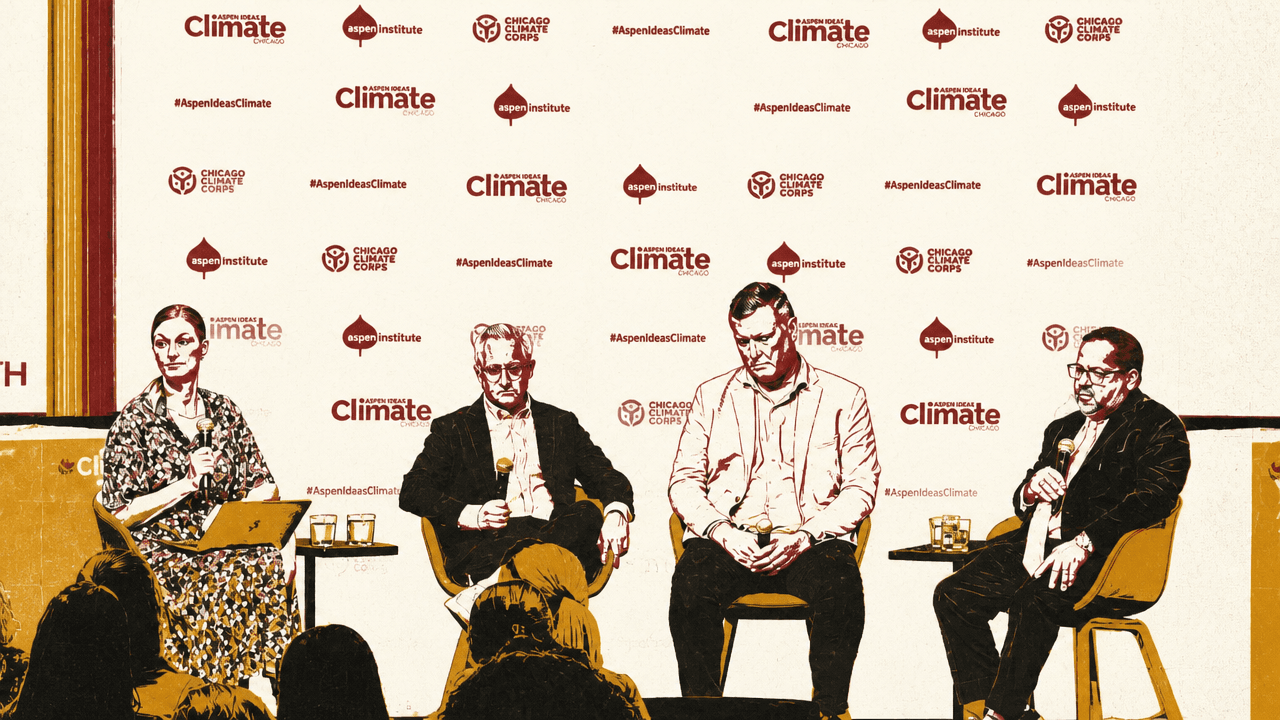
Energy politics is increasingly being fought through affordability rather than explicit climate language, as candidates tie electricity bills, insurance costs and new demand from data centers to household budgets. Mitch Stewart, Brandon Hurlbut and Neil Chatterjee differed over how that shift should shape campaigns and policy, but the discussion’s central tension was clear: pressure to lower costs can support cleaner generation, grid investment and flexibility, or extend the life of fossil-fuel generation and weaken climate commitments.
Affordability is now the contested language of energy
Climate and clean energy have not disappeared from electoral politics. They are being translated into household-cost politics: electricity bills, insurance premiums, fuel prices, housing, flood protection, wildfire, and the need to build more supply. That translation gives candidates a way to discuss energy systems in terms voters encounter directly. It also creates a substantive conflict. Pressure to lower bills can support cleaner, flexible resources and more grid capacity; it can also become an argument for extending fossil generation or retreating from climate commitments.
Mitch Stewart said cost of living, rather than climate, is driving voting behavior. Energy belongs to a broader basket of concerns that includes food, housing, and transportation. Even among Democrats, he said, climate often ranks low among the issues that determine a vote, despite voters’ broader concern about it.


The political implication, in Stewart’s view, is not necessarily to abandon climate-related policy. Candidates can argue for more renewable generation by emphasizing lower utility costs and a larger supply of electricity. They can argue for transmission, storage, and resilience through reliability and local economic benefits. The substantive policy may be similar; the electoral frame is different.
Brandon Hurlbut traced the shift partly to a changed economic environment. Democrats emphasized clean-energy jobs after the financial recession, when unemployment was high. Today, he said, most people have jobs but do not feel they earn enough to make ends meet. Electricity and insurance bills offer more immediate political terrain than a broad promise of green employment.


Hurlbut said Democrats also absorbed an unwelcome lesson from the Inflation Reduction Act: voters did not generally connect the projects and jobs it supported to Biden or congressional Democrats. In his account, governors—including Republican governors—received more credit for investments in their states than the federal officials who enacted the law. He also contrasted what he described as 625,000 manufacturing jobs created by this point in Biden’s presidency with 75,000 manufacturing jobs lost by this point in Trump’s presidency, despite tariffs intended to protect domestic manufacturing.
Electricity affordability, Neil Chatterjee argued, has become a frontline issue in a way he had not previously seen. Gasoline prices are posted visibly and paid frequently at the pump; electricity bills are more often automatically paid and tend to rise incrementally. If voters are now focused on power bills, he said, incumbents of any party are vulnerable.


That does not make affordability automatically a climate win. Chatterjee sees an upside in a system that relies more on distributed generation, solar, batteries, demand response, and grid-enhancing technologies. In discussing recent Federal Energy Regulatory Commission work on serving data centers while maintaining reliability and affordability, he highlighted flexible resources and curtailability: the use of demand-side resources, distributed energy, and clean generation when the grid is under maximum stress.
But the same political pressure can push governors toward gas, coal, or reversals of existing climate objectives. Chatterjee cited Governor Kathy Hochul’s move away from parts of New York’s climate agenda and discussion of California backing away from fuel-economy standards as examples of the risk.
Affordability may translate to an elongated lifespan for some really, really fossil fuel carbon heavy emitting sources of generation.
The divide is visible in campaign advertising. An Americans for Prosperity Action ad attacking North Carolina Democrat Roy Cooper says, “MONEY’S TIGHT. GAS IS SKYROCKETING,” and says Cooper’s policies would add $434 to electric bills. The ad presents Republican Michael Whatley as the candidate who will “CUT REGULATIONS,” “UNLEASH AMERICAN ENERGY,” and lower costs. High prices become evidence that the governing approach has failed; more energy supply becomes the remedy.
Stewart said Republicans generally have an easier time making an argument for expanding supply, including fossil-fuel supply. But he also sees an emerging Democratic “abundance” argument. In that view, the Inflation Reduction Act won little political credit in part because voters did not see enough projects built quickly enough. The answer to rising costs, he said, is ultimately to build more.
That proposition runs into local resistance that does not follow party lines. Communities may favor lower bills and increased supply in the abstract while resisting the land use, noise, water demands, or visual impacts of specific projects. The conflict is less a simple ideological divide than a collision between broad deployment goals and local control. Candidates who promise plentiful, cheaper energy still have to explain what gets built, where it gets built, and who bears the costs.
Climate’s consequences are appearing without the climate label
Campaigns are addressing problems shaped by climate and energy systems while avoiding the language of climate change itself. Stewart called the dynamic “climate hushing”: candidates run toward the concerns voters rank highest, particularly cost of living, without turning climate into the explicit ideological contest.
Sam Forstag, a Democratic congressional candidate in Montana and a smokejumper, offered a direct example. The campaign ad shown at the event opens with the imperative of responding to a fire alarm: “When that siren goes off, you go. Because fire moves quick.” Yet it does not turn wildfire into an explicit climate argument.
Instead, Forstag describes “the richest people in this country” as trying to “burn it all down so they can buy it all up.” The ad’s on-screen identity markers—“Smokejumper,” “Union Leader,” and “Son of a nurse and public school teacher”—place him within a working-class and labor coalition. His closing line is collective rather than environmental: “We take care of us.”
The fire is the setting; inequality is the message.
Julia Pyper identified a similar pattern in Louisiana, where Senate candidate Julia Letlow has emphasized flood-risk reduction and coastal restoration. Pyper said Letlow was attacked in her Republican primary for supporting carbon capture and sequestration, yet won the primary. Energy and climate-related concerns can therefore be present in a campaign without becoming the explicit ideological contest.


Chatterjee endorsed the move away from overt climate branding. He recalled a period when carbon policy was less sharply ideological: John McCain, the 2008 Republican presidential nominee, was a primary author of cap-and-trade legislation, while Newt Gingrich and Nancy Pelosi appeared together in an ad discussing climate change. In Chatterjee’s account, Republican support receded when carbon reduction became a cultural and partisan marker rather than a technical question for engineers, economists, and policymakers.
He is comfortable with campaigns focused on policies that produce climate benefits without making climate their stated rationale. A more flexible electricity system, for example, may be sold as a way to maintain reliability and affordability while meeting new demand from data centers. If it also produces lower emissions, that is a consequential outcome even if the campaign never uses the word climate.
Hurlbut’s position was that the label still has value, but for a narrower electoral purpose. He cited a UC Santa Barbara survey of 3,500 people, discussed by Leah Stokes, which he said found a 4.5-point increase in support when climate was mentioned. He said the increase was about seven points among voters open to supporting a Democrat and roughly nine points among committed Democrats.
For Hurlbut, that made climate a mobilization tool rather than a universal persuasion message. He pointed to Roy Cooper’s formulation—“good for our people, good for our planet, and good for our pocketbook”—as a way to combine environmental and economic goals without leaning entirely on the climate label.
Stewart drew the distinction more sharply. He recommended emphasizing the outcomes of climate policy: more renewable supply, more electricity on the grid, and lower costs. He cited an older Yale study in which climate ranked fourth among 28 issues motivating liberal Democrats but last among 28 for conservative Republicans. A campaign seeking to persuade voters who are not already committed, he argued, should not unnecessarily trigger the elite or partisan associations those voters attach to the word.
The disagreement is not over whether clean-energy deployment matters. It is over when explicit climate language helps and when it gets in the way. Hurlbut sees it as useful for activating voters already inclined to care intensely about the issue. Stewart sees affordability and reliability as the more useful language for persuading a broader electorate focused on monthly budgets.
Clean-energy advocates face a choice between punishment and coalition
The One Big Beautiful Bill Act put a strategic dilemma before the clean-energy industry. The legislation rolled back many incentives enacted through the Inflation Reduction Act. Should clean-energy capital punish Republicans who voted for those rollbacks, even those who sought to preserve selected credits? Or should it protect the limited Republican coalition willing to offer incremental support, in the hope that those members can become stronger allies later?
Hurlbut treated the bill as evidence that clean energy lacks sufficient political power. He contrasted the sector with crypto, which he said organized, raised substantial money, and built electoral influence. In his view, clean-energy interests need comparable political infrastructure, including electoral spending, so that lawmakers face consequences when they vote against the industry’s priorities.
He was particularly critical of Republican members who signed letters supporting clean-energy tax incentives but ultimately voted for their repeal. Those members, he said, tried to have the argument both ways: publicly support the credits while backing the legislation that dismantled them.
Pyper pointed to the Invest in Tomorrow Coalition PAC as an example of a more confrontational strategy. Backed by renewable-energy developers and crypto billionaire Chris Larsen, the group spent more than $1.7 million targeting Texas Republican Chip Roy, according to Pyper. Roy had been a prominent opponent of renewable-energy tax incentives and pressed for a faster phaseout of solar and wind credits. Pyper said he later lost an attorney-general race, in part because of efforts including those of the coalition.
The Chip Roy case is the straightforward version of electoral retaliation: an opponent of renewable incentives becomes a target for an industry that now sees political spending as necessary self-defense. Chatterjee did not contest that logic in Roy’s case. His concern was the broader rule advocates might draw from it.
Neil Chatterjee argued that climate and clean-energy advocates should not treat every Republican who fails to support the full agenda as an enemy. His example was former Representative Carlos Curbelo, whom Chatterjee described as Congress’s leading Republican advocate on carbon emissions and climate change in 2018. Environmental groups did not sufficiently support Curbelo because of his position on the Affordable Care Act, Chatterjee said, and he lost in that year’s midterm election.
For Chatterjee, Curbelo demonstrated the cost of making climate support contingent on agreement across every other policy domain. If advocates want Republicans to take risks on carbon policy, they need to defend the Republicans who do so.
I actually don’t want to see the letter writers taken out. I want to see them supported. Because maybe they’ll be even stronger the next time this goes around.
Hurlbut accepted the longer-term premise: durable clean-energy policy eventually needs Republican support. But he placed a different priority on the immediate election. Control of the House, he said, is the central objective, and a small number of competitive districts could determine who holds the gavel. The near-term calculation is therefore not simply whether an individual Republican is better than an alternative. It is whether a district affects control of the chamber that will shape permitting, transmission, utility business models, market design, and the remaining federal clean-energy incentives.
Stewart described the financial asymmetry facing Democrats as part of that calculation. His reading of recent Federal Election Commission filings showed a $724 million advantage for the Republican political ecosystem, including roughly $400 million associated with MAGA Inc.
The disagreement between Hurlbut and Chatterjee is not merely tactical. Hurlbut’s position is that clean-energy interests cannot preserve their policy agenda without demonstrating political consequences now. Chatterjee’s is that a durable settlement cannot be built if every Republican who offers partial support is left exposed. The industry’s political test is whether it can do both: impose costs on determined opponents while building a constituency for members willing to defend a narrower but meaningful clean-energy agenda.
Data centers turn a system-design problem into a populist target
Data centers are becoming a compact political symbol for a much larger set of anxieties: electricity bills, water use, land, AI, job displacement, corporate power, and whether ordinary customers will subsidize infrastructure built for major technology companies.
The political case against them is fast and visible. Households see their utility bills. Candidates can point to large facilities, “sweetheart deals,” and wealthy technology companies. The governing question is slower and less intuitive: how should the cost of generation, grid upgrades, and local impacts created by new demand be allocated—and what kind of system should serve that demand?
Sherrod Brown, the Democratic nominee in Ohio’s 2026 special Senate election, made the political case in a 15-second attack ad against Republican incumbent Jon Husted. “Electric rates continue to go up. How’d Ohio get here?” the ad asks, before saying Husted spent years recruiting data centers and cutting “sweetheart deals” while residents watched their bills rise. It calls Husted “the face of data centers.”
Hurlbut said the ad works because it joins several voter concerns in one target. He cited polling that, he said, found 84% of voters concerned about their electricity bills. He also said voters, by a 22-point margin, believed congressional Republicans were making energy prices higher, a 26-point movement from December 2024. The data-center charge turns an infrastructure issue into a populist one: large companies get favorable treatment while households are left with the costs.
The reaction is bipartisan. Hurlbut said Republican governors including Greg Abbott in Texas and Ron DeSantis in Florida have moved against data-center development in various ways, including restrictions and efforts to ensure developers or hyperscalers pay for system impacts. The coalition against data centers brings together concern about AI, electricity consumption, water, jobs, and the concentration of wealth among major technology companies.
Stewart said Brown had released three data-center advertisements in roughly 48 hours, including one that used Pac-Man consuming electricity along a power line. He said Brown was tying Ohio’s 226 data centers to Husted’s record and presenting their rapid growth as an explanation for household cost pressure.
Chatterjee worried that this political compression would make it harder to govern. He recalled that in November 2024, FERC rejected a Pennsylvania data-center proposal over resource-adequacy and affordability concerns. Chatterjee said he received calls from both the Trump and Harris campaigns afterward because both supported data centers as part of the effort to lead in AI and were frustrated with the decision.
In his view, AI development will happen somewhere. If it does not happen in the United States, he said, it will occur in Alberta, Japan, South Korea, China, or elsewhere. Blocking domestic data centers may raise the cost of computing power rather than halt its growth. That, Chatterjee argued, could deepen inequality: people and organizations able to pay for expensive compute could become substantially more productive, while those priced out would be left with lower-quality systems characterized by hallucinations, advertising, and poorer information.
If we block data centers here in the United States, all that is going to do is increase the cost of compute.
Chatterjee’s preferred alternative is a practical bargain rather than a moratorium: make data centers more energy efficient, reduce water use, noise, and land impacts, use cleaner distributed energy where possible, and determine how to serve new load without placing excessive costs on other customers. He acknowledged the political imbalance in that argument. A short attack ad can make a clean villain of a data center; explaining a cost-allocation regime takes longer.
That imbalance connects directly to the broader affordability argument. New demand can be met through flexible resources, distributed generation, storage, demand response, transmission, and other investments that may lower system costs and support cleaner supply. Or political pressure can produce a turn toward gas, coal, and broader retrenchment from climate commitments. Affordability does not dictate which path follows.
Stewart said developers are beginning to adjust because the old model of confidentiality agreements and limited local disclosure does not work for much larger AI facilities. Closed-loop water systems and renewable-energy commitments, he said, are becoming important to securing community support. Among local residents skeptical of data-center development, he said, the use of renewable energy was the strongest motivator for changing opinion.
The issue also produces awkward alliances. Brown is closely aligned with labor, while Ohio building-trades unions strongly support data-center construction. Stewart wondered whether that explains the precision of Brown’s message: attack high electricity costs and favorable deals, but stop short of explicitly calling for a moratorium or an end to development.
That distinction will matter after the election. Politicians can campaign against unchecked data-center growth, but they will still have to decide how much new generation and transmission to build, whether developers must fund the upgrades they require, how communities are compensated for local burdens, and whether the resulting system serves new demand with cleaner flexible resources or longer-lived fossil generation.