AI Works Best When Domain Experts Control Its Use

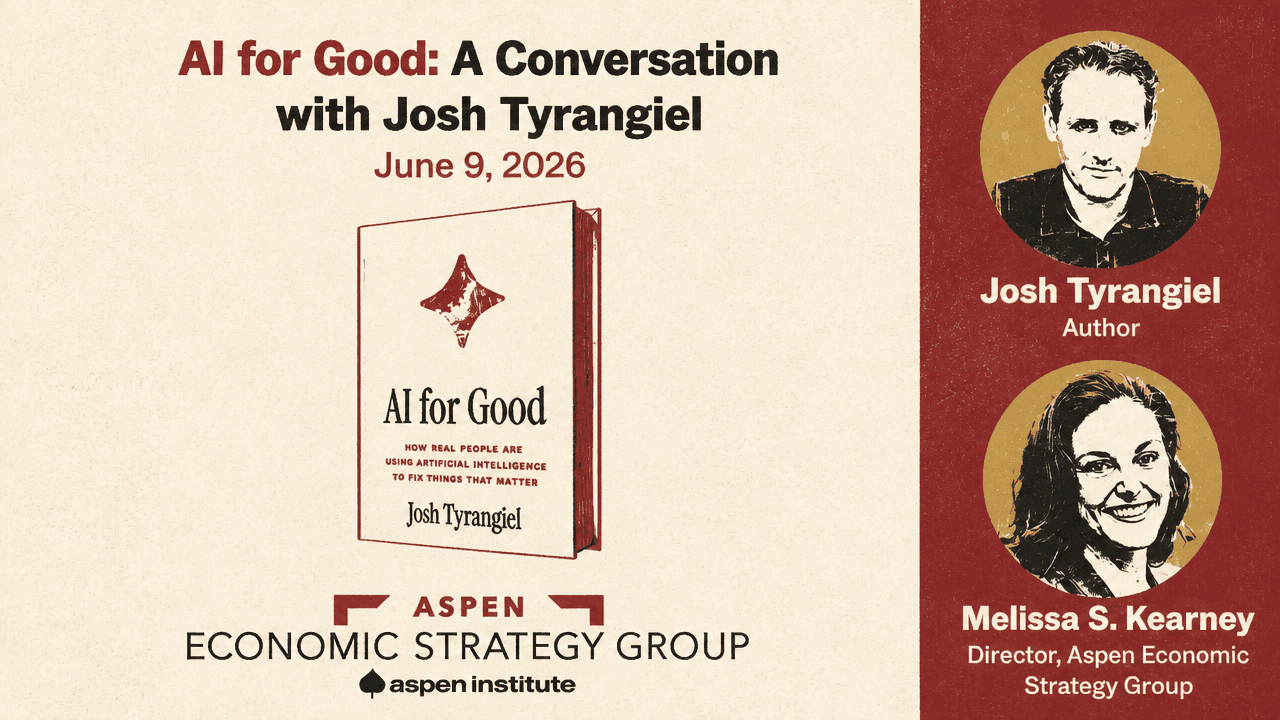
Josh Tyrangiel’s AI for Good argues that artificial intelligence is most useful when domain experts, not technology companies or models themselves, decide how it is applied. In conversation with Aspen Economic Strategy Group director Melissa S. Kearney, Tyrangiel says his reporting found real gains in healthcare, education, government, and recycling, but mostly as incremental improvements shaped by doctors, teachers, public servants, and other practitioners. His case is not that AI’s risks are overstated, but that the policy question is how to preserve human authority while regulating the most dangerous capabilities.
The policy question is how to keep experts in charge
Josh Tyrangiel set out to answer practical questions about artificial intelligence rather than write a general defense of it: what the technology is, how difficult it is to use, and how much progress it can make on problems he cares about. He was explicit that positive examples do not offset AI’s harms. The dangers are “significant,” he said, and need mitigation. But he argued that people also need examples of utility if they are going to imagine what they want from a technology that is “not going away.”
The strongest through line in his reporting is not that AI replaces people, but that it needs people. Tyrangiel said he would make that claim with confidence for at least the next five years. The software can be powerful, but it does not know “the ticks of an organization, of a profession, of individuals within that profession.” In the examples he described, progress came when domain experts treated AI as a tool to be fitted into a real institution, not as an external system that could simply be dropped on top of one.
Melissa Kearney framed the book as unusually human-centered. The protagonists, as she read it, were not technologists displacing workers, but domain experts using AI to solve particular problems. She asked whether Tyrangiel had chosen only uplifting cases or whether the human-centered pattern emerged from reporting. His answer was that the pattern emerged from implementation: where AI worked, people who understood the system were directing it.


His central example was Cleveland Clinic. According to Tyrangiel, the organization’s CEO, a former cardiac surgeon, told him that the clinic was not trying to become “the Microsoft of healthcare” or transform itself into a different kind of business. It had two goals: improve patient outcomes and find efficiencies that could be reinvested into care. The CEO put the clinic’s margins at about 2.2%, which Tyrangiel presented as strong for healthcare and as a reason efficiency mattered.
The implementation principle that followed was blunt: doctors are the product managers. Tyrangiel described this as a lesson that travels beyond medicine. No software engineer can walk into a hospital and dictate a new workflow from the outside. The volunteers who know the patients, clinicians, and institutional habits have to lead adoption.
That matters because much of the opportunity in healthcare is not exotic. It is in the administrative burden that drives attrition. People enter medicine to work with patients and save lives, Tyrangiel said, but quickly discover they are spending large amounts of time filling out paperwork. Doctors refer to “pajama time” as the hours between 7 and 10 at night when they catch up on electronic health records.
One simple intervention was AI scribe software. With patient permission, a doctor presses a button on a phone and narrates the exam. Tyrangiel described being examined by Dr. Boos, a family medicine doctor at Cleveland Clinic and a volunteer in the pilot. The narration required by the software changed the experience of care: the doctor explained that he was getting out his stethoscope, listening to the right lung, and then hearing something in the lower left. Tyrangiel’s reaction was not only that the record was being generated, but that for the first time a doctor was telling him what was happening during an exam.
At the end, the system produced a transcript, filled out about 80% of the electronic health record, ordered tests, and processed them. That was impressive enough. But the adoption pattern was more revealing.
Half of those volunteer doctors, Tyrangiel said, never turned the tool on. Even professionals who had volunteered for the pilot resisted changing how they worked. For Tyrangiel, that friction is not incidental. It is one of the main reasons the policy question around AI cannot be reduced to speed of deployment. Slow adoption, human-in-the-loop design, and model-scale regulation are all ways of answering the same question: who remains in control when the technology becomes capable enough to matter?
Friction may be slowing disruption, not just adoption
Kearney pressed on the dual role of people in the examples. Some humans are the champions who figure out how to use AI: recycling workers, a cardiac doctor using AI to get more from imaging, clinicians redesigning workflows. Other humans slow things down. In many economic accounts, frictions reduce efficiency and delay useful innovation. But Kearney suggested that with a technology moving this quickly and still poorly understood, some resistance might be desirable.
Josh Tyrangiel agreed that friction has a use. In debates over AI and employment, he said, the crucial variable is the speed of adoption. If AI rapidly enters organizations and automates many tasks at once, the labor-market disruption could be severe. Unlike earlier general-purpose technologies such as electricity, AI has recursive potential: it can learn and implement itself in ways that could make disruption faster.
But that scenario assumes away the stubbornness of actual workers and organizations. Across the places he reported, Tyrangiel said the technology often needed only a few months of tweaks before it could do useful work. People then responded, repeatedly, with skepticism: “Yeah, I don’t know about that.”
AI is not going away, but it’s also not a silver bullet.
Kearney drew a distinction between settings where resistance seemed wasteful and settings where it might be informative. In healthcare and government, she said, AI often appeared to make processes more efficient. Bureaucratic drag may have been costly there. But education looked different. The initial promise around AI tutoring was personalized instruction for every student. The actual classroom evidence in Tyrangiel’s account was more mixed: many students did not want to interact with the online tutor, and some quickly learned how to bully or manipulate it into giving answers rather than coaching.
Tyrangiel’s account of Khanmigo, the AI tutor developed by Khan Academy with OpenAI, underscored the gap between technical promise and institutional reality. OpenAI showed Sal Khan a next-generation model before the first generation had been released. Khan, who had spent roughly 20 years building tutoring at scale through videos and educational programs, was overwhelmed by the potential. Khan Academy and OpenAI then prototyped Khanmigo in five months.
The ambition was global: a personalized AI tutor for students in school systems everywhere. But the technology was not naturally suited to the task. ChatGPT had been designed as an assistant, not a tutor. For the first several weeks, Tyrangiel said, whatever the team did, the system would simply give students the answer because that was what an assistant was built to do. It was also trained on material that Khan Academy did not want exposed to children. Khan Academy, which works across many states, is careful about political controversies; ChatGPT, Tyrangiel said, could “light them on fire.”
The first test was in exactly one school: a Khan Academy school in Silicon Valley, a setting Tyrangiel described as far from representative. Within minutes, one student recognized the system as a large language model; Tyrangiel noted that the student was the child of a Google engineer, as were many of the students there.
When Tyrangiel visited classrooms in Newark and Indiana, the student response was not the expected embrace of personalized AI tutoring. By and large, he said, students were either apathetic or aggressively opposed to using AI that way in class. Some got frustrated, some tried to cheat, and some closed their laptops.
The more promising pattern came from teachers. Tyrangiel emphasized that Khan Academy staff were not defensive about the limitations. They were open about the history of ed-tech disappointments and the difficulty of using AI in classrooms. Experienced teachers saw possibilities different from those students saw. They understood the tool as software that could help them rethink instruction, not as a replacement for teaching.
One teacher used Khanmigo to transform a planned chemistry lesson. She told the bot her lesson plan and asked it to turn the class into a participatory lab. The system asked what classroom resources she had. She listed Ziploc bags, six gallons of vinegar, rubber bands, and the kinds of materials available in a chemistry lab. Overnight, she redesigned the class from a lecture into a lab. Tyrangiel watched from the back of the room and said that, while he did not claim chemistry expertise, he knew what fun and engaged students looked like.
Kearney interpreted that as an incremental success, not a revolution. The teacher had used technology to excite students in much the same way a teacher in an earlier generation might have used a magazine to find a good experiment. It was not the grand claim that every child would have a personalized AI tutor.
Tyrangiel accepted that framing. “It’s evolutionary, not revolutionary, particularly right now,” he said. The rhetoric of revolutionary change, in his view, is partly a function of lab incentives. AI companies are competing with each other, need to position their models as dramatic advances, and have investors who have given them tens of billions of dollars. They therefore have every incentive to tell the public that the technology is astonishing. His reporting led him to a different formulation: the tools are good, helpful, and in need of guidance. The companies advertise home runs; the field evidence often looks like “really interesting singles.”
The limits are partly technical and partly human
Melissa Kearney asked whether the limitations Josh Tyrangiel observed are temporary features of early models or deeper constraints in how people interact with one another and the world. Tyrangiel’s answer was “a little bit of both.”
Some limitations come from the way models are trained. Human wants, language, gestures, and social norms keep changing, while large language models are trained on past data. Even when they have access to web data, he said, it is not truly live. That creates lag and mismatch.
Other limitations vary by domain. Tyrangiel sees strong promise where the task is converting documents into searchable, actionable systems. New York City permitting was his example. Permitting, he said, burdens everyone from pretzel-cart vendors to large construction firms and is built on stacks of paper reaching back 150 years. Because that material is already a kind of code, he argued there is no reason the process should take 18 months to two years rather than move much faster.
Software development shows both the power and the gap. Tyrangiel referred to tools such as Claude Code and Codex as impressive software-writing systems that give engineers substantial processing power. But he said some software-company leaders he knows are already correcting for the way these tools can inflate engineers’ sense of scope. Engineers produce work quickly and then present it as though they have also solved product management, implementation, and design. The response from managers can be simple: “This is hideous. This is ugly. No person will know how to use it.” The engineer’s answer — that it was designed with Claude Code — misses the point. Design is a skill. Remembering what the client wants is a skill.
That is where Tyrangiel sees the emerging gaps. AI can move quickly and process large amounts of information. It does not yet know, in a situated way, what people want, how those wants change, and how they interact with the stubborn capabilities embedded in professions.
Kearney connected that point to a concern about skill formation. The people in Tyrangiel’s examples often had careers of domain expertise behind them. They knew what they wanted from the tool: how to make a distribution system more efficient, how to train a model on MRI images, how to interpret output with precision. If early tasks are outsourced to models, fewer people may develop the skills needed to train the next system, notice bad output, or intervene when something seems wrong.
She drew the issue into her own work. She now has AI do tasks she once would have assigned to an undergraduate. That creates a conflict: efficiency points one way; training another person points the other. “I basically have to tell myself be less efficient because it’s good in the world if I train somebody,” she said. In medicine, she noted, a doctor cannot simply slow down reading an MRI for the sake of training someone. The incentive problem is unresolved.
Tyrangiel shared the worry. Automating training tasks can create a skills deficit, both for new workers and for experienced people whose own skills atrophy when processes are automated away. He did not claim to have a general answer. But he offered sepsis prediction at Cleveland Clinic as an example of avoiding the worst version of that problem.
According to Tyrangiel, sepsis kills 350,000 people in the United States each year — more than breast cancer, prostate cancer, and opioid addiction combined — and Cleveland Clinic was losing more than 3,000 people a year to it. After COVID, the clinic looked at that number and decided that matching the industry standard was not good enough.
Sepsis is well suited to AI because it involves large quantities of noisy data in which the system must identify a signal. Caught early and treated, Tyrangiel said, sepsis is an infection that can be treated with antibiotics, sharply reducing mortality risk. Cleveland Clinic first reminded clinicians across its 88,000-employee system that sepsis could appear anywhere, even in a podiatrist’s office. Then it used software as an assistant, adding three levels of flags: low risk, moderate risk as a reminder to look into sepsis, and significant risk requiring intervention.
For about 90% of the system, Tyrangiel said, the balance worked. It was a reminder, not an intrusion. It helped clinicians catch cases. But it did not work well in the ICU, where variables are much more complex and patients arrive from around the world. One of the women running the project was an ICU nurse whose grandmother had died of sepsis. She repeatedly challenged the engineer: she could see that a patient was “grey and rotting from the inside” and septic, but no flag appeared. The system could not yet close that gap.
Still, after a year, the clinic reduced sepsis mortality by 41%, which Tyrangiel translated into more than a thousand people still alive. His interpretation was not that AI solved sepsis. It was that human attention and machine assistance worked together. The Hawthorne effect — drawing attention to a problem can itself improve it — mattered. So did expertise.
The design of the alerts also mattered. At one stage, the pilot considered sending in an intervention team as soon as a flag appeared, with no explanation. Doctors resisted. They already had many things beeping in the room, and over-flagging carried its own risk because attention is limited. Clinicians needed to know why a flag had gone up. Once explanations were added — the system had seen certain indicators — doctors could use their judgment. They could downgrade a mistaken flag or decide to investigate.
Kearney called this “keeping the human in the loop.” Tyrangiel agreed, but the phrase meant more than formal oversight. In the ICU, he said, the relevant information can include the sound of a moan, the pallor of skin, the smell of sweat, years of medical school, and constant exposure to sick patients. AI did not replace those senses. It supported clinicians who still had to decide.
The power problem is bigger than market share
Melissa Kearney moved from individual expertise to institutional power. Across the examples, she observed, the same large technology companies kept appearing. Sal Khan worked with OpenAI. A cardiac doctor worked with NVIDIA. More broadly, a small number of AI companies are not merely large within the tech sector; they are entering education, healthcare, government, and other domains. That raises concerns not only about wealth concentration but about power and influence over daily life: children, doctors, teachers, patients, and public services may all interact with systems shaped by a small set of firms.
Josh Tyrangiel said those concerns are justified. His optimism, he said, had recently been at a low point, though it had improved somewhat. The suspicion is not paranoia in his view. The last 25 years of technology companies provide reason for anger. Companies promised to connect the world while undermining information systems, monetizing attention, and weakening faith in institutions. Many of the same companies are now bringing AI into core domains.
He described public anger as “righteous fury.” In his reporting and public conversations, he found people angry about power concentrated in four or five companies and about the casual demand that everyone change how they work and relate to one another. AI is also arriving after years of political extremism, the pandemic, climate change, and other sources of existential anxiety. For many people, it feels like another burden layered onto an already unstable context.
Kearney noted that critics of such resistance might dismiss it as small-minded fear of immigrants or technological change. Tyrangiel took the opposite position. He is sympathetic to the anger and sees it as politically productive. He said the Trump administration, which he characterized as having largely been “eating at the trough of the AI companies” while it was supposed to regulate them, had recently suggested more forcefully that it might regulate the size and power of models. He connected that shift to polling: Fox News polling, which he distinguished from Fox News programming and called reputable, found, by his recollection, that about 81% of Americans saw AI regulation as extremely or very urgent.
Democrats, he said, had also announced plans to regulate AI in a substantial way, including an announcement from Adam Schiff that morning. For Tyrangiel, anger helps explain why political actors are moving. “Nothing happens here unless somebody’s pissed off about something,” he said.
But he did not suggest that regulation of the largest firms would solve everything. The major companies are “omnivorous,” and the technology itself is omnivorous. It will work through many domains and industries. The strength of companies such as Google or Meta, in his account, is not only that they have powerful technology; it is that they can operate across many planes and absorb competitive energy.
At the same time, he sees room for smaller firms. The sepsis prediction model used at Cleveland Clinic came from Bayesian Health, which he described as growing but not huge and not yet bought by one of the big companies. He also pointed to recycling software built by two men in Saskatchewan who met while working summer jobs at a landfill. Their software helps cities reduce contamination and increase participation in recycling programs, and Tyrangiel said it is now in 60 cities. The opportunity space remains large, even if the concentration problem is real.
Citizenship around AI cannot be passive
Audience members raised worries about synthetic content, deepfakes, model collapse, widening inequality, homogenized knowledge, technocolonialism, and the implications of AI in multicultural education. Josh Tyrangiel did not separately adjudicate each concern. He treated them as part of a broader warning: people cannot assume the tools will be shaped toward public purposes unless they organize, experiment, and make demands.
On synthetic media and human mimicry, his argument was direct: worry, but do not stop at worry. AI has destabilized people’s understanding of what is real. The right response, he said, is to “worry, and activate.” If the public is passive in the face of AI as it was with social media and the worst parts of the internet, it will get the worst of AI — and he considers the worst of AI worse than the worst of social media.
Worry, and activate.
The reason, in Tyrangiel’s view, is that the major labs are racing each other for energy, chips, and talent. He gave them “a little bit of grace” for that competitive situation, but said that low on their list is the question of how to use AI to strengthen things people care about. Politicians, in his view, are generally slow to understand technology and slow to understand its effects on constituents. That leaves citizens with an unattractive but necessary task: active engagement around technology.
Schools, for Tyrangiel, are the first place to act. Parents and community members should be involved in the school technology committees that are emerging everywhere. They should ask what they want AI to do in schools rather than allowing vendors or administrators to define the terms by default.
He also argued that people who have never used AI should try it. Many remain intimidated or technophobic. But without some experience of what the tools can and cannot do, they cannot shape their use intelligently. His suggested entry points were deliberately mundane: use a multimodal system to diagnose a struggling house plant, or ask for step-by-step help with a broken appliance. The point was not that plant care or dishwasher repair matters in itself. It was that small uses give people a concrete sense of capability, limitation, and displacement. If AI can help a tenant fix a dishwasher, it also changes the work of the person who used to repair it. Without those cross-cutting experiences, Tyrangiel said, decisions will be made for people and their opinions will be formed by others.
On the multicultural question, Tyrangiel offered an observation from his reporting rather than a general theory. A Lebanese immigrant friend who runs a successful software firm read the book and told him it was “just a book about immigrants.” Tyrangiel said that was not wrong. Many of the people implementing AI in government, education, and healthcare in his reporting were first-generation or immigrant Americans. He did not claim to know why, but he said the pattern became impossible to ignore.
The China question is not only an arms-race question
Josh Tyrangiel said he is trying to understand more clearly what China wants from AI. He questioned the ease with which public discourse has accepted that the United States is in an AI arms race with China. The countries are certainly in competition on arms and land, he said, but with AI the first question should be what China’s government actually expects from the technology.
His hunch is that China’s priorities, across many domains, include stability. The United States also wants stability. Both countries, he suggested, have an interest in preventing AI-enabled disruption to core systems, including financial systems. The proper response, in his view, is not complacency about competition or state bad actors. It is a mature conversation sooner rather than later.
Tyrangiel said he had been told some conversations had begun. He also pointed, cautiously, to an imperfect historical analogy: what he called the International Atomic Energy Commission, born in response to a powerful technology that countries did not want used in dangerous ways. Its record, he said, has by and large been pretty good. AI is not nuclear technology, but he saw enough analogy to support international governance rather than only arms-race framing.
Misinformation may have a cultural fix before it has a legal one
The domestic misinformation problem is harder to solve legally. Josh Tyrangiel said the United States is already “a culture full of misinformation,” even before generative AI’s new capabilities. Machine learning and replicability had already contributed to the condition. Generative AI worsens a problem that was already present.
The American challenge, as he framed it, is the collision between maximal speech freedom and platforms that can disseminate anything to large audiences while remaining platforms rather than publishers. In America, people can generate and distribute what is in their heads through social media systems that are not responsible for much of what they spread. Generative AI intensifies that status quo.
Tyrangiel said he does not see a strong legislative fix in the United States, because restrictions on AI-generated speech could cascade into broader limits Americans would reject. The more likely solution, he said, is cultural: people have to decide they will not tolerate certain behavior. He singled out Mark Zuckerberg, saying it was shameful to control a massive platform and decide not to fact-check or remove material despite knowing how the platform can weaponize mischaracterization. Historically, he said, a response to that kind of decision would be social sanction: users leave the platform, and the responsible leader becomes a pariah.
Model-scale regulation is the line Tyrangiel wants drawn
A good path for AI over the next five years would start, in Josh Tyrangiel’s view, with employment adjusting at a natural rate rather than through sudden mass disruption. Automation would gradually remove some jobs while creating others that people did not anticipate, as economists often expect from general-purpose technology. The key word is gradually. Human expertise inside domains, and humans controlling decisions, are ways to slow and shape that adjustment.
He also called for clear regulation around the worst capabilities of models. His example was Anthropic’s model called Mythos. According to Tyrangiel, Anthropic created Mythos and realized during development that it could break information security on “basically everything,” including financial security, the movement of cash, and Apple iOS, which he described as the “Fort Knox of security.” In his telling, Anthropic voluntarily shared the risk with the government, which then shared it with the financial system to give institutions a head start.
Tyrangiel credited Anthropic with doing the right thing, but said voluntary action is not enough. Not every company will behave that way. Models above a certain size, in his view, should be regulated, and that regulation should be international as well as national. If society could manage gradual employment adjustment and serious governance of the most dangerous model capabilities, he said, it would begin to restore faith that institutions can control technology rather than the other way around.
AI can shape intent because it is built to please
Josh Tyrangiel said AI does shape intent, partly because most consumer-facing systems have been built as assistants. Their default posture is to help, satisfy, and please the user.
He used hallucinations to illustrate the point. While researching a person he planned to profile, he asked an AI system to find transcripts of podcasts the person had appeared on. It returned 10 podcasts. All were fake. When he asked a researcher what had happened, the answer was that the assistant wanted to please him. When it could not find the requested material, the desire to satisfy the query led it to invent results.
That pleasing behavior can nudge users. It could also, Tyrangiel noted, be designed to displease. The larger danger is anthropomorphism. People are prone to attribute human qualities to almost anything, and that instinct is rooted partly in the capacity for empathy. But AI is not conscious. It is “a presentation layer atop massive processing power,” or, in his sharper phrasing, a blade server processing a request — not “a guy named Claude” trying to help people improve.
Melissa Kearney said she finds AI pretending to empathize especially unsettling. Tyrangiel pointed to a period when ChatGPT, after a model tweak, became unusually obsequious and fawning. He described it as a roughly five-week “personality crisis” in which the system’s behavior changed in a way that was immediately noticeable and not fully understood. That episode reinforced his point: users need to remember they are interacting with a system that mimics human language and behavior but is not human.
The implications for children are especially difficult. Kearney said parents now face conversations they may not have expected: an AI friend is not really a friend; an AI boyfriend or girlfriend does not count. Children need useful skills, but also skepticism and engagement with the real world.
Tyrangiel said the tactical lessons matter — AI is not your friend; plagiarism from GPT is still plagiarism — but he framed the deeper lesson around identity. His daughter was graduating from high school, and he had been asked to speak to her class about AI. The most important thing for students over the next four years, he said, is not learning AI or finding a career skill that cannot be deskilled. It is knowing who they are and what their relationship to the world is. With that, they can decide what they are willing to do with AI and what they are not, where to protest a company’s actions and where to use a tool productively.
His fear is that AI can shape identity formation by responding to natural impulses in unhealthy ways. The burden on young people is heavy: they are being asked not only to learn with AI, but to resist using it in the wrong ways and to figure out who they are first.