Adam Smith’s Economic System Could Create Wealth—and Concentrate Power



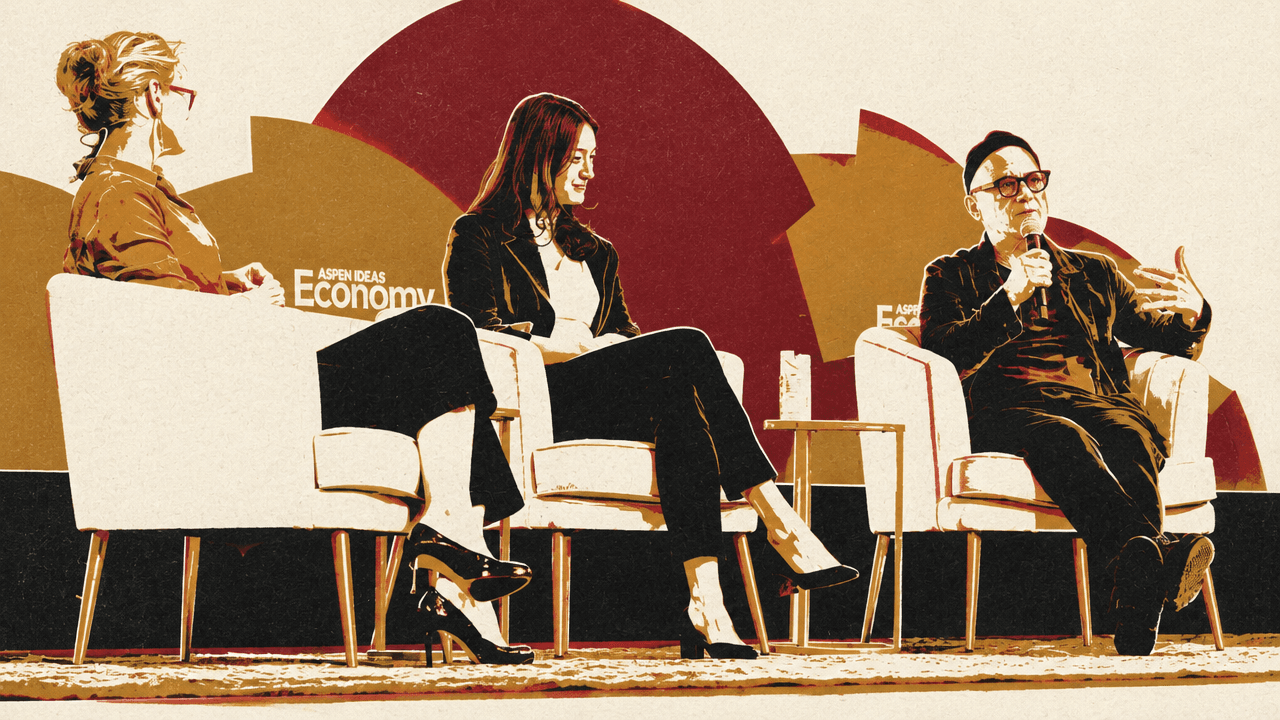
Historian and political theorist Glory Liu argues that Adam Smith’s account of economic cooperation is not a simple defense of self-interest: it also asks how societies can benefit from rising productivity without letting wealth concentrate into private power. In a discussion with composer David Lang, Liu places that question in the context of Smith’s critique of mercantile privilege, company rule and slavery, and argues that economic life is about who sets the terms of exchange and who gets to participate—not just how wealth is produced.
Smith’s problem was how productive economies could become instruments of power
Adam Smith’s The Wealth of Nations is often reduced to a defense of self-interest: people pursue private gain, and the “invisible hand” turns that pursuit into public benefit. Historian Glory Liu argued that this familiar reading misses a harder question: how can societies harness the extraordinary productivity of economic cooperation without allowing wealth to concentrate in ways that enable private domination?


Liu described Smith as an Enlightenment moral philosopher concerned with the general rules that hold society together. His 1759 Theory of Moral Sentiments examined how people learn moral rules; The Wealth of Nations, published in 1776, examined how they learn to cooperate economically and politically. Smith also wrote on the history of science, arts, and letters. He planned a book on law and government, but ordered his remaining manuscripts burned shortly before his death. His lectures offer some clues to its intended subject, Liu said, but not a complete account of what he would have written.
The book’s account of economic cooperation begins with a practical limit on benevolence. People cannot expect the butcher, brewer, or baker to provide dinner simply out of kindness. They are more likely to get what they need by showing others that an exchange serves their interests too. As Liu explained, this is how people cooperate with strangers: each party offers something the other wants.
That is not the same as saying selfishness automatically makes everyone better off. Liu said the invisible-hand passage comes after Smith’s “huge and blistering critique” of Britain’s mercantile system. Its wider context complicates the idea that private self-interest, by itself, reliably produces public good. The butcher-and-baker example describes how exchange can work; it does not settle who shapes the rules of exchange or who benefits from them.
David Lang came to Smith from outside economics and history. He said Smith’s name had come to his attention as a familiar justification for why desirable things, such as good health care, supposedly could not be provided: “It’s the invisible hand.” Lang decided to read the book by making an artistic project out of it, eventually composing an 18-movement work for the New York Philharmonic.

Music makes the terms of exchange feel less settled
In a performance excerpt shown during the discussion, a choir sings the passage that begins, “we stand at all times in need of the cooperation and assistance of great multitudes.” The text moves from the limits of relying on others’ benevolence to an appeal to mutual interest: “give me that which I want and you shall have this which you want.” It closes by repeating “the butcher, the brewer, the baker.”
Liu, who had attended the performance, said the passage can sound like a celebration of selfishness when heard on its own. In her reading, Smith’s point is that people cannot rely on pure altruism to get what they need; they can make cooperation possible by showing others that an exchange is in their interest. The excerpt’s repetition makes the familiar formulation difficult to miss, but its place in a larger work also matters: Lang sets Smith’s words alongside other writing about wealth, inequality, and power.
Lang said music adds an emotional message to the intellectual one. It can prompt listeners to ask not only what a claim means, but how they feel about it. If a system corrects itself through people’s pursuit of private interest, he asked, is that good—or does it mean people cannot be as benevolent as they might wish? The choir’s rendering gives that tension a felt dimension: the exchange is presented as a way to secure cooperation, but its appeal to self-interest is not emotionally neutral.
Music adds emotion to what it is we are reading and thinking.
Lang described the composition as a work about a foundational text that people can misquote or twist to say what they want. He read about 100 books for the project, including Liu’s Adam Smith’s America. He also set Smith alongside later American writing and public speech: texts by Ralph Waldo Emerson, Franklin Delano Roosevelt, Frederick Douglass, and The House of Mirth. He used them as commentary on Smith and as examples of what people in different periods thought about wealth. The work began with 60 movements and was cut to 18. One omitted section concerned land use and ownership, including Thomas Paine’s argument that American land should be free.
Liu’s book takes up a related question: how Americans have read, debated, and transformed Smith over more than 250 years. Those interpretations, she said, have often conflicted. Smith’s ideas have been appropriated, weaponized, criticized, and played with. The meaning of a text, in this account, is not exhausted by what its author wrote; it is also shaped by how later readers put it to use.
Liu locates Smith’s critique in a world shaped by company power and slavery
Liu situated Smith’s argument in the global upheaval he was observing. In her account, the Boston Tea Party of 1773 was not just a protest against a tax on tea. The tea came from the British East India Company, which held a monopoly on trade between the Indian subcontinent, Britain, and the colonies. The company was nearing bankruptcy, Liu said, and the Crown raised taxes on the colonists to bail it out.
For Liu, this arrangement made visible a problem Smith was trying to understand: a private company could steer the policy of a nation with global reach while ruling over a population much larger than Britain’s. She said the company controlled about half of global trade. Smith was asking how private merchants had acquired such power, and how a nation might understand wealth differently from a system in which private interests shape public policy. Liu compared the problem to what would now be called state capture.
She connected this commercial system to slavery and the transatlantic slave trade, which were bound up in the networks through which commerce and capital accumulation operated. Liu said Smith opposed slavery both because he regarded it as morally abhorrent and because he saw it as economically unsound. His commitment to the moral dignity of individuals accompanied his view that wealth was generated by the productivity of free human labor. Liu’s point was not that economic growth and violence were separate forces: she said they were deeply entangled in the world Smith was observing.
Lang found another way into this question in Smith’s description of a poor person’s wool coat. Making it involves a shepherd, someone who spins the wool, a person who makes the shears, workers who smelt the metal, and people who transport it. Even an ordinary object, Lang said, depends on a far-reaching network of labor.
For Lang, that network sharpened the question of who has agency within economic interdependence. The people involved in making the coat contribute to a chain of production, though they may never meet or know the final use of their work. Slavery, by contrast, denies people the freedom to participate as agents in such a network. Lang saw an objection to slavery not only in Smith’s moral commitments but also in the structure of his account: interdependence depends on contributions from people whose freedom cannot be treated as incidental.
Liu described the central tension in The Wealth of Nations: the division of labor can generate productive capacity on a scale earlier forms of society could not match, potentially improving the condition of poor people. But the same economy can concentrate wealth and enable private domination, including collusion between business interests and the state that rigs the rules. The question is how to harness the benefits of production without allowing wealth to become a source of control.
For Liu, the economy is about power as well as prices
Asked what Smith might say about the economy today, Lang declined to speculate. He said the book feels modern because Smith writes about human problems, not only the particular circumstances of the eighteenth century. “Sadly,” Lang said, “we are the same people he is talking about then.”
Liu cautioned that Smith wrote before industrialization, mass democracy, and late financial capitalism. The relevance she sees is not that he anticipated those later systems, but that his approach to the economy remains deeply human. It is not just about making money or maximizing utility, she said. It is about who controls how people meet their needs, who receives the benefits, and who gets to participate in decisions about national wealth.
That emphasis links Liu’s account of exchange and production to her examples of the East India Company and slavery. Cooperation and interdependence can generate wealth, but they do not by themselves determine who has agency, who sets the terms, or who gains from the result. Those questions are shaped by power, and by the laws, histories, and institutions through which economic life is organized.