Youth Sports Participation Rebounds, but 63% Goal Requires System Change

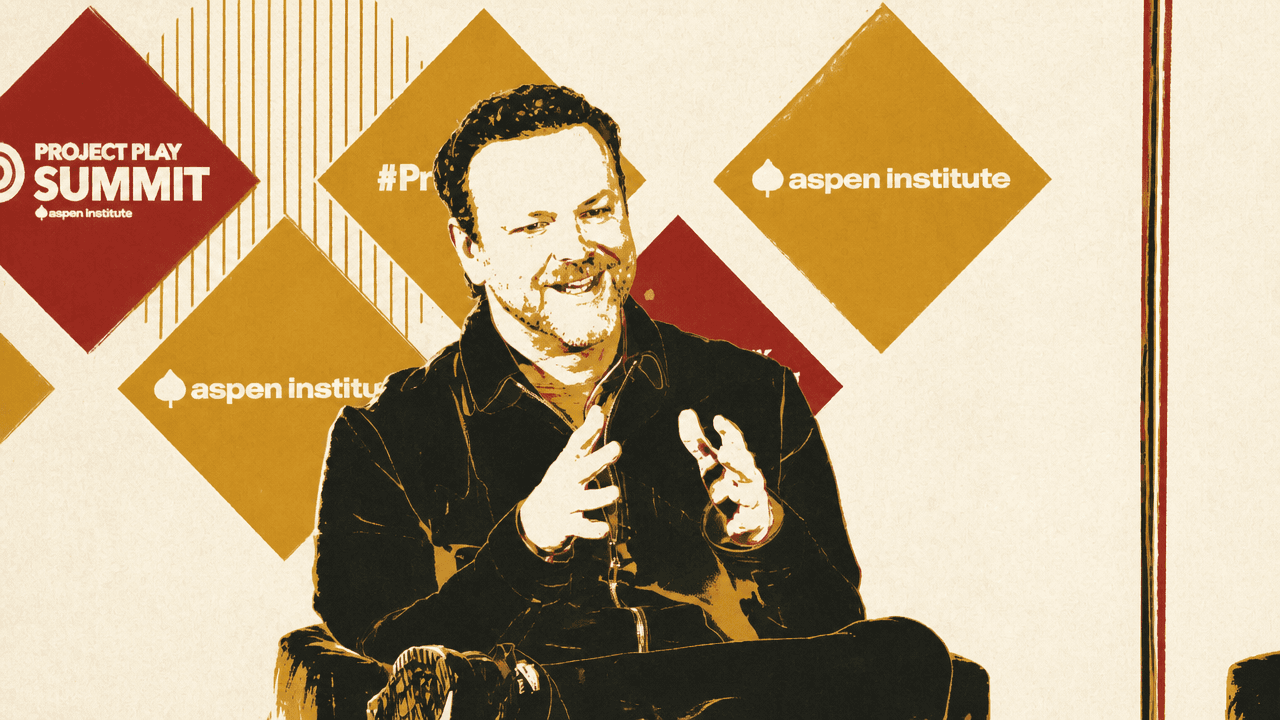
At an Aspen Institute Sports & Society Program session on the 63x30 challenge, Ashleigh Huffman said youth sports participation has rebounded from its COVID-era low but remains constrained by a system built to “weed folks out.” Rick Jordan of the DICK’S Sporting Goods Foundation and Steve Tanner of PGA of America argued that reaching 63% participation by 2030 will require more than new programs: longer community investments, coordinated sport pathways, practical access to facilities and equipment, and coaches who make children want to return.
Participation is rising, but the system still weeds children out
The 63x30 challenge is built around a clear target: move youth sports participation to 63% by 2030. Ashleigh Huffman said youth sports has made real progress since the COVID-era low point, with participation “clawed” back from 49% to 58%. The Aspen description for the session cites the most recent government data at 55%, up from 49%. However stated, the direction of travel was the same: participation has rebounded, but not enough to declare victory.

Huffman credited the rebound to intentional work by people and organizations trying to change youth sports rather than merely talk about it. She tied that progress to the 63x30 roundtable’s activity over the prior year: $71 million invested, 263,000 coaches trained, 3.5 million parents engaged, plus community days, advocacy, efforts to unlock funding, and work to expand access and opportunity.
The harder question, as Huffman framed it, is not whether more children can be brought into sports. It is which children are being reached, whether they stay, and whether the structures around youth sports are designed for inclusion or attrition. She described American youth sports as “beautifully chaotic, slightly dysfunctional, deeply fragmented, and super rich in talent,” comparing it to a family group chat where some people are doing too much, some have muted and archived the thread, and everyone else is trying not to fall five messages behind.
Her critique was sharper than a general call for more programming. Huffman argued that the country does not have a participation problem because children do not want to play. It has a participation problem because the system is producing the outcome it was built to produce.
We have a participation problem because the system is doing exactly what it was intended to do: weed folks out.
That diagnosis set the terms for the discussion: alignment across fragmented organizations, longer investment horizons, facility and equipment access, coach quality, and a shift from isolated programs toward community-level systems.
Golf is trying to build a pathway instead of another standalone program
Steve Tanner described the 63x30 Golf Alliance as a response to a familiar youth-sports problem: many well-intentioned organizations doing strong work, but mostly within their own lanes. In golf, he said, organizations have their own boards, strategies, and profit-and-loss responsibilities. That makes collaboration easy to praise and harder to execute.
The alliance began after PGA of America started talking with First Tee and Youth on Course at the prior year’s Project Play Summit in Berkeley. The question was whether the three organizations could make a larger contribution by working together under the Project Play banner and explicitly aligning with the 63x30 goal. Over the remainder of the year, that became the 63x30 Golf Alliance, announced at the PGA Show in January.
The alliance brings together PGA of America, First Tee, and Youth on Course. Tanner called them arguably the largest, most impactful, and most influential organizations in youth golf. The significance, as he described it, was not only operational but symbolic. Some of the reaction to the announcement was essentially surprise that the organizations were publicly coordinating at all. Tanner said people responded with versions of, “Wow, you guys talked to each other?” even though he has close colleagues and friends at the other organizations.
The alliance has three goals. First, each year it will activate around the priority set by 63x30; for 2026, that priority is facility access. Second, it hopes to make a contribution toward the 63% participation goal. Third, Tanner said it can model leadership within golf and perhaps across other sports by showing that collaboration can produce better outcomes.
The alliance’s logic is structural. Tanner said a healthy youth sports network needs three things: access, structured play, and free play. In his view, the three golf organizations map onto those needs. First Tee provides access and integrates golf into a life-skills curriculum. PGA Jr. League provides structured play. Youth on Course addresses free play by offering rounds of golf at $5 or less.
That distribution of roles matters because it moves beyond a single program trying to fill every gap. Tanner said the alliance can help create “a system that makes more sense at the community level” by connecting organizations that already serve different parts of the youth golf pathway.
PGA Jr. League is the structured-play piece of that pathway. Golf carries perception barriers around access, and Tanner’s answer was not simply to invite children into the adult version of golf. PGA Jr. League simplifies rules, creates a more playful format, scales down the course, and borrows from Little League Baseball’s social architecture: put children on a team, give them a jersey, give them a sense of community, and let them play.
The program is led by PGA of America golf professionals, whom Tanner described as the stewards of facilities across the country. He said PGA Jr. League operates at about 2,400 golf facilities, expects nearly 100,000 participants this year, and has more than 80% beginners among its participants.
| PGA Jr. League measure | Figure cited by Tanner |
|---|---|
| Facilities | About 2,400 golf facilities |
| Expected participants this year | Nearly 100,000 |
| Beginners among participants | More than 80% |
| Scholarships awarded this year | More than 5,000 |
Financial access is part of the same strategy. Tanner said PGA REACH, the PGA of America’s foundation, and partners including the Arthur M. Blank Family Foundation have awarded more than 5,000 scholarships this year to children receiving financial aid and to military families. He described access in three layers: programming access by meeting children where they are, facility access through PGA members, and financial access through scholarships.
For Tanner, the point is not only to open the door to golf, but to make the first organized experience feel like a youth sport: social, scaled appropriately, and supported by adults trained to make children want to return.
DICK’S is making longer bets on community organizations
Rick Jordan described the DICK’S Sporting Goods Foundation’s role as removing barriers to play. Its newer strategy, he said, is to go deeper into communities over a longer period of time.
The Sports Matter Impact League is a 10-year commitment across nine cities. Organizations receive three-year grants, but Jordan emphasized that the funded groups are “doing more than just sport.” Sport is the hook that brings children in, but the organizations also provide services such as mental health support, tutoring, and career readiness. In his framing, these groups are wrapping their arms around children, not simply filling a schedule with games.
Huffman connected that longer funding horizon to nonprofit reality. Year-to-year fundraising makes it difficult for organizations to build durable programs, retain people, and learn from peers. She described the community element as just as important as the money: “If you’re on an island with a great idea, you’re still on an island by yourself.”
Jordan said the first cohort began last year and included representatives from the nine cities present at the summit. As more groups are added each year, the foundation wants to create a community of organizations focused on youth development. That community, he said, can learn together, have shared experiences, and participate in activities such as coach training.
Jordan’s model treats sport participation as connected to mental health, academic support, readiness for work, local relationships, and the capacity of community organizations to become durable parts of children’s lives.
Equipment can be the barrier between an open court and actual play
Huffman identified equipment as one of the concrete barriers to participation and asked Jordan about a new DICK’S Foundation partnership with Equip. Jordan described Equip as a system of free lockers placed in public spaces so people can borrow the equipment they need to use nearby facilities.
The Equip model is designed for a simple sequence: a person opens a locker with an app, takes the equipment, plays, and returns it. The demonstration shown during the session used an outdoor basketball court and a blue Equip locker beside it. The on-screen prompts included steps such as opening the door, taking a photo to confirm, enjoying play, and returning the equipment. A title card identified the partnership as “DICK’S FOUNDATION SPORTS MATTER X Equip sport.”
Jordan said Equip has operated in Europe and Canada, and that DICK’S Foundation is its first U.S. partner. The U.S. effort is a three-year pilot in Miami, scheduled to debut in June. If it works, he said, the foundation hopes to scale it to multiple cities.
The practical problem is straightforward. A city may build or renovate a court or field, and children may be able to physically reach it, but play still fails if they arrive without a ball or other equipment. Jordan described the locker model as a way to make nearby public facilities usable in the moment. A child might come to a court and realize the court is available but no ball is. With a locker nearby, that barrier is removed. Or a group of friends passing through a park might decide to play because the equipment is already there.
The lockers are not limited to basketball and soccer. Jordan said they will include fitness equipment and gear for multiple sports. Huffman called equipment access “a real barrier, and a real solve,” and suggested that if the model works it could be spread widely by the time of LA28. That was framed as aspiration, not a commitment.
Retention depends on the coach children meet
Huffman drew a distinction between getting a child to arrive and getting that child to return. Once a child reaches a program or facility, she said, “it’s the coach that keeps you there.” The quality of the experience determines whether children feel they belong and want to come back.
Steve Tanner said PGA of America treats quality coaching and quality programming as “two sides of the same coin.” In his view, both are required to create what he called a magical experience for the child.
PGA of America’s coaching infrastructure rests on its association of 31,000 men and women golf professionals. Tanner described them as the people who greet participants at courses and serve as coaches and instructors. The organization has an education system for becoming a certified PGA member and for lifelong learning afterward.
He also pointed to industry-level collaboration around the American Development Model for Golf, developed after golf rejoined the Olympics in 2016. Tanner said PGA helped shepherd that work and that more than 18,000 coaches have completed ADM certification.
The coaching strategy extends inside PGA of America’s own staff. Tanner said the organization has worked with Vince Minjares on coaching communities of practice. PGA staff, especially the field team working around the country with members, think of themselves as “coaches of coaches.”
Huffman’s comparison was deliberately mundane: McDonald’s french fries taste the same at every McDonald’s, so how does PGA create a great coach in every program? Tanner did not claim uniformity is easy. His answer was that the organization invests in member education, industry standards, staff development, and field support at the same time.
System change means listening, coordinating, and accepting longer timelines
When Huffman asked what it would take to move from isolated programs to system-level change, Rick Jordan returned to the need for long-term investments. He said the work requires bringing schools, community recreation leagues, nonprofits, leagues, partners, and other stakeholders together.
For funders, Jordan emphasized listening. He said the DICK’S Foundation should not prescribe what it thinks is best for a community. It should listen to the community and then bring people into the room to ask how they can solve the problem together.
Steve Tanner agreed and added the need for shared purpose and responsibility. PGA of America has a board, committees, and the governance structure of a membership association, and he said it is easy to get stuck in immediate institutional concerns. His argument was that organizations have to rise above self-interest enough to recognize a shared responsibility to children, communities, and families.
That does not mean ignoring institutional interest. Tanner said if sport grows, each organization’s self-interest will be served over the long term. The challenge is getting organizations to accept that long-term logic instead of optimizing only for their own near-term program, budget, or brand.
He also cautioned that change does not always require large interventions. Sometimes, he said, it takes smaller shifts, such as embracing collaboration or adopting models like the Captain program mentioned immediately before the panel. His phrase was “lock arms”: if organizations do that, he said, they can make an impact, and the data shows they already are.
Huffman closed by reframing participation as more than a metric. The goal is not just children playing. It is belonging, thriving, and learning life lessons through sport. She called sport “the best school of life” and said the aim is for that to exist for everyone.