Cohen’s $56 Billion eBay Bid Targets Costs, Sellers, and Digital Collectibles


GameStop chief executive Ryan Cohen is pitching a $56bn bid for eBay as an operating turnaround rather than a financial trade. In an All-In interview, Cohen argues that eBay’s marketplace remains valuable but has been mismanaged through weak growth, rising costs and damaged seller relationships, and says GameStop could cut $2bn in expenses while expanding eBay into live commerce and digital in-game collectibles. The fight, in his telling, is over whether eBay shareholders trust incumbent management or an owner-operator offering half cash, half GameStop stock.
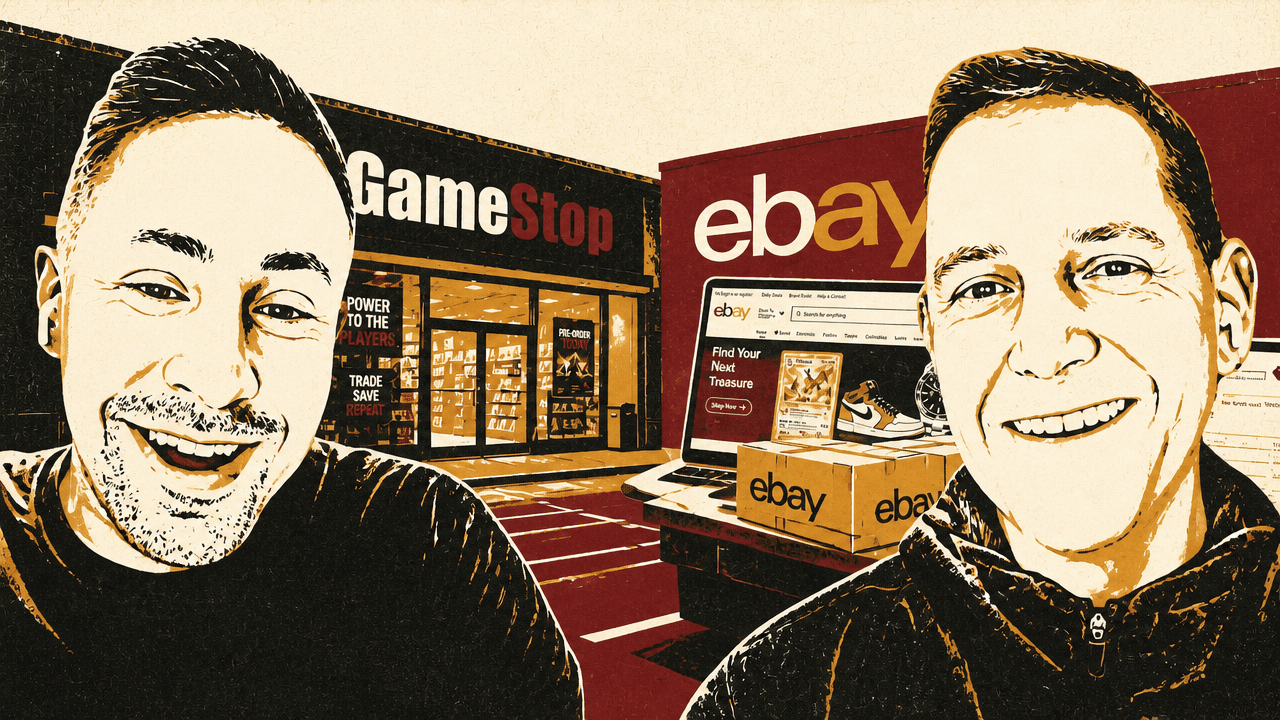
Cohen’s eBay bid is an operator’s indictment, not just a financial offer
Ryan Cohen frames GameStop’s bid for eBay as a question of operating competence and ownership incentives. His case is not only that eBay is a valuable marketplace trading below its potential. It is that eBay has allowed a durable position in online resale, collectibles, refurbished technology, and hard-to-find goods to stagnate while expenses rose, sellers became frustrated, and newer commerce formats developed elsewhere.


The structure Cohen describes is a 50% cash and 50% GameStop stock offer. The stock component is central to his pitch: eBay shareholders would still own the economics of eBay through the combined company, but under a different operator. In his telling, the choice for shareholders is less about whether eBay is a good business — he says shareholders generally love the business — than about “who do you want to run the business” and “who’s going to maximize shareholder value.”
| Measure | Figure or claim | Attribution |
|---|---|---|
| Bid structure | 50% cash, 50% GameStop stock | Cohen |
| Cost-cutting target | $2B of costs | Cohen |
| Expense base described | Close to $5.5B | Cohen |
| Sales and marketing spend described | $2.4B for essentially no user growth | Cohen |
| Live-commerce TAM | About $400B | Cohen |
| GameStop store network | About 1,600 nodes | Cohen |
| Personal capital commitment | $500M | Cohen |
The immediate investor question is whether eBay shareholders should take GameStop stock and Cohen control in exchange for eBay’s current trajectory. Cohen says GameStop is offering a premium to where it bought shares and that he is personally putting $500 million of his own money into the transaction. He contrasts that with what he describes as eBay management and board members who have not bought stock in the open market with their own money, are well paid, and are protected by the status quo. He says he has not “pulled a penny out of GameStop” and has invested substantial capital into it over time.
Ultimately, the vote is on who's going to be a better fiduciary of capital and, and who can grow this business.
Cohen’s criticism of eBay is specific. Since COVID, he says, “every important metric is down”: GMV, active users, operating earnings. He says active users are down by 30 million, revenue is essentially flat to up only a few points, and operating expenses are up significantly. For a marketplace business that does not carry inventory, he argues, eBay’s expense base is too high: operating expenses are “over half” of revenue. He also points to $2.4 billion spent on sales and marketing for “essentially no user growth.”
The first part of his plan is immediate: cut costs. Cohen says he sees an opportunity to remove $2 billion of costs from an operating expense base of roughly $5.5 billion. That would, in his view, produce an immediate improvement in earnings before any growth plan has to work.
The growth case has two parts. The first is live commerce. Cohen says eBay has the users, brands, and platform footprint to be a leader, but that “the platform sucks” on both the front end and back end. He says sellers have told him they applied to participate in eBay Live and were waiting to be approved, a process he sees as self-defeating for a business trying to attract sellers and creators. He says “nobody even really knows eBay Live exists,” and that live commerce is a roughly $400 billion addressable market, popular in Asia and growing quickly in the United States.
The second growth vector is the one Cohen says he had not previously discussed publicly: using eBay to create liquidity for in-game digital items. He distinguishes those from NFTs by arguing that in-game items have utility: skins, weapons, and other goods accumulated inside major game titles can be used in the games themselves. Physical collectibles, in his telling, are often “an ego play” — art, trading cards, rare objects — but digital game items combine collectible value with actual usage. He says no marketplace is providing broad liquidity for them, and that eBay should already be doing it.
Cohen does not present this as a generic conglomerate thesis. He says eBay and GameStop overlap where GameStop has been moving: collectibles, secondary markets, refurbished technology, authentication, and liquidity for consumers. What GameStop does in stores, he argues, eBay does online. eBay has global scale; GameStop has stores and a growing trade-in model. The combination, in his view, creates both operating overlap and a physical footprint that could support the next version of the marketplace.
The rejected bid has become a fight over control, financing, and legitimacy
Cohen says eBay’s board rejected the offer in a letter that cited uncertainty, including financing uncertainty. He rejects that objection by arguing that GameStop would finance the transaction off eBay’s balance sheet; in his framing, if GameStop cannot obtain that financing, eBay itself could not either.
He says there has been “really no engagement” from eBay management or the board. His account is that eBay directed GameStop to high-priced advisors, but meetings were not scheduled when GameStop reached out. Cohen says he has not sat down with eBay’s CEO, though he would fly to California immediately to do so, and that he has not met with board members despite reaching out.
The half-stock structure is not incidental. Asked why GameStop has not raised enough capital to make the bid entirely in cash, Cohen says that is not what GameStop has presented to date and that “we don’t have 60 billion dollars of cash just lying around.” His argument is that eBay shareholders do not need to be fully cashed out if they believe in the asset. They can keep economic exposure through the combined company, with Cohen running the business.
The governance path is constrained by shareholder mechanics. eBay shareholders recently rejected a proposal to reduce the threshold for calling a special shareholder meeting from 20% to 10%, making it harder for GameStop to force a shareholder meeting without 20% support. Cohen says the vote was close. He will not describe individual shareholder conversations, but says the consensus he has heard is broadly aligned: investors love the business and see opportunity. He also suggests the composition of the offer could change if shareholders who love the business prefer less cash and more continuing ownership.
Cohen’s argument about incentives is sharper than his financing explanation. He says the eBay CEO has not bought a single share of stock in the open market with his own money and has sold tens of millions of dollars of stock. He describes eBay’s management team as overpaid, without builder experience, and insufficiently owner-like. He says the board makes hundreds of thousands of dollars a year, attends a handful of meetings, and does not buy stock with personal capital. David Friedberg notes that eBay’s CEO would receive a large payout if removed; Cohen says the golden parachute is over $100 million.
There’s nothing more American than basically risking your own capital. So why does everyone want us to fail?
The fight is also about public legitimacy. Cohen asks why the media and market commentators seem to want GameStop to fail while favoring eBay’s incumbent management. David Friedberg offers a theory: commentators who dismissed GameStop as merely a meme stock would have to admit they were wrong if they acknowledged the operating improvements at GameStop and Cohen’s credibility as an executive. In that view, maintaining the old narrative requires continuing to make Cohen seem less credible. Cohen’s response is brief: “Yeah. Yep.”


Asked whether GameStop will go hostile or launch a tender offer, Cohen does not specify the next step. He says he will do whatever he needs to do to succeed and is “clearly” committed. He says there are “a lot of different escalation paths” in the toolkit and that GameStop is working with bankers and high-priced advisors.
Cohen’s claim about other bidders is that the deal makes unusual sense for him because of what he believes he can do with eBay: near-term earnings improvement through cost cuts, and longer-term growth through live commerce and a digital marketplace for gaming items. Large competitors, he notes, would face antitrust issues on a deal of this size. Beauty, he says, is in the eye of the beholder: eBay is worth this much to him because of his operating plan.
Cohen says eBay’s seller relationship is the operating failure
Cohen’s critique of eBay turns repeatedly on sellers. In a marketplace model, he says, sellers are the customer. If sellers are happy, they bring more inventory onto the platform; more inventory drives more sales. His complaint is that eBay has taken sellers for granted, alienated them, and failed to give them the tools they need to operate inside the platform.
He contrasts eBay with Amazon Seller Central. Amazon charges sellers a lot, he says, and sellers may dislike the margins, but they can move a lot of inventory and the platform gives them an integrated operating environment. With eBay, Cohen says sellers often need third-party tools outside the platform because eBay itself does not provide enough functionality. “It’s a pain,” he says.
That seller failure is also part of his broader critique of professional management replacing founder-operator intensity. Cohen says the simple work is to call top sellers, ask them about pain points, put engineering on the phone with them, and start “banging them out.” His view is that eBay management is not doing that kind of direct problem-solving; instead, he says, they are likely using multiple outside consultants.
The diagnosis is not that eBay lacks a brand or a market position. Cohen says eBay remains the de facto online marketplace in certain categories. Its strength is precisely in categories where Amazon is less natural: unique baseball cards, hard-to-find pens, used auto parts, secondhand goods, refurbished technology, collectibles. But he argues that those strengths were not necessarily the result of sustained strategic excellence. eBay may have “defaulted into” them because Amazon focused elsewhere.
In a marketplace model like eBay, the sellers are the customer. You make your sellers happy, you give them the tools, they bring more inventory online, and you end up ultimately doing more sales.
Cohen is careful not to argue that eBay should become Amazon now. He says he would not be interested in taking possession of first-party inventory and does not want to go head-to-head with Amazon in that way. He likes eBay’s marketplace model. The missed opportunity, in his view, is that eBay once had the position to become much more than it did. It had first-mover advantage and became the default online marketplace, but did not compound that position through execution as e-commerce grew.
Asked whether eBay missed the shift to stores and seller storefronts, Cohen says eBay “could have been Amazon.” But the path he now favors is not replicating Amazon’s full-stack inventory-and-logistics model. It is strengthening eBay’s marketplace around categories where it already has power and where GameStop’s current strategy overlaps.
He also likes focus. He does not criticize eBay for shedding unrelated assets in principle. Asked about PayPal, Skype, and StubHub, Cohen says he prefers building organically through eBay and concentrating on a singular brand, especially for a global marketplace already active in many categories. The problem, as he sees it, is that focus has not produced meaningful GMV or earnings growth.
GameStop’s stores are the infrastructure behind the live-commerce plan
The live-commerce plan depends on more than adding a feature to eBay. Cohen says GameStop’s store network can become infrastructure for creators, sellers, fulfillment, logistics, photography, and authentication.
He says GameStop has roughly 1,600 stores that could function as “nodes.” In a live-commerce strategy, those nodes could become studios for creators. They could also help sellers with the operating tasks creators may not want to handle: photographing items, fulfilling orders, authenticating products, and managing logistics. Cohen says creators should be able to focus on creating content, while the platform supplies the commerce infrastructure around them.
This is not presented as a replacement for the marketplace. It is an extension of it. GameStop’s trade-in model already gives Cohen a template: consumers bring goods into stores, GameStop pays cash, and the items are either sold in-store or moved to warehouses and sold online. In collectibles, Cohen says GameStop now buys graded PSA cards 8 and above, pays cash on the spot, and resells through its store and online channels.
That model, he says, worked in trading cards because it was adjacent to GameStop’s existing trade-in muscle in hardware and software. Collectibles were not an entirely new category for GameStop; the company already had exposure, then deepened it after other consumer-electronics experiments failed to take off. Trading card games have been “very, very, very popular,” he says, and sports collectibles are now growing as well.
Friedberg describes GameStop’s recent figures as part of the operating record Cohen wants eBay shareholders to recognize: collectibles at 42% of revenue, or $350 million; first-quarter revenue of $835 million; 14% year-over-year growth; SG&A reduced from $228 million to $202 million; $9.7 billion in cash; $333 million in free cash flow; and board authorization for a share repurchase. Cohen’s response is not to dwell on GameStop as a finished product, but to say organic growth alone is not enough for what he wants to build.
Cohen says the size of what GameStop can build organically is “nice” and “okay,” but he likes doing big things. Chewy could have been run as a smaller, profitable business with lower marketing spend, he says, but “life is too short to do it small.” eBay, in his view, is the larger move because the overlap is unusually strong and the market position is already global.
He also says eBay is closer to his own circle of competence than physical retail. Cohen built Chewy in e-commerce and says he understands eBay’s online marketplace better than he understood GameStop’s stores when he became CEO. He describes the eBay idea as one he “can’t stop thinking about,” and, unlike Chewy’s low-margin fight with Amazon or GameStop’s distressed retail situation, calls it “actually a really good idea.”
The digital-collectibles plan is Cohen’s largest growth claim
The most expansive part of Cohen’s eBay plan is not cost cutting or seller tooling. It is the idea that eBay’s role as a marketplace for physical collectibles can extend into in-game digital items. Cohen argues that eBay is already a leader in physical items and physical collectibles, and that its marketplace identity could be applied to skins, weapons, and other digital goods accumulated inside major games.
His comparison to NFTs is pointed. NFTs, he says, were treated as if they would become useful digital collectibles, but “ultimately they had no real utility.” In-game items, by contrast, do have utility because people use them in games. Cohen’s view is that existing collectibles markets already demonstrate how much value people attach to scarce, identity-laden objects even when the utility is mostly social. A trading card is “a piece of cardboard and a piece of plastic,” he says, but it can be very popular because ownership itself signals something.
The claim is that in-game items combine the collectible psychology of cards and art with actual use. Yet Cohen says there is no marketplace providing broad liquidity for those assets. He believes the addressable market could be significantly larger than eBay’s marketplace for physical items.
That vision also ties back to GameStop’s history and customer base, though Cohen does not present it as a nostalgia play. GameStop’s original business was tied to games, hardware, software, and trade-ins. Its turnaround has deemphasized software and expanded into collectibles, but a marketplace for in-game items would reconnect the company’s gaming heritage with eBay’s marketplace infrastructure.
Cohen says an existing management team would “never be able to build” such a marketplace “in their wildest dreams.” That is both a strategic assertion and a challenge to eBay shareholders: the value of the offer depends not only on cost removal, which is comparatively straightforward to underwrite, but also on whether Cohen can use eBay’s brand, users, seller relationships, authentication know-how, and GameStop’s physical network to build categories eBay has not captured on its own.
Chewy is the operating credential Cohen brings to eBay
Cohen’s e-commerce claim rests heavily on the way he describes Chewy. He did not start with pet food. He and his team were preparing to launch an online jewelry business despite knowing little about jewelry. They had gone to trade shows, bought hundreds of thousands of dollars of inventory, built the website, and set up distribution. Then Cohen, while shopping at a neighborhood pet store for his poodle, concluded that the pet category made more sense.
The attraction was practical. Pet food and related supplies were recurring purchases. The market was fragmented. Neighborhood pet stores still existed despite Petco and PetSmart. Amazon had carried pet products since the 1990s but had not achieved category scale. Cohen saw the opportunity to replicate the neighborhood pet-store experience online and at scale: deep product knowledge, customer intimacy, and passion for the category, combined with Amazon-like supply chain practices.
Chewy focused first on food, treats, litter, and other consumables that customers bought repeatedly. Cohen says cohort data showed customers were sticky. The bet was that if Chewy treated customers well, they would continue buying and refer others. The visible customer touches became part of the company’s identity: handwritten holiday cards, pet portraits, 24/7 customer service, and a posture of taking care of the customer when problems arose.
For Cohen’s eBay argument, the more important part is the operating discipline. Chewy was low margin and in direct competition with Amazon. It was “a game of pennies.” Success meant moving from pallets of dog food to truckloads, from distribution to direct purchasing, and negotiating fiercely with suppliers to lower product costs. It also meant optimizing labor, warehouses, shipping rates, and advertising. Cohen says he stayed in Google AdWords until 4 or 5 in the morning managing campaigns himself and negotiated directly with major suppliers.
His supplier philosophy is blunt: if suppliers send gifts, that is a bad sign because it means the retailer is overpaying; if suppliers say they do not want to speak again for a year after a negotiation, that means the retailer is getting the right price. He says this runs against the instinct of employees who want smooth relationships with suppliers. In a money-losing, low-margin business, he argues, sustainability depends on transactional discipline.
It was a game of pennies. And we, you know, we were the the goal was to grow quickly and establish market leadership, and the difference between failure and success was, you know, pennies in the red is failure and and and pennies in the black is success.
Chewy also shaped Cohen’s people doctrine. He says he looks for “will over skill.” His example is a woman who repeatedly applied for a customer-service role despite not having the obvious background; she had worked in an old people’s home and was initially passed over, but her relentlessness got noticed and she became “incredible.” Cohen says he wanted “die-hards” willing to put everything in — people “as psychotic as me,” a group he jokingly calls “fellow psychopaths.”
Chewy sold in 2017 for $3.35 billion. Friedberg notes that it later went public at a much higher market capitalization. Cohen says nobody had a crystal ball, and that investment bankers at the time believed the sale price was excellent. He calls Chewy “my baby” and says he loved the business, while accepting that life worked out in a way that led him to GameStop and now eBay.
GameStop taught Cohen not to impose the wrong playbook
Cohen’s GameStop story begins as a contrarian investment, not an operating plan. He says he looked for established businesses with a strong historical record of making money that were out of favor with passive and activist investors. GameStop fit because it was widely hated, heavily shorted, and treated by media and markets as an inevitable failure. Cohen says he liked the underdog setup: running into “a burning house” where pessimism and fear could create opportunity.
His original thesis was tied to the console cycle. GameStop, he believed, might survive until the next PlayStation and Xbox cycle, and historically performed well early in console cycles when hardware and software demand were tight. He initially owned less than 5% and considered it passive. Then GameStop’s CEO contacted him while the company was fighting another activist and, according to Cohen, offered him a board seat because they thought he would help fend off the activist. Cohen says they “kind of put the idea” in his head.
After COVID worsened the business and the stock fell, Cohen kept accumulating. Crossing 5% forced the filing decision: a 13G for passive ownership or a 13D for engagement with management. Cohen chose the 13D. He eventually joined the board in early 2021 with two former Chewy colleagues. The stock then took off, short sellers covered, and, according to Friedberg’s account, GameStop raised $1.7 billion and wiped out its debt.
The first operating plan, Cohen says, was wrong. He imported his Chewy bias and tried to make GameStop more like Chewy. He hired e-commerce people from Chewy and Amazon and hired a CEO rather than running the business day to day himself. It took a little over a year, he says, to realize that applying the Chewy playbook to GameStop was “really, really stupid.”
The difference was structural. Chewy sold consumables with recurring demand and sticky cohorts. Inventory turned quickly, revenues were growing, and overbuying was less dangerous because goods would eventually sell. GameStop was physical retail, and Cohen says he had no physical retail experience when he became CEO. Inventory errors were costly: TVs and other poorly chosen products could get stuck in stores, require markdowns, and destroy margin.
Once he became CEO, Cohen says he shifted quickly after looking at the financials. He moved into “maniacal cost-cutting mode,” focused on efficiency, and concentrated on what GameStop was good at: pre-owned products and running the retail business well. That path led into collectibles, where the trade-in model was transferable and demand proved strong.
The lesson matters for eBay because Cohen is not claiming that one universal playbook can be imposed on every company. When asked whether he has a management framework comparable to a repeatable Koch Industries-style operating system, Cohen says he probably does but is not good at articulating it. He says if he describes what is going through his head, it may come out wrong. Someone else might be better at explaining his method.
That creates a real tension in the eBay bid. Cohen is asking eBay shareholders to trust his operating judgment, but he does not offer a polished management doctrine. What he offers is a record, a set of instincts, and a willingness to change course aggressively when the first strategy proves wrong.