Google’s Frontier AI Push Is Constrained by Compute Demand

Google CEO Sundar Pichai argues that staying at the frontier of AI is a strategic necessity, even as the models are costly, compute is scarce and many products can use smaller systems. In an interview with Big Technology Podcast, he said Google is prioritizing research and model development over some short-term Cloud revenue, while planning capacity years ahead. He also described a broader strategy: develop models and agents across Google’s products, and invest in safeguards as AI capabilities advance.
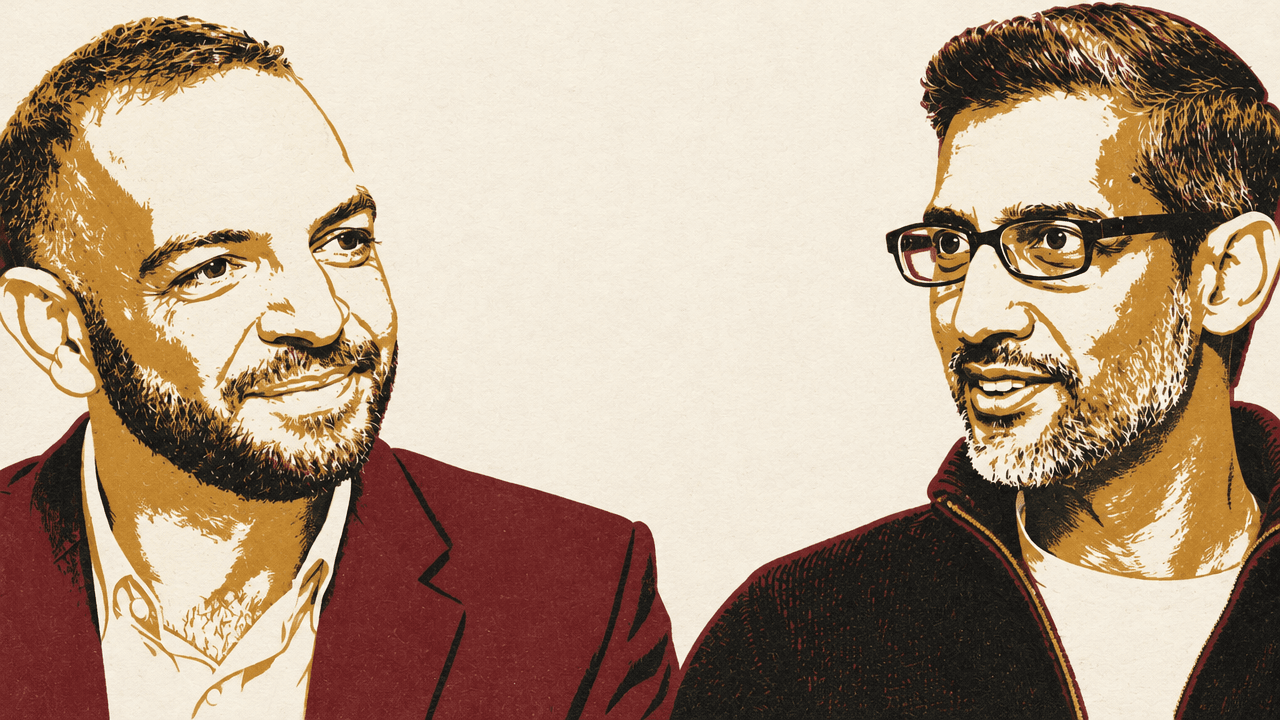
Frontier models are a strategic position, not just a premium product
Sundar Pichai says Google remains committed to building frontier AI, rejecting the idea that it should settle for capable, cheaper models and focus on adding them to existing products. He described frontier work as part of the company’s identity and argued that it matters even when many users can get useful results from less capable models.
Pichai pointed to Gemini 4 Argon as evidence of that commitment. Google took longer to test and deploy it than it had with other models, he said, because of its capabilities. He described it as strong across agentic work, knowledge work, coding and creative tasks. In its first 72 hours, Argon was approaching 25 trillion tokens of use—about three times Gemini 3.0’s usage in its first 72 hours. Google was already capacity-constrained while serving it.
That adoption did not mean the model was finished. Pichai said Google could identify areas where Argon needed improvement, including particular pockets of coding. In a fast-moving field, he argued, a model’s strengths have to be understood against the shifting frontier: a model can be better across the board than it was two months earlier and still have visible gaps.
The case for continuing to invest at the frontier is not that every product needs the most powerful, most expensive model. Pichai agreed that less-frontier models can make excellent product experiences, and noted that Google offers models of different sizes and capabilities, including Flash and Flash Lite. Frontier models can be slower and more expensive. But he gave several reasons Google still wants to compete at the top end: frontier work exposes the company earlier to emerging capabilities; some Cloud customers want access to frontier models; and, in his view, frontier models may be better positioned to help develop the next generation of models.
There is also an internal research and engineering payoff. Pichai said deploying Argon to Google’s developers had produced a “steep point of inflection,” letting them tackle problems previous models could not. He said developers were using it on complex projects affecting millions of lines of code.
Pichai said the older measure of the proportion of code written by AI had become less useful because AI now deeply influences every part of the code Google touches. In the four weeks after Argon’s launch, he said, Google saw a 30% increase in CLs and a roughly one-third decrease in rollbacks. He described the changes as evidence that developers were writing code more productively and with fewer rollbacks; these are figures he reported, not independently established outcomes.
The figures do not describe a simple share of code authored by a model. Pichai said Argon was being used on larger, more complex projects, and that Google was tracking newer measures because AI’s influence on coding had become pervasive. That benefit makes frontier access valuable even if a product team ultimately chooses a smaller model. The goal, as Pichai put it, is parity at the frontier alongside a range of models for different uses—not forcing every use case onto the largest one.
Current self-improvement still depends on researchers
The prospect of models helping build better models raises concerns about how quickly capability could advance and whether systems will reliably do what people intend. Pichai’s key qualification was that current recursive self-improvement is far from a system autonomously improving itself: researchers use feedback loops and agents to help with aspects of model development, while researchers remain involved. He expects that process to progress further in the coming year.
Today, the right way to describe it is you have RSI loops along with AI researchers in various aspects of model development.
On safety, Pichai said alignment remains active research, with clear gaps. Google does not rely on alignment alone. He described a broader approach that includes monitoring model activity in real time, collecting enough telemetry to detect unexpected behavior and intervening when needed. The systems that make monitoring possible—how they are architected, isolated and kept able to do their work under observation—are themselves areas of investment.
He also emphasized controls for customers, especially enterprise customers: monitoring in real time, deciding where a model is deployed and limiting the data it can access. Pichai said the compute needed to deploy models safely has to be part of the investment. His account joined model training and deployment safeguards: alignment work is one part of the process, alongside monitoring, isolation, customer controls and the ability to intervene.
Pichai called concern about the risks reasonable. He said the industry should continue raising its standards for alignment and safety testing, and argued for cross-industry standards and independent evaluation. He compared the need to develop them with the role of accounting standards and independent auditors in financial controls. He also said regulation would play a part.
Google is pursuing research beyond language models. Pichai argued that systems able to understand physical laws and simulate the world in high fidelity could be important building blocks for intelligence. He linked Google’s work on world models to Argon’s performance on embodied-reasoning benchmarks, including robotics-related tasks. He said Argon had performed strongly on those benchmarks and credited Google’s experience with world models as one contribution.
The rationale, as Pichai described it, is that intelligence involves more than processing language: people perceive the world around them, and models that can represent physical laws and simulate the world could support applications such as robotics. He expects approaches to converge over time, but said Google wants to work across them now. He described intelligence as a “jagged frontier” and argued for pursuing multiple approaches rather than assuming there is only one route to more capable systems. In his view, working across language and world models can produce better research and insights, and ultimately contribute to a more capable general model.
The same portfolio logic applies to less mature research bets. Pichai listed synthetic data, continual learning and more efficient architectures alongside world models. Google allocates a meaningful share of its compute to these lines of work, he said, and ideas from such bets can eventually enter its main models. He cited Argon’s million-token output capability and the earlier Gemini models’ million-token input context as examples of breakthroughs associated with this research effort. He described several parallel bets rather than a single research priority.
Compute decisions made years ahead are shaping the present
Pichai described compute allocation as a long-range planning problem with a clear priority: Google DeepMind must have enough compute for research and frontier model development. He said that priority was non-negotiable, with the company’s other businesses planned around it. Google’s 2015 decision to become “AI first” reflected his view that AI is a horizontal capability relevant across Search, Cloud, Waymo and the rest of the company.
After protecting frontier research, Google plans for its separate businesses using their forecasts, customer demand and committed contracts. Cloud has its own projections and signals, Pichai said, but its near-term revenue can give way to compute needs for frontier work. He confirmed that Google Cloud forgoes some short-term revenue when it makes those trade-offs.
The supply problem cannot be solved quickly. Google is building its own compute and data centers, and the facilities have long lead times. Pichai said the compute available now reflects decisions he made in 2024. Demand can shift faster than the infrastructure plan: he noted that the surge in agentic coding had not happened a year earlier. By the time new capacity arrives, the needs against which it was planned may have changed.
That is why he was cautious about judging individual decisions in hindsight. Google, like other companies, is short of compute, and companies would prefer to have twice what they planned. A customer asking for compute in 2027 would be difficult to accommodate, Pichai said. Google had leased short-term compute the previous year to help meet some customers’ needs. He described the industry as facing similar timelines.
He nonetheless expects the capacity Google plans to have uses for, given enough time. That confidence is qualified by the possibility of overbuilding. A data center depends on many components, Pichai said—Kantrowitz named memory, electricity and electricians as examples, and Pichai said there could be 2,000 components or more. Bottlenecks, external economic shocks or other constraints could leave parts of the buildout out of balance. Overbuilding is possible, he said, even if the long-run demand for compute looks compelling.
Pichai’s answer to whether the broader industry is in a bubble depended on the time horizon. He argued that current investment makes sense over a sufficiently long period because the technology is already in use, applications are improving and Google is constrained by demand. At the company level, he said, planning should be disciplined: weigh demand signals and committed revenue against technical capability, internal evaluations, internal use and the trajectory of the models. The result should be aggressive investment, but not investment detached from those considerations.
That position also complicates the idea that researchers should simply receive the largest possible computers, regardless of what Cloud could earn by selling capacity. Pichai said Google is already making that kind of trade-off, but resisted treating unlimited compute as automatically optimal. Some constraints can spur researchers to find more efficient algorithms or use less memory. Google’s commitment, he said, is to invest what is needed to remain at the frontier.
AI products will combine new interfaces with existing ones
Pichai rejected a simple divide between “AI-native” products and AI added to existing services. He said Gemini was built from the ground up as a product, but also argued that adapting existing products and creating new experiences will both matter. The question can be turned around, he noted: as companies build agents, it is not obvious whether they are adding them to existing assistants or building agentic products natively. For Pichai, the test is whether the resulting experience is world-class.
Google’s broad product portfolio is both an opportunity and a coordination challenge. Pichai’s proposed answer is an agent that carries context across services, rather than requiring the user to repeatedly move information between separate interfaces.
When asked about a possible Google competitor to Meta’s Muse or other newer products, Pichai did not announce a separate product. He pointed instead to the Gemini assistant and its developing task capabilities, saying that personal agents would be brought to consumers and work across Google surfaces. He said a steadily growing percentage of incoming requests to Gemini were agentic tasks; a year earlier, he said, most would have been classified as chats. The intended experience is one in which users do not have to decide whether to start a chat or assign an agentic task: Gemini should increasingly infer the right action and be able to keep working in the background. Pichai said the app’s Chat and Task experiences were already steps toward this, and that Argon had accelerated those capabilities.
In Google’s plan, the agent will not live only in the Gemini app. Pichai described a persistent agent as a headless service—its runtime, harness and model working in the cloud, with the user’s context available across products. In response to a complaint about searching Gmail through Gemini versus connecting Gmail to ChatGPT, he said Google was working toward a unified agent that could be addressed from Workspace, Search or Gemini.
That answer also acknowledged an execution problem. Pichai conceded that a broad product portfolio moving quickly will have areas that advance at different rates. He called the Gmail feedback valid and said Google was putting effort into making its agentic experience work consistently across its surfaces.
The interface, in his view, will adapt more to people rather than requiring people to adapt to software. AI should be available when wanted, retain context, provide continuity and avoid unnecessary complexity. But Pichai does not expect interfaces to disappear. Voice can make some interactions more natural; he described using Gemini’s voice input to dictate informally, including names that might otherwise need correction. Yet people will still want to watch a video or consume something an AI has created. The product should shift fluidly between modes, not assume that conversation is the only interface.
He also expects the economics of these products to evolve with their usefulness. Pichai cited software developers’ willingness to pay for coding models as an example of people paying for productivity. For consumer agents that arrange purchases or other commercial activity, he said that providers on the other side will see value and that some mechanism will emerge to account for it. His emphasis was on building products valuable enough to support a business.
Partnerships extend Google’s reach, but do not settle product questions
Pichai described Google’s relationship with Anthropic as a bet on a team it believed could stay at the frontier. He said Google recognized early that Anthropic’s founding team had been involved in some of the earliest GPT models and judged it to be a world-class group. Google has tried, he said, to identify and partner with companies likely to remain at the cutting edge. Some of the partnerships have also involved Google’s TPUs.
On Apple, Pichai framed the Gemini partnership as a way to translate AI capabilities into better user experiences. He praised Apple’s work customizing models and incorporating them into Siri, and said the partnership was working well. Asked whether it was expanding, contracting or holding steady, he said he had nothing specific to announce but that the companies were committed to doing more.
The two arrangements illustrate different forms of cooperation in Pichai’s account: a financial and technology relationship with a company he viewed as a frontier developer, and a partnership intended to bring AI capabilities into another company’s consumer product. Neither, in his description, replaces Google’s own effort to build frontier models and consumer-facing agents.
Space is a long-term infrastructure bet, not a demonstrated solution
Pichai described space-based data centers as an early, difficult project, not a proven way to supply compute. He compared the work with Waymo and quantum research: technologies that can look like science fiction early in their development but may become meaningful over a decade or two. Google had been working on space for two to three years, he said, and had recently sent TPUs into space. At the time of the interview, the team was expecting a “hello world” moment from them.
The long-term rationale, as Pichai sees it, is access to abundant solar energy in sun-synchronous orbits as demand for compute grows. He said the approach could make sense in the future, while emphasizing that the project is challenging and has disciplined milestones. Sending the TPUs and awaiting an initial test were steps in the project; Pichai did not present them as proof that space-based data centers are feasible at scale.
On Earth, the immediate constraints include not only equipment and power but the places where data centers are built and the effects on nearby communities. Pichai said Google is committed to building responsibly by engaging communities early and transparently, bringing incremental power and covering the full cost of the power the projects need. He also said the company must understand the impact on neighborhoods and work early to address it.
As an example of what local investment can mean, Pichai pointed to communities where Google has operated for a long time. He said people there had told him their children went to college because of Google’s investments. He presented that as part of the case for building and growing in those communities, while also acknowledging that not every company operates in the same way.
Kantrowitz noted that people can be surprised when data centers appear in their backyards. Pichai agreed that the industry should do better on those issues. He also linked the search for other locations, including space over a much longer horizon, to the possibility that infrastructure trade-offs might be different elsewhere.
Optimism means working to make technology serve people
Pichai said his confidence comes from the belief, grounded in his own experience, that improving technology and access to it can make people’s lives better. But he distinguished that conviction from building without restraint. Humanity has to work to harness technology so that it serves society, he said, and improving the human condition should be the defining goal.
He expects important gains in areas such as health care and the discovery of new materials. He also pointed to the possibility of making things less expensive in areas where costs have risen for a long time. Pichai said it is difficult to understand from the present how profound those changes could be. At the same time, he said, people should be concerned about the ways the technology can go wrong and work to address those concerns.