Anthropic’s $518 Billion Compute Commitments Face Uncertain Customer Demand


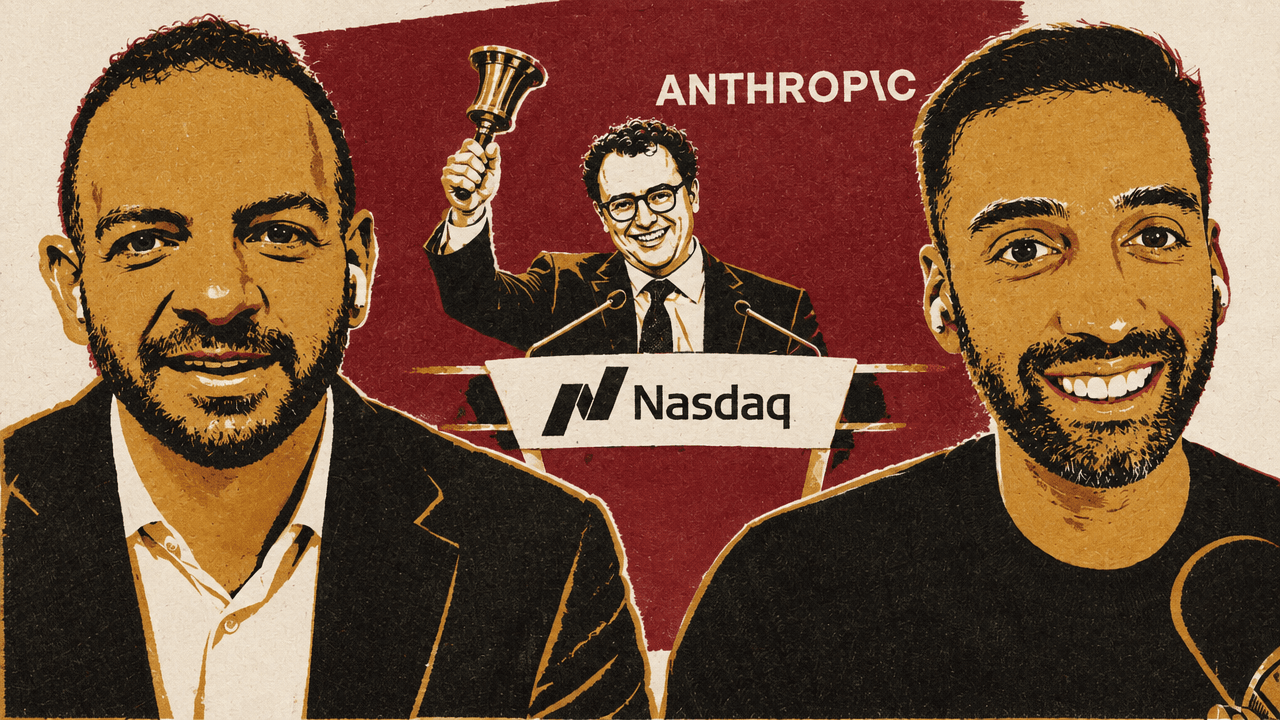
Anthropic’s leaked financial figures show revenue rising from $400 million in 2024 to $4.6 billion in 2025, alongside a decade-long commitment to $518 billion in computing and infrastructure spending. On Big Technology Podcast, Alex Kantrowitz argues that those obligations could amplify the effects of slower growth, both for Anthropic’s suppliers and for a stock market increasingly reliant on AI-related companies. Ranjan Roy sees customer concentration and losses as more immediate risks, and expects Anthropic’s counterparties to have reasons to negotiate if the company falters.
Anthropic’s growth has to outrun its infrastructure commitments
Anthropic’s leaked financial figures put two different businesses side by side: one growing at extraordinary speed, and one committed to spending on a scale that may be difficult to support. The tension is not just whether the company can keep growing. It is that its spending obligations are comparatively fixed while its customers may be able to reduce their spending.
Alex Kantrowitz cited revenue of $400 million in 2024 and $4.6 billion in 2025. Anthropic had said it ended 2025 at a $10 billion annualized revenue run rate, he said. That run rate is not the same as revenue earned across the year: a business that grows sharply between January and December can finish at a much higher annual pace than its full-year total suggests. The leaked figures offer a retrospective view, not a settled account of where revenue stood in 2026.

The infrastructure plan is harder to reconcile with the reported revenue. The company expected to spend $518 billion on computing and infrastructure over the next decade, according to the figures discussed, and 80% of that amount was described as binding or non-cancellable.
The commitments were reported to include $111.1 billion to Alphabet, $110 billion to Amazon, and $31.4 billion to Microsoft. The figures do not mean that all of the spending is due immediately; they cover a decade. But the non-cancellable portion makes the scale consequential even if the company’s growth slows.
The comparison with revenue depends heavily on which revenue figure is used. Ranjan Roy said the leak showed Anthropic at the end of 2025 but did not include first-half 2026 financials. He wanted to see more recent revenue and loss figures before judging the company’s current position. He also challenged a reported $42 billion net-loss figure: in his account, $34 billion of that total reflected an unusual accounting treatment related to the company’s increase in value, leaving an underlying net loss closer to $8 billion. Even on that interpretation, he said, Anthropic was losing about $2 for each dollar of revenue in 2025.


Other figures discussed were forward-looking estimates, not reported results. Kantrowitz recalled estimates putting Anthropic’s annualized revenue at roughly $45 billion to $60 billion for much of the year, and a report attributed to people close to the company said it could reach a $100 billion annualized rate by year-end. Neither estimate resolves the question of what Anthropic actually earned in 2026. Kantrowitz’s point was that spending hundreds of billions looks less daunting if revenue is moving toward the higher estimate than if it remains closer to the end-2025 run rate.
The mismatch is between a long-term supply commitment and a less certain stream of customer demand. Anthropic has reason to secure computing capacity in advance: if it has too little, it may be unable to serve customers while competitors have more capacity available. But the company’s customers are not necessarily making equivalent commitments to Anthropic. The leaked risk disclosures said nearly a quarter of 2025 revenue came from two customers, and that many of its largest clients were not locked into long-term contracts and could cut or stop spending.
That asymmetry is the practical risk behind the headline totals. The company may be committed to buy capacity even if some customers can scale back what they buy from it. The source did not establish that the contracts would be enforced without negotiation, or that every commitment would translate into spending on the same schedule. It did establish why the issue would matter to investors: Anthropic’s future demand has to grow into obligations that cannot all be cancelled.
Roy resisted Kantrowitz’s suggestion that failure to meet those obligations would necessarily drive Anthropic into bankruptcy. The counterparties include companies that have invested in Anthropic or rely on its business. If the company faltered, Roy argued, they would have strong reasons to negotiate rather than enforce contracts in a way that destroyed a valuable customer. He framed the commitments as a risk to the suppliers and investors as well as to Anthropic.
Kantrowitz agreed that Amazon would have reasons to try to prevent an Anthropic collapse, given its investment and commercial relationship. But he did not think the possibility of rescue removed the risk. A negotiated accommodation could still mean losses or weaker expectations for the companies supplying and financing Anthropic. The consequences could spread without a formal bankruptcy.
He pointed to the scale of the cloud relationships and the sector’s growth. AWS had grown at roughly 17% annually before the AI boom, Kantrowitz said, and was now growing in the 30% range. He connected some of that acceleration to business from companies such as Anthropic and OpenAI. If an important customer’s growth weakened, he argued, the effects could reach the forecasts attached to the suppliers as well.
The two speakers differed most over which warning sign was likely to matter first. Roy saw customer concentration, losses, and a possible slowdown in revenue as more immediate concerns than the compute commitments. The obligations stretched over time and could, in his view, become the subject of negotiations among sophisticated counterparties. A change in the company’s growth trajectory would be harder to work around. Kantrowitz’s concern was that the commitments could magnify the effects of that change: even before bankruptcy or a contract dispute, investors might reconsider the value of the businesses exposed to Anthropic’s growth.
The public offering would test whether investors are willing to accept that combination: exceptional reported growth, continuing losses, substantial long-term obligations, and customers that may be able to leave. Roy expected Anthropic to provide more recent financials, reasoning that investors considering a reported valuation around $2 trillion would want a better picture of the current business. But he acknowledged uncertainty about what the company would actually disclose. Kantrowitz likewise said the newer figures would matter because the trajectory—not just the 2025 total—would determine how investors read the spending commitments.
A narrow group of AI companies is carrying the market’s story
Anthropic’s prospects matter beyond its own balance sheet because the market’s gains have been concentrated in AI and adjacent companies. Kantrowitz cited figures attributed to Goldman Sachs: the S&P 500 was up about 13% that year even as the median stock traded 16% below its 52-week high. He said half of the index’s earnings-per-share growth was coming from AI investment and described market breadth as its weakest since the dot-com bubble.
The other figures shown during the discussion made the concentration more concrete. A chart shared by Steve Rattner said that, since late August, chip stocks were up 9%, the S&P 500 was up 0.4%, and everything except AI was down 5.4%. A post quoting Citadel said Microsoft, Nvidia, Apple, and Meta had added about 300 points to the S&P 500 in the third quarter—more than the index’s total gain—while the other stocks together had subtracted about 150 points.
| Measure discussed | Figure |
|---|---|
| S&P 500 gain that year | About 13% |
| Median S&P 500 stock below its 52-week high | 16% |
| Share of S&P 500 earnings-per-share growth attributed to AI investment | Half |
| Everything except AI since late August, according to the chart shown | −5.4% |
For Kantrowitz, that concentration makes the AI story a market issue, not only a question about whether one company can meet its obligations. If Anthropic or OpenAI begins to look weaker, the consequences could include lower expectations for the technology suppliers and investors that have built forecasts around AI demand. He did not predict an economic collapse. He suggested instead that doubts could lead the market to give back some of its gains if investors stopped believing that AI investment would translate into sustained growth and profit.
Roy described a reinforcing pattern in which investors who are not holding AI-linked stocks see other parts of their portfolios perform poorly and rotate further toward the apparent winners. That can concentrate the trade even more. If confidence changes, he said, richly valued companies could face renewed scrutiny, and investors might move away from the narrow group of winners or back toward companies that had been losing ground.
Neither speaker treated a market downturn as certain. Roy said he was not trading on the possibility of one: irrationality can persist, and he believes AI is a real technological development. Kantrowitz also called a collapse an overstatement. Their concern was that the market may be vulnerable to a shift in confidence because so much of its performance depends on a relatively small set of AI-related companies.
The points of disagreement were partly about the trigger. A weak IPO or slower revenue growth could prompt questions about Anthropic’s own prospects. But the broader market risk, in Kantrowitz’s account, comes from the possibility that such questions would weaken the shared expectation that AI investment will keep expanding. Roy emphasized the way that expectation already affects trading: when investors move into a few names because other holdings are lagging, a change in that behavior could be dramatic.
The anticipated filing is one possible test, but the discussion left its significance open. Kantrowitz sees Anthropic as an important indicator because it is relatively focused on AI, even though it has begun building products. Its disclosures could help show whether public-market investors believe the market for advanced AI is large enough to support the commitments. Roy expected the filing to include newer results but did not assume those results would settle the issue.
This concentration also complicates the competitive incentives among technology companies. Roy asked whether Meta might try to undercut Anthropic and OpenAI aggressively, even if doing so damaged the short-term market confidence on which Meta also benefits. Kantrowitz expected Meta to keep competing: it has cash, computing capacity, company relationships, and data. But he doubted that Meta’s consumer offering or its enterprise plans would necessarily displace providers of the most capable models in demanding business settings.
That question leads beyond market positioning to what customers need from agents. If the best models are valuable for only a narrow set of tasks, competition on price and distribution may matter more than the race to provide frontier intelligence everywhere. If they are necessary across a much wider range of work, the case for continued infrastructure spending is stronger. The disagreement over agents therefore bears directly on the market’s assumptions about compute demand.
Agents raise a harder question than whether they can do the work
OpenAI introduced Dots as an agent users can contact through ChatGPT, Slack, Microsoft Teams, text, or a phone call, and connect to third-party applications. Users can name their agent and ask it to handle tasks such as making reservations or managing finances. Kantrowitz said the product was announced for subscribers to OpenAI’s Pro plans, which started at $100 a month. The launch demonstration was shaky, he said, even as Meta’s stock rose—a sign, in his reading, that investors saw Dots and Meta’s Muse as competitors.
Kantrowitz’s experience with Dots was more compelling than the launch demo. He gave it access to his laptop, browser, and ChatGPT account, then asked it to read recent emails and articles so it could pick up his writing style. It began drafting replies in his voice, which he could review and edit before sending. He also asked it to find an invoice in Drive, attach it to an email draft, and prepare a note for the usual recipients.
The value in that task was not merely producing a sentence. Kantrowitz described the energy involved in turning a clear intention into a properly phrased email—direct without sounding offensive—and the way those small tasks accumulate. Dots drafted replies that he could revise in his drafts folder, allowing him to clear messages faster. For him, the agent’s ability to take an instruction, find the relevant material, and sequence the work made it useful.
He then asked Dots to plan a weekend trip to El Salvador: find a rental car and hotels, work to a budget averaging about $100 per night, and put together an itinerary. Dots offered hotel options, but Kantrowitz chose among them and completed the bookings himself. When it noticed that reaching one hotel might require off-road driving, it asked whether it should check with the rental agency and hotel. He agreed. Dots drafted and sent those emails.
Roy pressed him on how much autonomy that demonstrated. Kantrowitz had made the hotel choices and confirmed the bookings; Dots had raised a logistical concern and followed an instruction to contact the relevant businesses. The example showed useful delegation, but not a process in which an agent made all consequential decisions without a human.
Roy also challenged the use of “enterprise” for this sort of work. An individual handling email, travel, and invoices is delegating work, but that is not the same as a large organization adopting an agent for operations that involve security, privacy, and approval chains. In Roy’s account, enterprise products are expected to serve complex organizations with controls and processes beyond an individual’s own decisions. That distinction matters because agents may be valuable to individuals and smaller businesses without satisfying the requirements of the largest customers.
The products are also starting to feel interchangeable. Roy had tried Meta’s Muse and Instinct, and described Manus’s consumer agent, Q, as another product in the category. He noted that Manus had earlier experimented with natural-language workflow generation and that Q included an in-line video editor on the desktop. His broader point was that companies were converging on products that accept natural-language instructions and turn them into workflows. If those capabilities converge, he argued, the differentiator may be which company users trust with access to their accounts and data.
Kantrowitz said he did not fully trust any of the agents, but was more willing to tolerate some than others. Dots would not accept his credit card, he said. Yet he also instructed it to find and sign a speaker release in his email, and it did. The example raises a practical question about what an agent should be permitted to commit a user to. Roy had given Instinct his credit card but not Muse; he had allowed Muse access to his American Express login to check card benefits. The choices were not a simple ranking of product capability. They were judgments about access, usefulness, and risk.
Proactivity creates a related tension. Roy described Muse sending him an unsolicited update about an investigation involving OpenAI, even though he had not asked for AI news. In another case, the agent checked a restaurant reservation site after he had looked for a table and found a newly available booking. One intervention felt useful; the other felt like an overreach. The same background activity that makes an agent seem attentive can make it feel intrusive.
Roy’s standard was that agents need to “play it cool.” A useful reminder can feel almost magical when it anticipates a real need. Constant notifications and attempts to demonstrate activity can wear down that value. This is particularly important for products presented as always-on assistants: more activity is not the same as more help, and engagement can conflict with a user’s sense of control.
The product debate also became a disagreement about the cost of intelligence. Kantrowitz found the latest OpenAI and Anthropic models more thoughtful than earlier versions and other competitors. He uses AI to review stories and interviews, ask what he may have missed, and make sense of material from multiple sources. In his experience, newer models are better at diagnosing what a story is about, clarifying information, and connecting inputs. He sees a meaningful difference in how well the systems understand a problem.
Roy argued that many of the tasks Kantrowitz described do not require frontier models. Email and a limited corpus of personal information are manageable tasks, he said, and producing a reply in someone’s style does not by itself demand the most advanced system. If an always-on agent relies on frontier models for every background task, the cost of that activity could become substantial.
He also said that enterprise use was spreading across open-weight models and in-house systems rather than flowing only to frontier providers. In his account, open-weight models had gone from being 12 to 18 months behind to perhaps three to six months behind. That narrowing, combined with model routing—using different models for different tasks—could let customers reserve more expensive systems for work where their added capability matters.
The disagreement was not simply whether frontier models are better. It was about where the difference is valuable enough to justify the cost. Kantrowitz pointed to research and writing analysis as tasks where he saw improvements. Roy argued that tasks involving a finite amount of text and a limited sequence of reasoning may be handled well by less expensive models. When Kantrowitz asked what requires frontier intelligence, Roy pointed to demanding scientific work such as sequencing DNA and to more complex capabilities involving simulated environments and virtual worlds.
If Roy is right that routine agent tasks can be routed to cheaper systems, a growing number of agent interactions will not necessarily mean equivalent growth in demand for frontier compute. Customers could use agents frequently while directing much of the work to less expensive models. If Kantrowitz is right that the newer systems are materially better at interpreting and combining information, customers may decide that the difference is worth paying for across more tasks. The market for agents and the market for the most expensive models are related, but they are not identical.
That distinction matters for Anthropic’s commitments. A larger installed base of assistants, or more delegated work, does not by itself show that customers will buy frontier compute at a rate sufficient to support the company’s spending plans. The key question is what customers will pay for: more AI activity in general, or sustained use of the most capable models.
A convincing avatar raises questions about disclosure and misuse
Tavus’s Griffin raised a different question: how quickly a video interaction can make a machine seem human. Tavus described Griffin as an AI model that can hear, see, speak, and react during a live video call. The company said that nearly half of participants in a short test believed they were speaking with a person. Tavus presented Griffin-Lite as a research preview for trusted testers and said it was working on safety and disclosure features before a wider release. It had not announced a firm public launch date.
The demonstration shown during the discussion featured an exchange between two apparent participants on a video call. Roy was struck less by perfect visual fidelity than by the interaction’s timing. Some synthetic performances he had seen felt unnatural because of the delay while a system processed a prompt and produced a response. Griffin appeared to respond more naturally. He found the result impressive, while also calling it frightening.
Kantrowitz asked whether the visual Turing test had been passed. Roy said he thought it had, but the evidence discussed was limited: a brief demonstration and a result reported by Tavus from a short company test. The test does not establish how people would respond across other settings or with longer interactions. Kantrowitz also cautioned that the participants could have been unusually receptive, given that it was a company test.
The potential uses were not clear to either speaker. Customer service was one possibility. Kantrowitz was more concerned about fraud: an avatar that looks and responds like a person could make attempts to deceive someone more convincing. He connected that risk to “pig butchering” scams, in which a stranger cultivates a relationship before exploiting the target. A video call could add a convincing face and voice to the kind of unsolicited contact people already encounter through messages.
Roy questioned whether the risk depends on how often people take video calls with strangers. Kantrowitz’s response was that people already receive unsolicited messages from apparent strangers, including messages that open with romantic or flattering language. If an avatar can make a fabricated identity feel more credible, the potential use is not limited to customer service. The company-reported result that nearly half of participants thought they were speaking with a person made the prospect more salient to both speakers, but they did not treat it as a definitive measure of real-world deception.
The discussion also used the example of “Shrimp Jesus,” a reference to the AI imagery circulating on social platforms. Kantrowitz predicted that one company might introduce avatars with safeguards while others reproduce the capability with fewer restrictions. Roy joked about a conversational Shrimp Jesus avatar. The example was comic, but it pointed to a serious uncertainty about how a convincing, responsive likeness might be repurposed after the underlying capability becomes available.
For now, the distinction is between an early product with stated plans for safety and disclosure, and the possibility that similar tools spread beyond those controls. The demonstration and company test gave the speakers reason to take the realism seriously. They did not establish how common misuse would be, or whether an avatar could reliably fool people outside a short test. The open questions are what users will be told, how consistently that disclosure will appear, and whether safeguards will hold as the technology moves beyond trusted testers.