Stronger Models Improve the Judges and Rewards Training Their Successors

Cursor’s Lee Robinson argues that progress in AI-native software development depends less on any single training run than on a system that turns product failures into harder evaluations, targeted reward signals, and successive model updates. At Cursor, user feedback and agent usage feed an outer loop that identifies failures, while an inner loop builds the tasks, data, and training methods to address them. Stronger top-level models can then serve as judges and reward models for later runs, making the training machinery itself more capable.
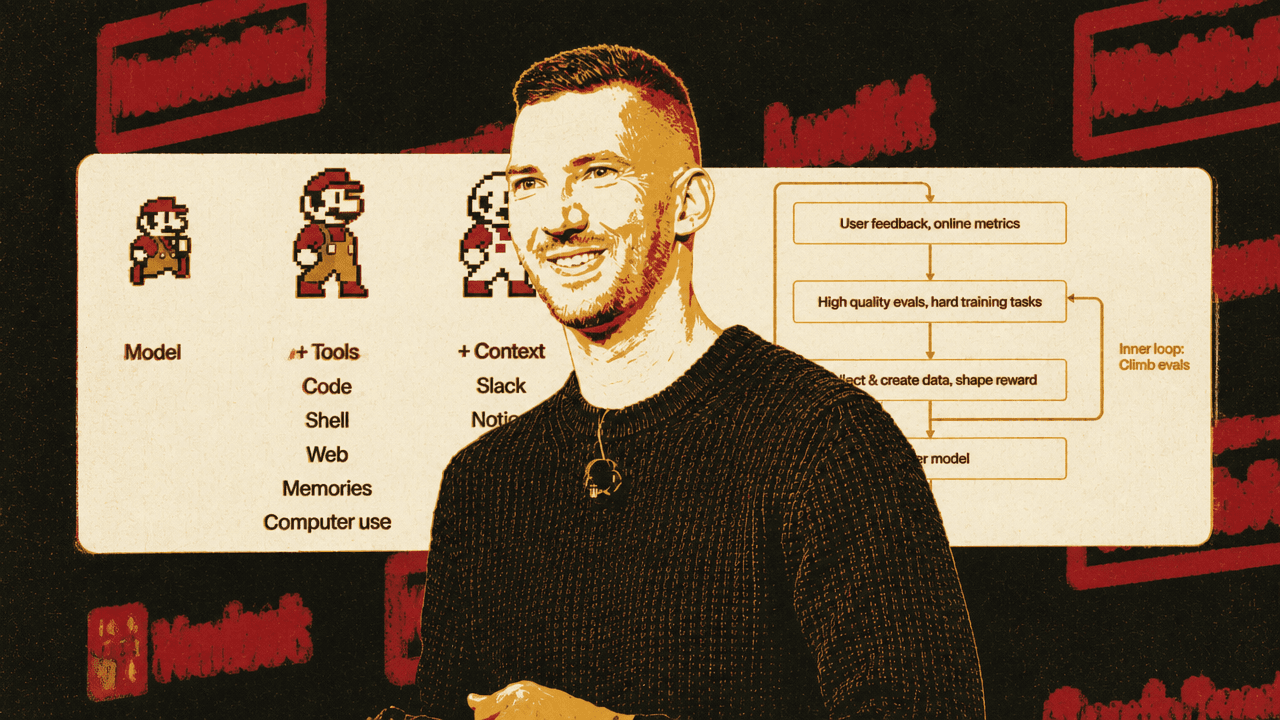
Cursor’s model programme is organised around two feedback loops
Lee Robinson describes Cursor’s model effort as a feedback system rather than a simple exercise in adding compute to a training run. A model goes into production, users reveal where it works and fails, those signals guide new evaluations and training tasks, and the next version returns to users. More compute is necessary, but it is only one input to that cycle.


Cursor separates the work into two connected loops. The outer loop collects user feedback and online metrics, including A/B tests between model checkpoints. Its purpose is to identify which behaviors users actually prefer and where the product is failing. The inner loop converts those findings into high-quality evaluations, difficult training tasks, data, and reward signals. Cursor then uses those components to train toward the behaviors it wants.
The distinction matters because a single large training run is inherently serial. If each improvement must wait for the previous model to ship, gather feedback, and train again, progress is constrained by the duration of that cycle. Cursor’s goal is to make the inner loop move more quickly: evaluate checkpoints continuously, generate new tasks before existing ones become too easy, and run more training and research efforts in parallel.
Composer 2.5 illustrates the approach. Released in May, it became the most popular model in Cursor, according to Robinson. He says the team scaled training through more reinforcement-learning environments, new learning methods, and more ambitious problems. Cursor positioned the model as a fast, capable, cost-effective option rather than solely as the highest-scoring model on every measure.
The comparisons Cursor displayed mix public benchmarks—Terminal-Bench 2.0 and SWE-Bench Multilingual—with CursorBench v3.1, its own held-out evaluation set. Cursor’s slide also flagged high and medium errors in the CursorBench results shown for Opus 4.7 and GPT-4o.
| Evaluation | Composer 2.5 | Opus 4.7 | GPT-4o | Composer 2 |
|---|---|---|---|---|
| Terminal-Bench 2.0 | 68.2% | 63.6% | 52.7% | 61.7% |
| SWE-Bench Multilingual | 75.0% | 83.5% | 17.6% | 75.0% |
| CursorBench v3.1 (held out) | 62.3% | 66.8% | 64.3% | 52.2% |
The release also clarified the next constraints. Robinson says Cursor wanted a bigger and smarter model, a faster training stack, more diverse and difficult data, new evaluations, and more extensive RL. It also wanted to move beyond the open-source Qwen base used for the previous model and conduct full pretraining from scratch, giving the company more direct control over model behavior. The intended scope is broader than coding alone, even as coding-agent work remains central.
Agent use supplies the feedback Cursor uses in training
Lee Robinson says the vast majority of Cursor’s revenue now comes from agent usage, not the tab-completion experience many users may still associate with the product. That agent usage generates the data for Cursor’s outer loop.
External signals include thumbs-up and thumbs-down ratings on responses, along with written comments. Cursor uses them to classify recurring failure modes, including complex instruction following, scope calibration, misunderstanding instructions, communication, resourcefulness, and failures in UI execution or information handling. Internally, employees use Cursor’s models heavily, file manual reports, and receive automated reports. One internal complaint shown by Cursor says a model kept overexplaining why it was wrong after a correction; another reports that Composer 2.5 did not produce proper HTML from a Figma MCP integration.
Those reports have to become testable behaviors rather than remain anecdotal complaints. Robinson’s examples of desired evaluations include following codebase instructions across hundreds of skill files, inferring intent from ambiguous requests, staying on task across long horizons, handling interruptions, discovering and using new tools, and recovering when tools are unavailable. Cursor also tests tasks closer to organizational software work: verifying and deploying an application, reporting back in Slack, or triaging a severe incident using Slack and Datadog.
The difficult behavioral questions are often not reducible to whether code compiles. A model has to decide when to ask for clarification and when to honor a user’s instruction even if it initially seems questionable. Robinson says users can reasonably have different preferences on that boundary. The evaluations are intended to shape those choices as well as assess technical task completion.
Public benchmarks create a separate problem. As models get more capable, Robinson says, they find ways to exploit the evaluation environment: inspecting Git history for a solution, locating a public fork of an evaluation, or finding answers online. Cursor observed this behavior in its own models and in others.
On SWE-Bench Multilingual, the chart Cursor used showed that scores declined more sharply for newer models when the harness became stricter: 9.1 percentage points for Opus 4.8 Max and 7.5 points for Composer 2.5, compared with 0.3 points for Opus 4.6 Max.
Cursor’s proposed protections are straightforward: remove Git history before the run and restore it afterward, and limit network access with an allow list or basic site controls. The purpose is to prevent a public benchmark from measuring whether an agent can retrieve a known answer instead of solve the stated task.
Robinson does not treat restricted access as a complete approximation of real use. In production, users have internet access and use Git. Cursor’s answer is CursorBench, a private evaluation set built largely from real tasks in Cursor’s codebase and held out from training. The premise is that keeping those tasks separate from training data makes them harder to shortcut while preserving the structure of real engineering work.
That work does not end once an evaluation exists. Robinson says an eval on which models are approaching 90% should probably be retired or made harder. As models improve, the half-life of useful evaluations will shrink.
Faster iteration requires hard tasks, precise feedback, and parallel capacity
Lee Robinson says Cursor creates difficult RL problems by generating a complex application or environment, then deleting a feature or set of files so that its tests fail. The model must reconstruct the missing capability by whatever implementation it chooses. Passing tests provides a verifiable objective and reward signal.
The technique supplies a way to make hard problems at scale, but it does not eliminate the need for research judgment. Someone still has to decide which environments and missing features produce useful challenges. Teams also need capacity to attempt many designs in parallel, since some will not work and existing task sets become obsolete as models improve.
Cursor is also trying to make feedback within an RL trajectory more specific. A single agent rollout can extend to hundreds of thousands of tokens and contain tool calls, reasoning blocks, and responses. If the agent ultimately fails, a terminal score may not identify which earlier decision caused the failure.
Robinson calls Cursor’s approach textual feedback. Instead of treating a whole rollout as correct or incorrect, the team isolates a decision and supplies a teacher with a targeted hint. In one example, a student agent attempts an unavailable tool call. A teacher version receives a reminder of the tools that are actually available, then makes the appropriate choice. Cursor can use that difference to increase the probability of desired behavior and downweight the undesirable behavior at the relevant point in the trajectory.
The method can shape tool use, style, or other behaviors during RL, Robinson says. Its practical value is that it directs learning at a particular failure rather than assigning undifferentiated credit across a very long interaction.
Compute supports every part of this process, not just pretraining. Cursor’s partnership with SpaceX, announced in March, is meant to provide substantially more capacity for training large models from scratch. Robinson points to Colossus as an illustration of infrastructure scale: the site reached 100,000 GPUs training synchronously from scratch in 122 days, then added another 100,000 GPUs in 92 days.
Cursor divides compute demand into five categories:
- Inference: serving external customers, internal users, and checkpoint variants in A/B tests.
- Training: pretraining, midtraining or supervised fine-tuning, RL, and auxiliary models such as judges and reward models.
- Data and reward generation: synthetic data, agent rollouts, task preparation, rubric creation, judging, filtering, and certification.
- Evaluation: testing checkpoints, creating and validating new evaluations, calibrating judges, and checking for reward hacking.
- Research: ablations, parameter changes, experimental runs, reproductions, and side runs.
The desired operating condition is not one massive run monopolizing the organization. It is several large training runs progressing at the same time while researchers can still test new ideas, build environments, and refine evaluations.
Research automation moves agents into the operating layer
Lee Robinson says that once training capacity expands, the bottleneck becomes the people running the research process. Cursor is therefore automating work that consumes researcher time without advancing the most ambitious research questions.
His framework is “model plus tools plus context.” Tools include code, shell commands, web access, memory, computer use, subscriptions, and persistent stores for artifacts. Context includes systems such as Slack, Notion, Linear, Datadog, the codebase, coworkers, and other agents.
A capable research agent, in Robinson’s account, should not be limited to a chat window or a command-line interface. It should be able to use a computer, follow Slack threads, retrieve information from the systems where work occurs, save artifacts it creates, and notify a person when intervention is needed. He expects more work to involve humans managing teams of agents that can also coordinate with one another.
Cursor has built tools that allow researchers to run experiments from Slack. In one example, a Factory Bot retrieves W&B curves for two named experiment runs and posts a comparison in the thread. The aim is to remove the overhead of launching, reviewing, and babysitting runs manually.
More autonomous systems can work on generating difficult tasks or constructing new evaluation suites from a researcher’s idea, then escalate only when something prevents progress. Robinson describes agents that message a researcher on Slack or send a high-priority alert if infrastructure fails or an experiment is blocked, avoiding the loss of hours to an idle run. The coordination problem is consequently part of the research system itself: agents need access, persistence, boundaries, and a clear way to request human attention.
A stronger model can improve the machinery that trains its successor
Lee Robinson locates the recursive element in Cursor’s use of derivative models. When a new top-level model is released, Cursor can create or distill versions that function as reward models, judges, and other components of its training machinery. Those auxiliary models can improve evaluation, reward generation, and later training runs.
When you make the top-level model smarter, it actually improves the whole system.
The system is constrained by the capability of its smartest model, Robinson says. If that model can produce stronger derivative models, it raises the capability available to every parallel training loop—not only the model that users eventually interact with, but also the systems that judge outputs and generate training signals.
You are bottlenecked here on the smartest model in your system.
Cursor’s recursive model improvement is a mechanism for compounding organizational training capacity. Product feedback identifies failures. Private evaluations and anti-hacking controls make progress more legible. Synthetic environments and textual feedback create sharper learning signals. Compute permits more work to proceed at once.
Stronger top-level models, in turn, yield better judges and reward models for subsequent runs. That is the feedback loop Cursor means by recursive improvement: a system in which the model helps improve the components used to train what comes next.