At Arca, Agents Own Client Goals Across Days of Work
Aman Singh, who leads AI at Arca, argues that an AI-native financial-services firm should assign agents responsibility for client outcomes, not use them merely to assist employees. Arca’s agents track signals such as emails, calls and account events, carry work across delays and changing circumstances, and bring people in when a decision or action requires them. Singh’s longer-term aim is for the firm to steer its business by setting goals for agents, which then prepare and advance the work—including prompting employees to act.
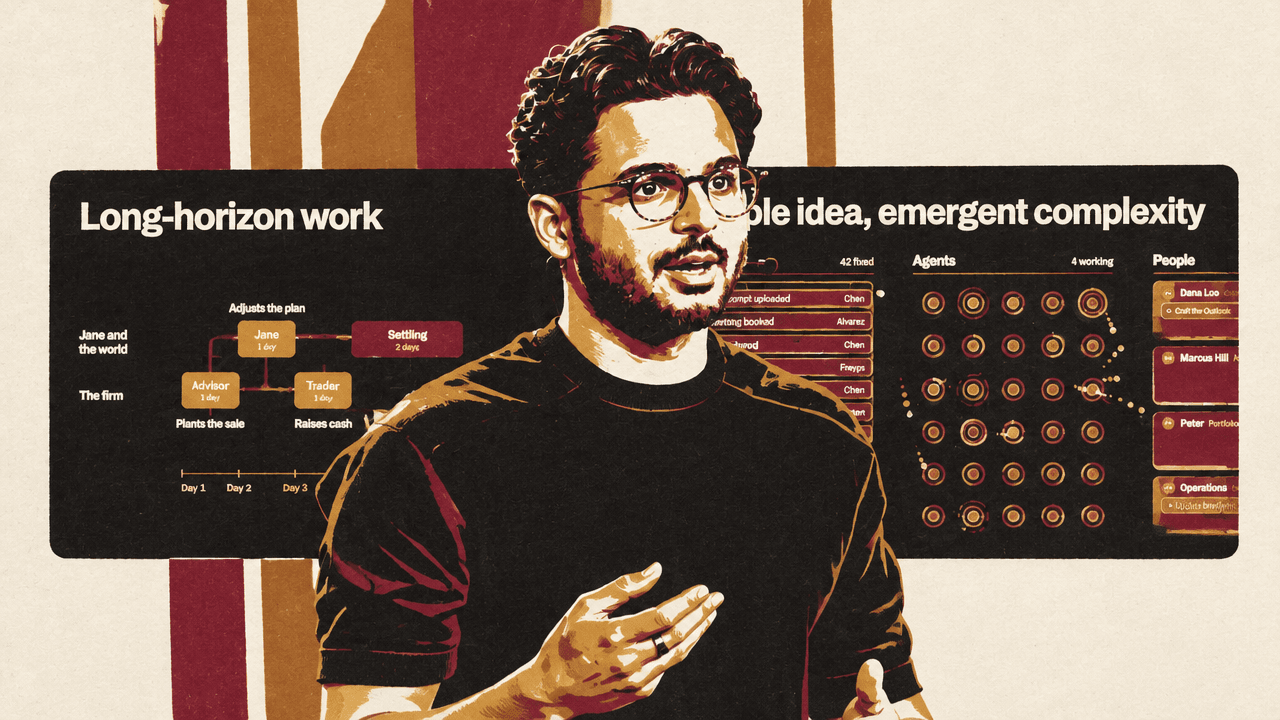
The work is long-horizon, not long-running
At Arca, financial-services work often takes days not because someone is continuously working on it, but because a client goal moves through pauses, decisions, handoffs and real-world settlement times. ? aman-singh described this as “long-horizon” work: one goal that may span about ten days, with multiple people and decision points along the way.
His example is a client, Jane, who owes $100,000 in taxes by April 15. The firm must work out which accounts to draw from and how to do so tax-efficiently, get Jane’s approval, raise the cash, wait for trades to settle, send an ACH, wait for it to land, and confirm with her. An advisor analyzes the accounts; a trader sells assets; operations handles the transfer. The timeline shown spans 12 days, including time for trades to settle and the ACH to arrive.
That distinction matters at scale. Run the same process for many clients and the firm accumulates work that is waiting on someone, something or a decision. Arca’s response is not to sell workflow software to other firms. Singh said Arca is an applied AI company running its own services business, and that its agents should own client outcomes end to end—not sit in a copilot corner assisting employees.
Agents need to notice, understand and carry work forward
Arca’s system gives agents four capabilities: signals, operational context, a harness for doing the work, and a way to bring people in when needed.
Signals are incoming events from inside and outside the firm: client emails and calls, uploaded documents, meetings, custodian events, market movements, and changes made in the firm’s own software. Background agents continuously evaluate those signals for work to advance. Jane’s email asking for help with her tax bill is one signal among many—not the only way the system learns what is happening.
To decide what to do, agents also need operational context: the firm’s knowledge of how to handle a situation and each client’s history. In Jane’s case, Singh said, that history includes a preference not to sell her Apple position, recorded in a call months earlier. The harness supplies tools and guardrails, financial computation in a sandbox, client memory, and persistent state to keep work alive over days.
The agents can then prepare a plan, but the plan still requires people. In Arca’s interface, an agent creates a shared space for the work: a place to inspect the proposed plan, ask the agent questions, and involve colleagues. The initial plan proposes three sources for the $100,000 bill: $55,000 from trimming an index fund, $25,000 from selling a bond fund at a loss, and $20,000 from cash already in Jane’s account. An employee can review the plan and approve a drafted email before it goes to Jane.
Agents watch the world so people don't have to.
That promise depends on more than waiting for a reply. Agents can register interest in an event—such as Jane responding or an ACH arriving—and wake when the signal comes in. They can also set time-based reminders if no signal arrives, such as checking again in two days or before April 15. The aim is to avoid making a person responsible for remembering to babysit the goal.
The operational payoff is not that the outside world moves faster. Singh’s comparison showed an agent-assisted version in which the firm’s work takes minutes rather than days, while settlement and ACH transit still take time. Agents remove people from the critical path of monitoring and advancing the goal; they do not eliminate the waits imposed by the transactions themselves.
The plan has to survive changes in the real world
The workflow does not proceed in a straight line. Jane might never reply to the email. Or an advisor might meet her in person and learn something that changes the amount needed. Singh’s example: a note entered after lunch records that Jane’s bonus will arrive March 1 and that she wants $20,000 of it applied to the tax bill.
That note is itself a signal. So are other actions in the firm’s software, such as rescheduling a meeting or completing a task. A background agent can read the note and notify the agent managing Jane’s tax plan. The plan then changes from raising $100,000 to raising $80,000: the $20,000 from Jane’s bonus reduces the amount to be raised from other sources. When Jane approves, the agent uses the firm’s procedure to route the next step to the portfolio manager, with a task to approve the cash raise and the updated amounts.
In this design, agents communicate with each other and translate changing information into work for the right person. People remain part of the process, but they are brought in for decisions or actions the agents cannot execute alone. Singh’s account of the engineering challenge is that the simple outline produces considerable coordination complexity: many signals can arrive at once, tasks can be assigned, background agents can exchange information, and work must remain tracked even when it is not yet actionable.
The business changes when agents set the agenda
Singh said Arca has spent the past six months closing context gaps, improving the precision of task routing, and making agents better at holding state over long horizons. The firm is also standardizing how work happens and turning colleagues’ reasoning into evaluations that help improve the system.
The intended result is a workday in which employees find tasks prepared by agents. In Jane’s case, the agent has already read the email, reviewed relevant information and updated the plan; a person is asked to review or approve when human action is needed. Singh said:
Agents prompt people more than people are prompting agents.
That shift, Singh’s example suggests, can change the firm’s agenda rather than merely improve the handling of an individual request. Jane’s email is a failure in this sense: the firm could have anticipated tax season instead of waiting for her to ask. Singh describes a different, firm-level goal—not another step in Jane’s existing workflow: every January, prepare each client’s tax situation and reach out before anyone asks.
At Arca, that goal could be added to the agents’ objectives. Singh presented this as an ambition: the system could then produce analyses and approval-ready outreach across clients, with tasks prepared for people to review and act on. The examples shown include clients whose bonuses, asset sales or other circumstances create a reason for proactive follow-up. The agents would be driving a new business outcome, not simply processing Jane’s original email faster.
For Singh, the difference between a company that uses AI tools and one that is AI-native is not simply that employees have access to agents. It is that the firm can steer its business by steering its agents: setting a goal and having agents drive the work, including the human tasks needed to pursue it.