Three Startups Target Oceans, Mining, and Nuclear Microreactors

Ulysses, Mariana Minerals and Radiant cast technology as a means of operating in, or remaking, large physical domains. Ulysses describes a round-the-clock network of surface and undersea vehicles, while Mariana Minerals CEO Turner Caldwell sees an opportunity to apply modern technologies more holistically across the minerals industry. Radiant extends the ambition furthest, arguing that mass-produced, reliable nuclear microreactors could ultimately enable humans to travel beyond the solar system.
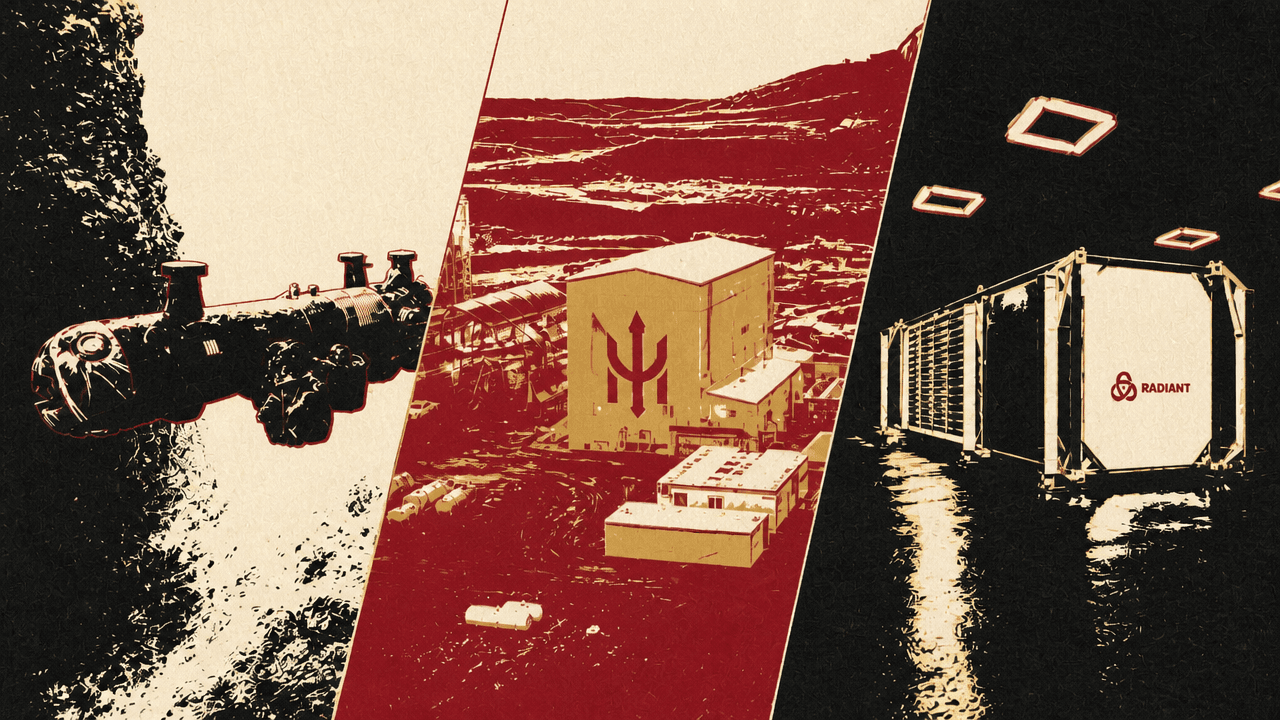
Three claims about applying technology to physical work
The three companies describe different starting points, but each frames technology as a way to act on a large physical domain. Ulysses describes a continuously operating network of vehicles on and below the ocean’s surface. Mariana Minerals identifies an opportunity to bring modern technologies to the minerals industry more holistically. Radiant’s unnamed speaker starts with mass-produced, reliable nuclear microreactors and extends their possible implications to travel beyond the solar system.
The statements are brief and promotional, and they leave important specifics unstated. Ulysses does not identify the “very specific problem” that prompted its founding or define the critical tasks its vehicles would perform. Mariana Minerals does not name the technologies Caldwell has in mind or the parts of the minerals industry it intends to address. Radiant does not describe a reactor design, a deployment plan, or the path from reliable microreactors to interstellar travel.
What is clear is the scale each company assigns to its work: ongoing ocean operations, a broad industry opportunity, and—in Radiant’s most expansive formulation—a civilizational project.
Ulysses describes a network operating around the clock
Ulysses says it began three years ago to build underwater robots for a “very specific problem.” Its broader vision is a network of surface and undersea vehicles operating 24 hours a day to address critical tasks across the ocean.
A network of surface and undersea vehicles ... operating 24/7 to solve these critical tasks all around the ocean.
The claim places continuous operation at the center of Ulysses’ stated vision. Rather than presenting only an individual underwater robot, the company describes multiple kinds of vehicles—on the surface and undersea—working as a network. The statement does not specify how those vehicles work together, what tasks they undertake, or where they operate. It does, however, make the intended persistence of the operation explicit.
The Ulysses title card appears over a person navigating a boat in dim light. The image situates the company in a maritime setting, while the spoken statement supplies the more specific claim: surface and undersea vehicles intended to operate continuously across the ocean.
Mariana Minerals sees room for a more holistic application of technology
Turner Caldwell says the minerals industry has not yet had today’s modern technologies applied to it “holistically.” As CEO of Mariana Minerals, he describes that gap as a significant opportunity for the company.


There's this like minerals industry that no one has yet really taken today's like modern technologies and applied it holistically to the industry. And so we see a bunch of opportunity to go and attack it.
Caldwell’s point is not that a particular technology has been absent from the industry. He speaks instead about the way modern technologies have—or have not—been applied across it. “Holistically” is his term for the opportunity, and the statement does not define it further. No product, mineral category, operational process, or technical approach is named.
That restraint matters. The claim is about Mariana Minerals’ view of the industry: it sees available room to apply contemporary technology in a broader way than has been done to date. The company’s title card, shown over a person walking through an industrial facility, provides the physical setting but does not add detail about the work Caldwell describes.
Radiant connects reliable microreactors to a far-reaching human ambition
Radiant’s unnamed speaker names two desired attributes for nuclear microreactors: they should be mass produced and reliable. The speaker then makes a deliberately expansive claim about what those qualities could enable. In the “most wild scenario,” such reactors would allow humans to leave the Sun and travel to other stars.
Nuclear micro reactors that are mass produced, that are reliable, in the most wild scenario, enables humans to leave the star that we were born at, the sun, and go to other ones.
The statement does not present interstellar travel as an immediate reactor deployment case. It is framed explicitly as the most extreme possibility the speaker sees in reliable, repeatable nuclear power. The speaker nevertheless states the ambition in imperative terms, saying that humanity must do this “as a civilization.”
Radiant’s title card appears over someone walking through a workshop while wearing a shirt bearing the company’s logo. The visual connects the company to a practical industrial environment; the spoken claim supplies the larger aspiration attached to the technology.