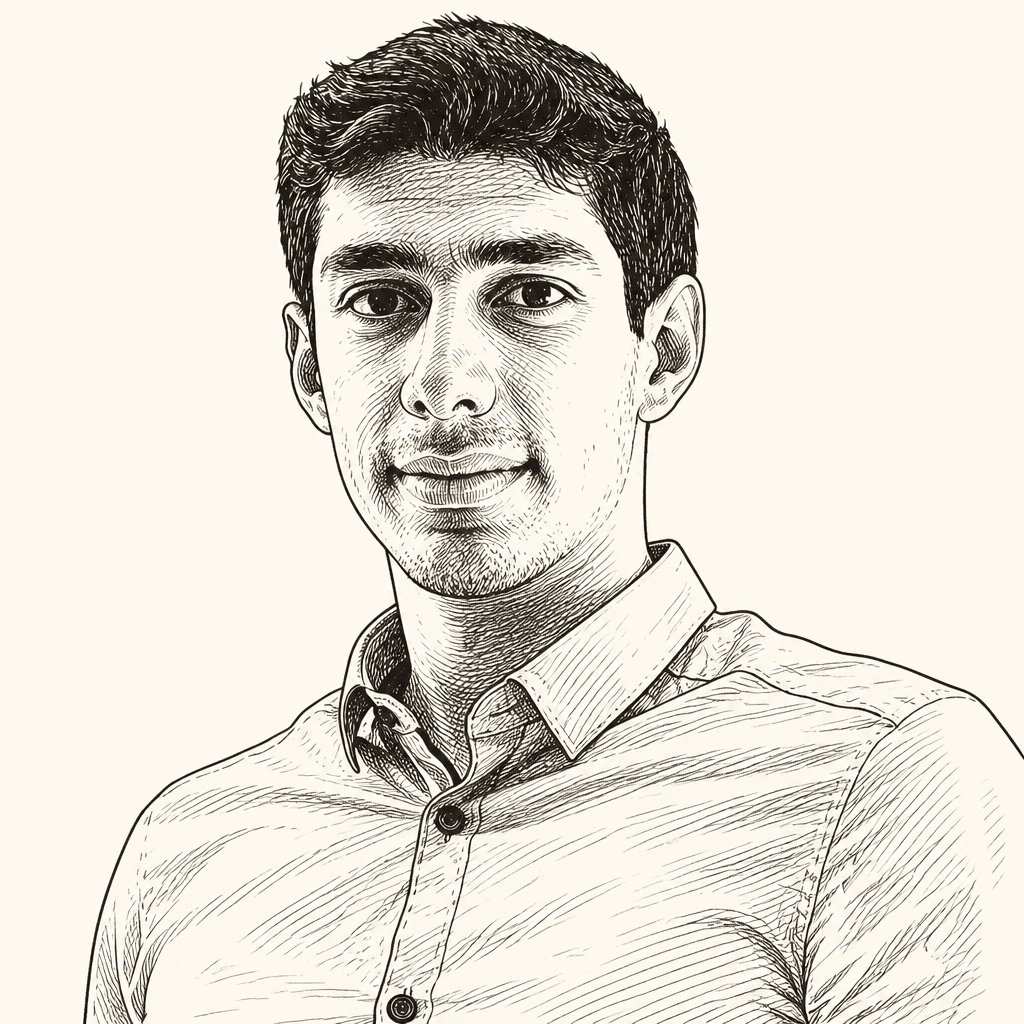
Shervine Amidi
Shervine Amidi is a senior software engineer at Google DeepMind, where he works on the Gemini team, and an instructor at Stanford University. He co-teaches CME 295, Transformers & Large Language Models, and has a background in machine learning and computational and mathematical engineering.
The Transformer Replaced Recurrence With Direct Attention Between Tokens
In the opening lecture of Stanford’s CME295 course on transformers and large language models, adjunct professors Afshine and Shervine Amidi explain how the Transformer offered an alternative to recurrent models. They argue that its use of attention let tokens connect directly across a sequence, rather than relying on a recurrent state to carry information forward one step at a time, and helped put language modelling on a more scalable path.
On-Policy Distillation Trains LLMs on Their Own Generated Responses
Stanford adjunct professors Shervine and Afshine Amidi argue that pretraining gives large language models broad text-prediction ability, but not necessarily the capacity to follow instructions, reason reliably, or work in specialized domains. They position fine-tuning, reinforcement learning, preference optimization, verifier-guided training and distillation as post-training methods for shaping that capability, highlighting on-policy distillation because it lets a stronger teacher assess answers the student model generates itself.
Open Image Models Converge on Flow Matching and DiT Architectures
Stanford adjunct lecturer Shervine Amidi uses Lecture 8 of CME296 to argue that modern visual generation is best understood as a stack of choices for transporting noise into data: the paradigm, representation, architecture, training procedure, and evaluation method. He presents flow matching as the current default for image-generation systems, diffusion transformers as the dominant architectural direction, and latent spaces as a practical compression tradeoff now being challenged by scaled pixel-space models.
Text-to-Image Evaluation Requires Metrics Matched to Specific Failure Modes
Stanford adjunct lecturers Afshine Amidi and Shervine Amidi argue that evaluating text-to-image models starts with separating aesthetic quality from prompt adherence, then choosing metrics suited to the failure being tested. In Lecture 7 of Stanford’s CME296 course on diffusion and large vision models, they treat human ratings, FID, CLIPScore, reference-based measures, multimodal judges, and benchmarks as imperfect instruments rather than substitutes for a universal image-quality score. Their central warning is practical: automated and qualitative evaluations can be useful, but only when their assumptions, calibration, and failure modes are made explicit.
Text-to-Image Training Is Becoming a Problem of Signal Allocation
Stanford adjunct lecturers Shervine Amidi and Afshine Amidi present text-to-image model training as a problem of allocating scarce learning signal across the full model lifecycle, not simply choosing a diffusion or flow-matching loss. In Lecture 6 of Stanford’s CME296 course, they argue that practical training depends on emphasizing hard timesteps, adjusting for resolution, using data curricula and representation alignment, then applying post-training, personalization, and distillation methods to improve control and reduce inference cost.