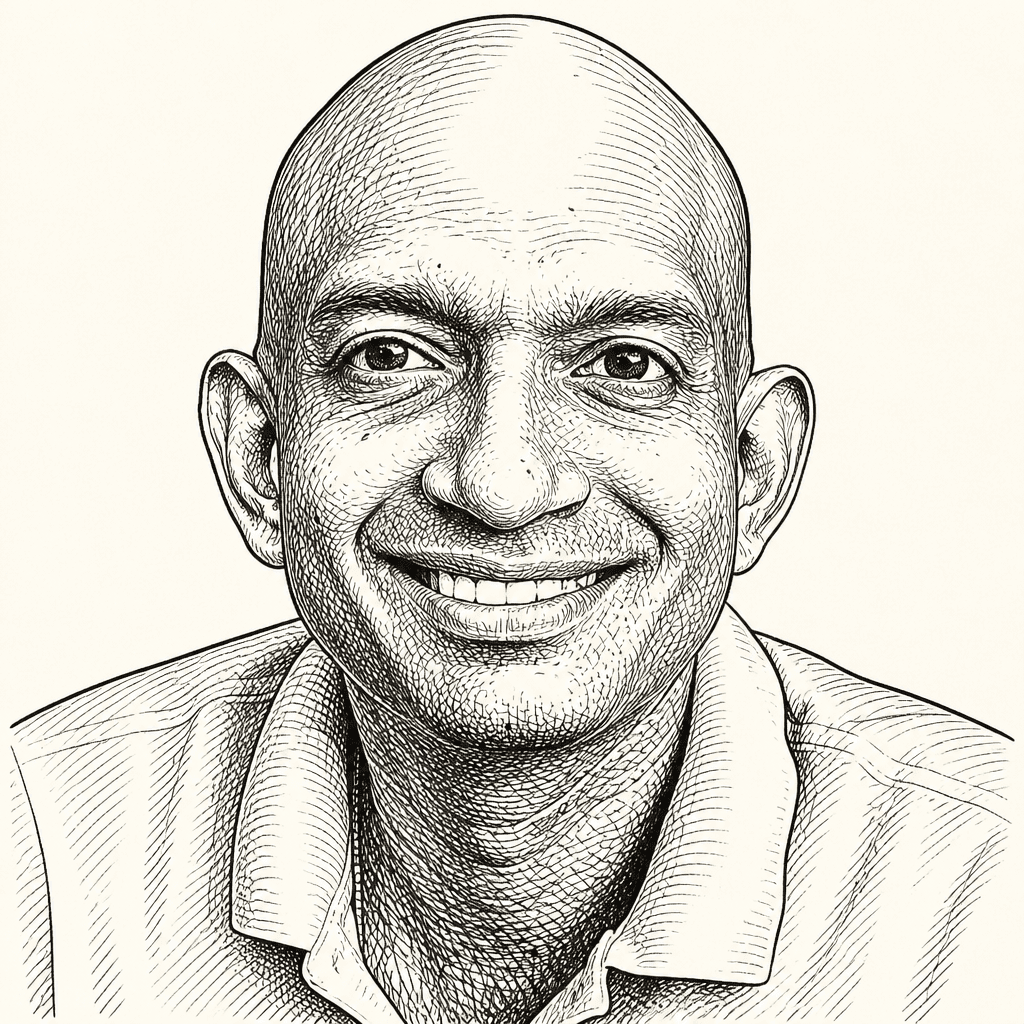
Prakash Narayanan
Prakash Narayanan is an AI entrepreneur and co-host of AI:AM, where he interviews guests and discusses AI development, markets, and adoption. He is also associated with Familiar AI and has worked in finance and applied machine learning.
J-Space Gives Researchers a Readable Workspace Inside Language Models
Nathan Labenz and Prakash Narayanan assess Anthropic’s J-space work as a potentially important interpretability advance: a computed Jacobian lens that appears to expose a model’s internal workspace rather than merely its written chain of thought. Labenz argues the finding could matter for AI safety because the space seems causally tied to flexible planning, hidden objectives and strategic reasoning, while Narayanan treats it more cautiously as a useful but incomplete tool whose larger claims remain unsettled.
Record Shows AI-Assisted Broadcast Setup, Not Fable or Goodfire Demo
The available record for “Fable Show & Tell + Goodfire's New Intentional Design Techniques” does not reach the advertised product or technical discussion. It shows only the pre-broadcast setup for the AI:AM Morning Show: hosts connecting, a guest panel waiting, audio checks underway, and an AI producer named Q confirming it can hear the human speaker. The source’s argument is that the fragment establishes an AI-assisted live-stream environment, but not any substantive material on Fable, Goodfire, or intentional design techniques.
AI Engineering Is Moving From Model Benchmarks to Production Harnesses
Shawn “swyx” Wang argues that AI engineering is shifting from a race over raw model capability to the production systems that make models usable: evals, harnesses, memory, routing, infrastructure and auditability. Drawing on Cognition’s Frontier Code benchmark and his view of the AI Engineer agenda, Wang says the key software frontier is no longer whether agents can pass tests, but whether they can produce maintainable, mergeable code inside real organizations. His broader case is that unstable model access and enterprise constraints make the surrounding system, not the model alone, the durable product boundary.
Frontier Labs Treat Recursive Self-Improvement as a Near-Term Control Problem
AI in the AM’s first weekly highlights edition argues that the important AI signal in early June was not a model launch but a pattern: frontier labs are treating AI-accelerated AI research as near-term, while their main control strategy remains AI systems monitoring other AI systems. Nathan Labenz presents that as a safety concern, and the source contrasts thin recursive-self-improvement plans with OpenAI’s more concrete tax-agent example, where the harness improves from practitioner corrections rather than from changes to model weights. The through-line is that value and risk are moving into the layers around the model: tax harnesses, private data and expert judgment in cyber, real-time moderation guardrails, and safety architecture in mental-health deployments.
AI Governance Shifts From Model Review to Release Bottlenecks
Nathan Labenz and Prakash Narayanan use Trump’s new AI executive order, state audit bills and frontier-model release reviews to argue that AI governance is becoming an operational bottleneck as much as a policy question. Their central concern is that early-access review, audits and classified benchmarks may reassure governments and the public, but can also delay defensive capabilities, obscure accountability and push hard technical judgments into political processes. The same pattern appears in the security and content-safety discussions: Enclave AI’s Tal Hoffman and Yanir Tsarimi argue that AI has made finding bugs easier than deciding which vulnerabilities matter, while Moonbounce’s Brett Levenson says real-time policy enforcement depends on decomposing ambiguous rules into fast, auditable product controls.
AI Acceleration Is Creating Dependencies Faster Than Institutions Can Govern
Nathan Labenz and Prakash Narayanan frame the second day of “Sprinting Through the AI Marathon” as evidence that AI acceleration is shifting from product progress into institutional dependency. OpenAI forward deployed engineers describe tax agents whose improvement comes from practitioner correction traces; Labenz reports that frontier safety circles are treating recursive self-improvement as a near-term premise reliant on AI monitoring AI; and Matthew Sanders argues the Vatican’s AI intervention is a claim for human and religious agency. The shared concern is that capital markets, service firms, labs, governments and moral communities are being pulled into AI systems faster than they can settle ownership, liability or control.