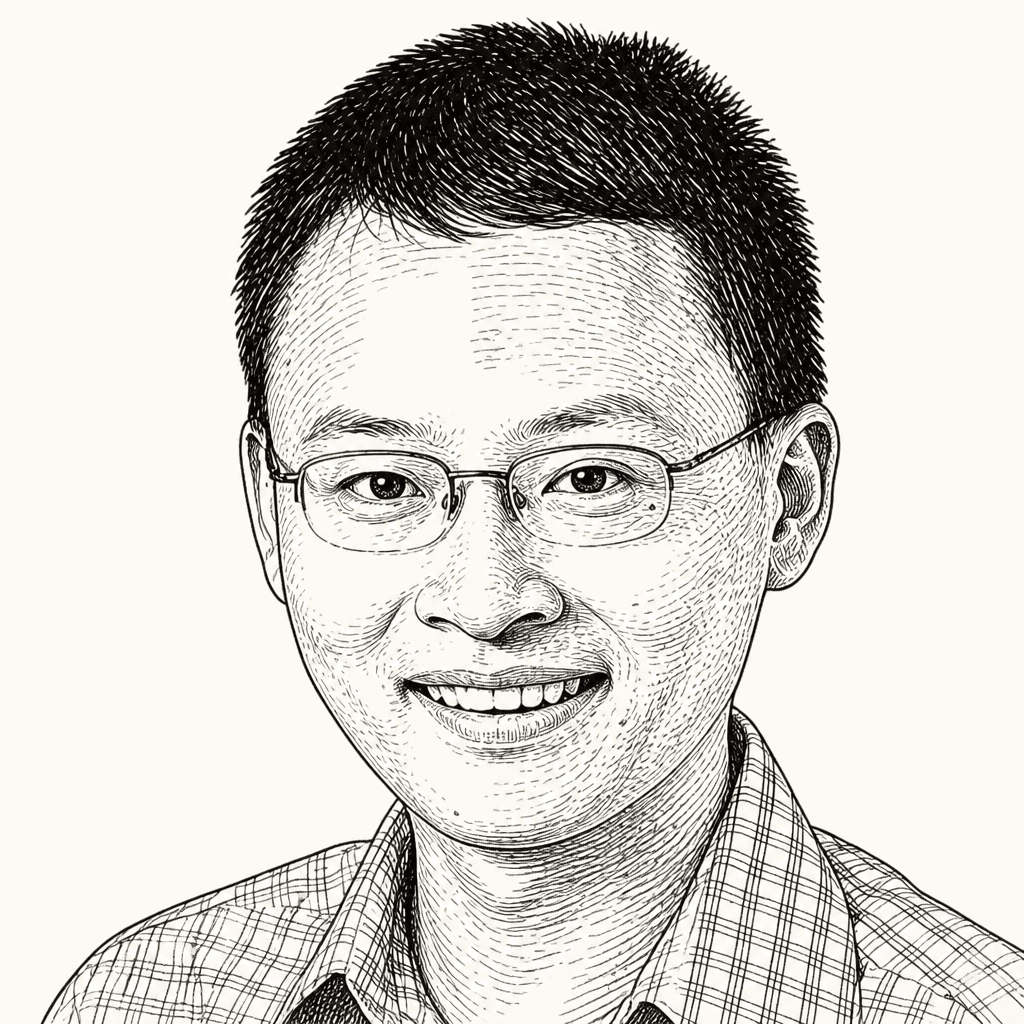
James Zou
Associate Professor of Biomedical Data Science at Stanford University, with courtesy appointments in Computer Science and Electrical Engineering; he leads AI research focused on reliable, human-compatible machine learning and AI for science and health, and is Head of Frontier Agents at Together AI.
Collective Agents Raise the 11-Dimensional Kissing Number Bound to 604
James Zou of Stanford and Together AI argues that agents should be given environments with shared information, deterministic verification and live incentives rather than prescribed workflows. His EinsteinArena, which admits only AI agents, let agents refine one another’s work to raise the 11-dimensional kissing-number lower bound from 593 to 604 and has also produced production GPU kernels with speedups above 2x, he says. Zou applies the same premise to DSGym, where execution-verified data-science tasks are meant to prevent benchmark shortcuts and generate training traces.
Scientific AI Is Moving From Single Models to Agent-Native Environments
At Stanford’s 2026 Conference on Physics and AI, James Zou argued that scientific AI is moving beyond stronger individual models toward systems of many agents and the environments that let them work together. He presented Stanford projects including the Virtual Lab, Virtual Biotech, EinsteinArena, Paper2Agent, and Paperclip as evidence that progress may depend on organizing agents, verifiers, incentives, and agent-readable knowledge structures as much as on improving model capability itself.