AI Moves Into Workflows, With Oversight Built Around the Task
Across Cognition and Ramp’s workplace agents, Replit’s enterprise platform, and AlphaGenome 2’s research predictions, the focus is shifting from plausible outputs to systems that can operate within processes people can inspect. The examples differ in purpose and risk, but each raises questions about access, testing, and what evidence is needed before people rely on a model’s work.

The day’s throughline: AI is moving from outputs into workflows
Across reasoning research, software development, finance, and genetics, the question is shifting from whether a model can produce a plausible answer to whether it can take part in a process people can inspect and use. That shift does not make these systems equivalent. A training method, a coding agent, a finance platform, and a model predicting genetic effects solve different problems and carry different risks. But each example puts model behavior in context: what a system is asked to do, what it can access, how its work is checked, and where people intervene.
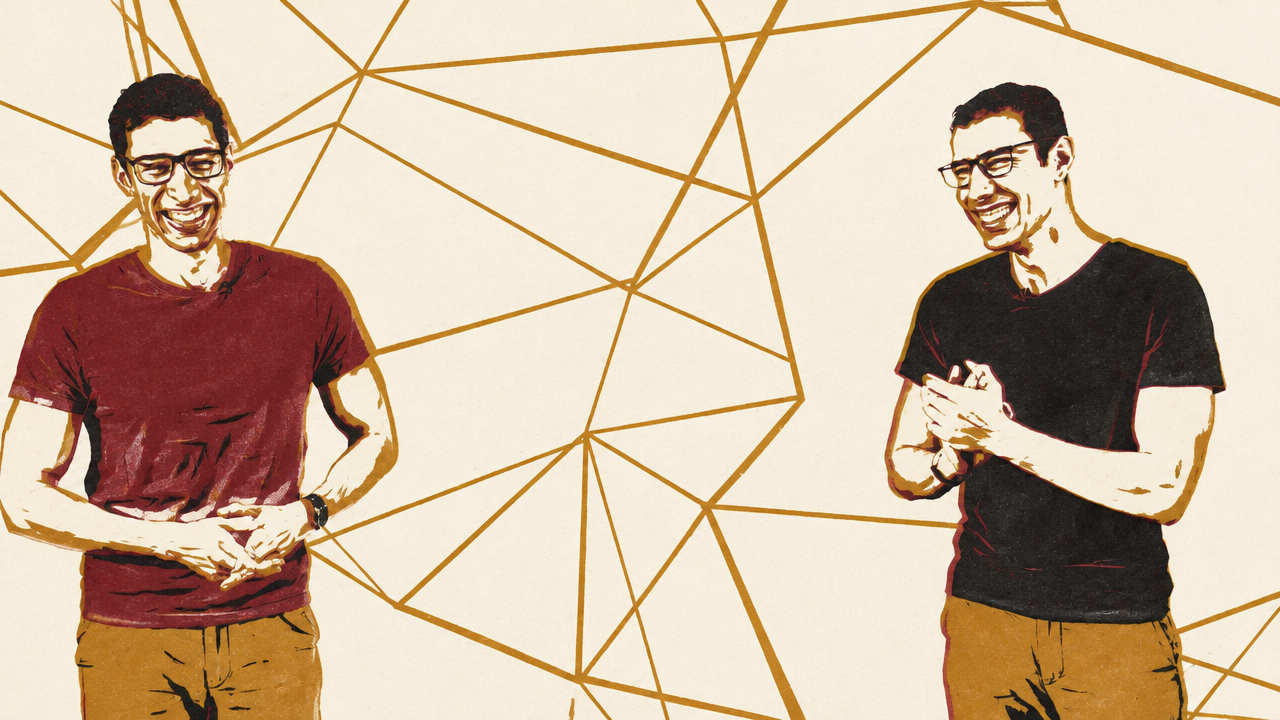
Stanford adjunct professors Afshine and Shervine Amidi describe one version of that change in post-training. In on-policy distillation, the student model generates its own responses, and a stronger teacher evaluates those attempts. The distinction from standard distillation is consequential: the material under evaluation comes from the student’s behavior, rather than only from examples the teacher has produced.
The Amidis argue this is especially relevant to reasoning, where intermediate steps, mistakes, and corrections can matter as much as the final answer. Their account describes a method and its rationale; it does not establish that teacher evaluation guarantees better reasoning. It does show how model improvement can be framed around the behavior a system exhibits while working, rather than only around its size or a polished final response.
That framing has an organizational counterpart. Cognition says its agents can take work from a customer report through implementation and testing; Ramp’s Eric Glyman describes tools that connect company information to actions such as investigating a bug or reviewing an expense. In both cases, the model’s usefulness depends on its place in a larger process—one that determines what it can do and how the result is checked.



From model improvement to measurable work
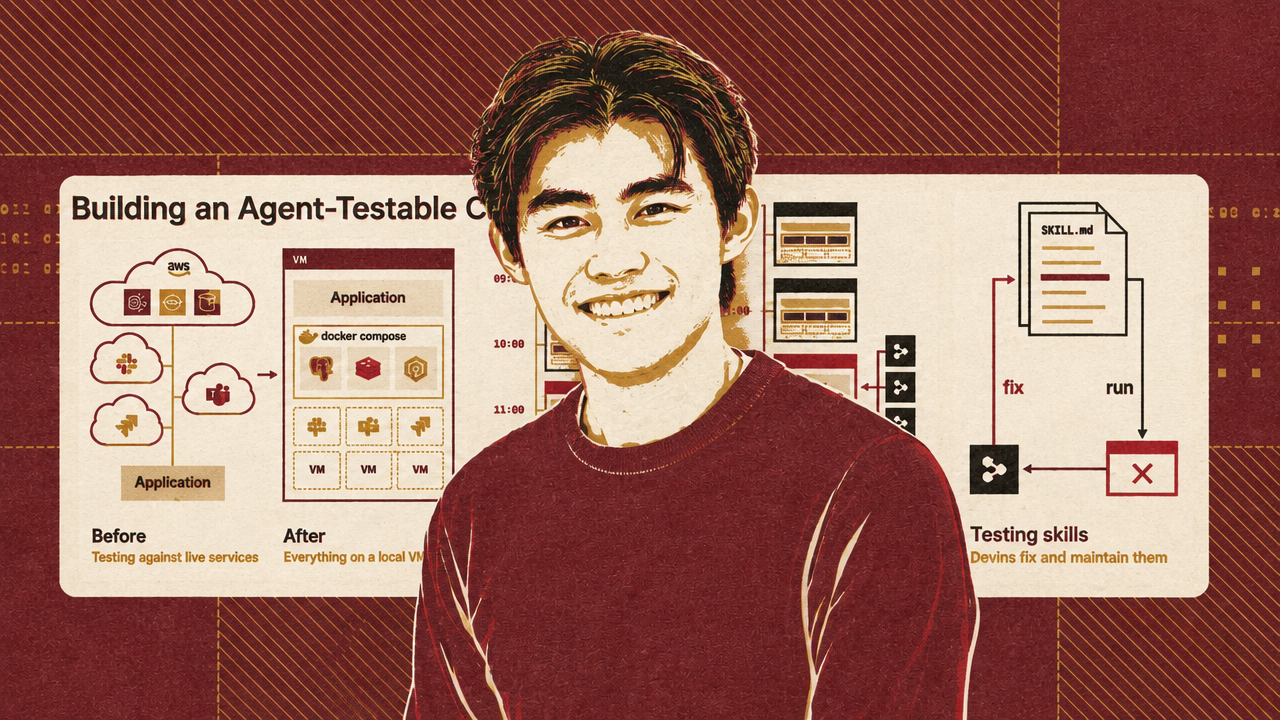
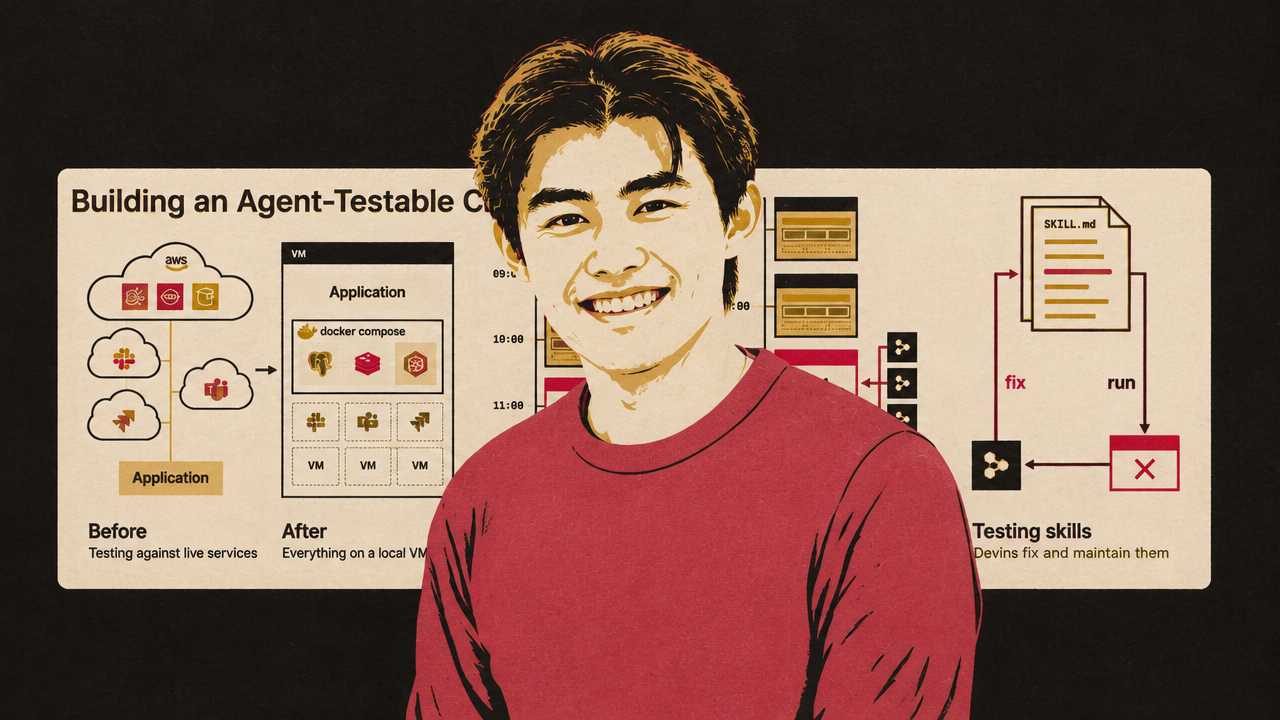
Cognition offers the clearest operational measure of agents being organized around outcomes. Walden Yan reported that merged pull requests grew 40.4-fold between November 2025 and October 2026, while engineering headcount rose 2.7-fold. He attributed the change not simply to faster coding, but to reorganizing development so agents handle more of the lifecycle and people take broader ownership of what should be built.
The company’s small pods—often two or three engineers—group product, engineering, and QA responsibilities around specific areas. An engineer can take a customer report from Slack, ask an agent to make a change, and review a pull request accompanied by a recording of the fix. Yan described human involvement as an escalation rather than a required stop at every step. Repeatable local test environments, rebuilt regularly and isolated from live services, let agents run changes without touching production systems.
The ambition extends from tickets to ongoing jobs. Yan described giving an agent a measurable target, such as reducing latency, and letting it establish a baseline, monitor performance, test changes, and report progress. In a separate Android project, Yan said an agent worked for 44 days to build an app in parity with Cognition’s iOS app. The presentation reported 1,134 merged pull requests and 2,841 screenshot tests, with 999 pull requests merged without human approval.
Those figures describe a company-reported project, not proof that the same autonomy generalizes to other codebases or higher-stakes work. They make the intended change concrete: delegate not only implementation, but sustained responsibility for a bounded result, while retaining ways to test and escalate.
Ramp’s account widens the question from engineering to company operations. Glyman argues that AI adoption depends on shared company context, access to tools, and redesigned workflows—not merely giving employees a model. Ramp’s internal Glass system connects company information while retaining individual permissions; its Inspect coding agent can investigate a customer bug against code and data, make a fix, and respond. Glyman said Inspect accounted for more than 85% of Ramp’s pull requests. He also said 1,925 of the company’s 1,930 employees had used Glass in the prior 24 hours.
The broader point in Glyman’s account is organizational: an agent that can only chat is still separated from the information and systems needed to act. Shared skills can make a useful method available to colleagues, while access controls and outcome-based measurement shape how that capability is used. Glyman’s productivity and savings figures—including his claim that the median customer saves 7.5% annually on expenses—are company-reported results, not independent assessments.
Together, Cognition and Ramp raise a practical management question: what work is suitable to delegate, what outcome will show whether the delegation worked, and what evidence or review is needed before the result is accepted?






The operating environment becomes part of the product
Replit CEO Amjad Masad’s enterprise account puts the surrounding environment at the center of agent deployment. He says the company’s focus on reliability and security, and its work directly with businesses, helped its enterprise business compound. That is a company account of its strategy and growth, but it highlights a requirement that appears in the other workplace examples too: organizations need an environment in which an agent can do useful work without gaining unbounded access or making unchecked changes.
Masad describes Replit as an “agent habitat,” built around zero-trust principles, sandboxing, and a reduced attack surface. He says the company was affected by about zero of roughly 100 zero-day vulnerabilities over the previous year. That figure, like his account of enterprise growth, is a company claim, not an independent comparison of Replit’s security with other platforms.
Masad also argues that automated engineering can be safer than human engineering. His examples are Rust, which he says agents can use without the ergonomic compromises that deter some human developers, and formal verification, which uses mathematical proofs to check software. He contends that AI can make such verification practical beyond exceptional, high-stakes projects. That is his argument, not an established general conclusion that agent-written software is safer.
The tension is central to the enterprise bet: more capable agents may let people delegate more work, but the value of that delegation depends on controls around the agent, the software it can reach, and the evidence used to approve its work. Cognition’s isolated, repeatable test environments and Replit’s emphasis on secure agent infrastructure address related operational concerns. They are different company approaches, however, and do not establish a common standard.



Applied AI also means extending what researchers can investigate
AlphaGenome 2 is a counterpoint to workplace agents: its role is not to execute a business workflow, but to help researchers predict how DNA changes affect gene activity in particular cell types. The problem is context-dependent. The same mutation may have different effects in different cells, and experimentally testing every possible change across many cell types is impractical.
In results presented by Two Minute Papers presenter Zsolt Hunyadi Zsolnai-Fehér, AlphaGenome 2 identified twice as many mutations known to affect gene activity, at 90% precision. That detection result is separate from a Parkinson’s disease comparison measuring whether models correctly predicted the direction of gene activity for known genetic effects. On that measure, AlphaGenome 2 reached 41%, compared with 17% for a specialist model trained on the study. AlphaGenome 2 had not trained on that study, according to the presentation.
The comparison is presented as evidence of generalization to an unseen study, not as a demonstration that the model can identify every relevant mutation or establish a clinical outcome. Zsolnai-Fehér stresses that the model still misses many disease-related mutations and struggles with rare cell types. Its potential use is investigative: helping researchers examine genetic changes that would be difficult to test exhaustively in a lab.
That limitation matters alongside the workplace stories. In each case, the system’s output has to fit a process people can judge: a teacher evaluates a model’s attempt; engineers test code and review escalations; finance teams set permissions and assess outcomes; researchers compare predictions with measured biology. These are not interchangeable forms of evidence, and none alone settles how much responsibility a system should receive. The shared issue is how to make a model’s behavior legible enough to use—and what evidence would justify letting it do more.