NVIDIA Built Its Strategy Around Algorithmic Domains, Not Chips

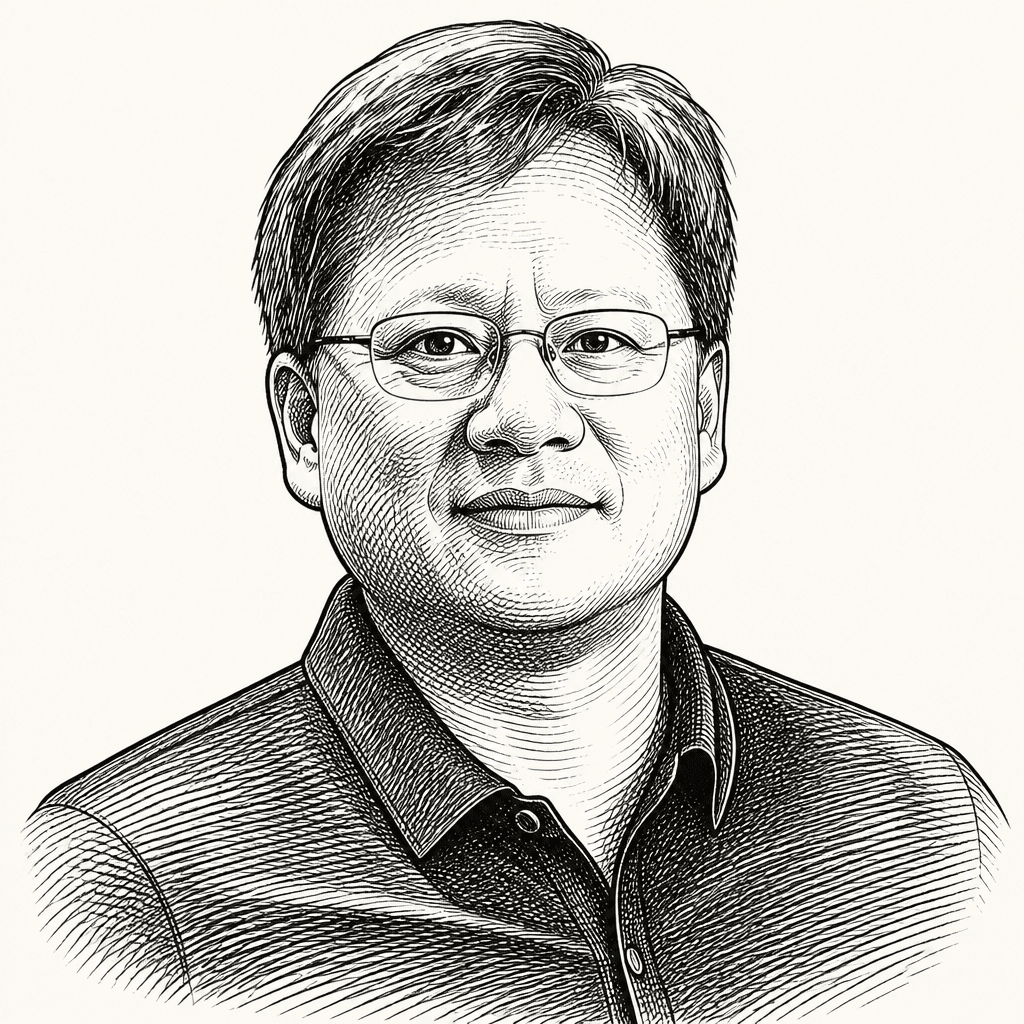
Jensen Huang argues that NVIDIA’s strategy has never been simply to build better chips, but to identify algorithmic domains where new computing architectures can change what is feasible and then build the stack around them. Recounting NVIDIA’s early failure in 3D graphics, its interpretation of deep learning after AlexNet, and its push into agents and robotics, Huang makes the case that technical leadership depends on confronting wrong assumptions quickly, learning the underlying workload, and organizing close to the work.

The strategic unit is not the chip but the algorithmic domain
Jensen Huang describes NVIDIA’s durable operating model as a way of interpreting technical change: identify an algorithm that can make a previously difficult problem tractable, ask what happens if it scales, and then build the computing stack required to support it.
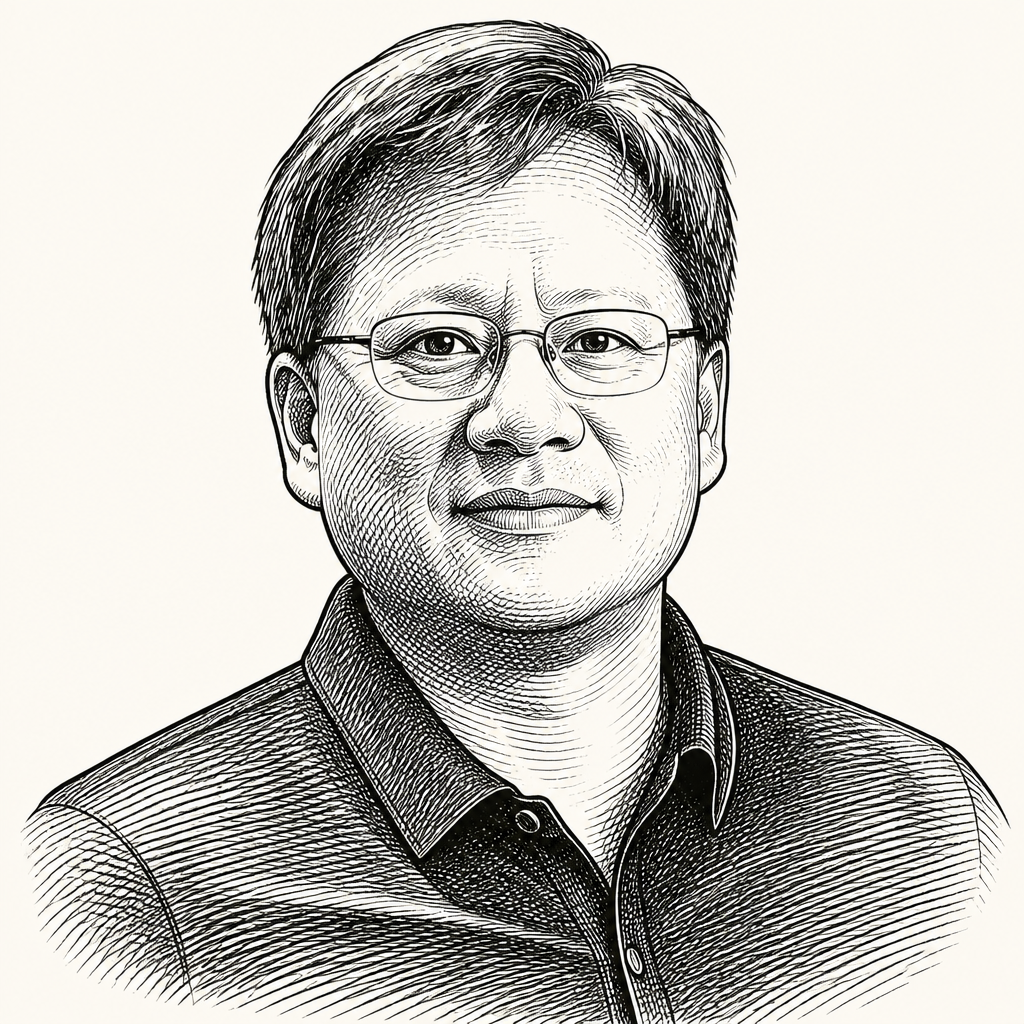

That is different from treating a chip, a model, or a product category as the central strategic object. NVIDIA’s founding premise, Huang says, was that general-purpose CPUs could be augmented with accelerators to solve problems that would otherwise be too hard to solve. The company first applied that premise to 3D graphics, imagining that a PC could become something closer to a game console if graphics work previously associated with large machines could fit inside it.
The initial implementation failed. NVIDIA developed new algorithms, raised money, and began building around them, only to conclude by 1995 that the company’s approach was “exactly wrong.” The danger was not abstract. Huang recalls that 35 to 40 companies were building 3D graphics for PCs, while NVIDIA had learned both that its technology did not work and that it did not know how to implement the alternative.
His response was to confront that gap directly. He went to Fry’s with a few hundred dollars, bought three textbooks on OpenGL and OpenGL-pipeline design, and brought them back to the engineers.
Everybody would have thought that NVIDIA started out as world leaders in 3D graphics. We learned it from a textbook.
The lesson Huang draws is not that the original choice did not matter. It mattered enough to threaten the company. But the survival question was whether NVIDIA could discard a failed implementation without discarding the larger thesis behind it. Technology changes constantly, in his account; the durable advantage is the ability to face reality and learn the next technology quickly enough.
That distinction shapes his description of accelerated computing. Molecular dynamics, image processing, inverse physics, deep learning, particle physics, fluid dynamics, and other fields may require different algorithms, but the strategic pattern is the same: locate a computational domain whose problems are difficult, understand its workload, and develop an architecture that changes what is feasible.
“It’s not about building a great chip,” Huang says. “It’s about accelerating an algorithm domain.” The chip is an implementation of a view about what kind of computation will matter.
A consequential company, in this formulation, begins with a distinct perspective about the world that its founders believe deeply enough to pursue through difficulty. The right technology, market, and timing make the work easier. They do not substitute for a view of what is changing and why it will matter.
The Sega episode is the operational counterpart to that philosophy. NVIDIA had been hired to build the game console that would follow the Sega Saturn, which became Dreamcast. Huang says the contract was worth about $12 million. Once NVIDIA recognized that its underlying technology was flawed, he traveled to Japan and told Sega’s chief executive, Irimajiri-san, that NVIDIA could not fulfill the work. He advised Sega to choose another supplier.
Then he asked Sega to continue paying NVIDIA because the company still needed the money.
Huang says the difficult request was met with understanding because he had been candid about the failure and because Sega’s leadership still trusted the people behind the company. Sega paid NVIDIA $5 million, in his account, giving the company time to find its way forward.
The point is not that candor makes a failed contract painless. NVIDIA lost the Dreamcast work. The point is that avoiding the failure would not have repaired the technology, while admitting it gave the company a chance to learn. Huang frames the decision as an instance of the belief that investors and partners ultimately back people, not only the product currently in front of them.
NVIDIA went public in 1999 at a $300 million valuation, Huang says, and Sega sold its stake at that point. The later outcome does not erase how contingent the earlier survival was. A company built around technical discontinuity needs enough intellectual honesty to recognize when its current answer is wrong—and enough support to survive the period before the next answer is ready.
A new capability becomes strategic when it forces the stack to change
Jensen Huang says he saw AlexNet when others did, but NVIDIA was already accustomed to looking for computational problems that could be accelerated: OpenGL, NAMD, VASP, SQL, or some other domain-specific language or algorithm.
The question was not simply whether AlexNet was impressive. It was what deep learning represented, why it worked, what other functions it could learn, and what would happen if its capability were scaled far beyond the original demonstration.
Huang’s conclusion was that “AlexNet was not AlexNet.” It was evidence of deep learning as a universal function approximator: a system that could learn a function from examples of inputs and outputs. That matters, he argues, because many important problems cannot be captured by exact, hand-written rules. Their inputs are ambiguous, their outcomes are probabilistic, or the rules needed to model them precisely are unavailable.
The big breakthrough was simply that this is much more foundational than AlexNet. This is a way of doing software.
That interpretation turns a research result into a systems question. If deep learning is a new way of building useful software, the implications extend beyond a model or a GPU. Huang says NVIDIA began, roughly 15 years ago, to imagine reinvention across what he now calls a five-layer cake: processors, middleware, algorithms, applications, and the broader industrial stack connecting them.
The practical discipline is to reason outward from a capability. If a model can learn functions that conventional software cannot specify effectively, what industries become susceptible to change? If those workloads improve, what becomes the bottleneck? What changes in data, networking, memory, processors, tools, and applications follow?
NVIDIA’s early work in computer vision, robotics, and self-driving cars followed from this line of inquiry. Huang did not present those as unrelated bets. They were applications where perception and action must operate in environments too variable to be reduced neatly to programmed rules.
The same horizon informs his view of agents. Agents are “the new software,” he says, which means NVIDIA has to understand their workload characteristics before it can design systems for them. Hardware planning cannot wait for a category to stabilize. A system may take roughly three years to build, a couple more years to ramp, and then remain in use for another decade. The company therefore has to reason five to 10 years ahead about how agents will behave.
For Huang, that requires working through concrete questions about bottlenecks, scaling, concurrency, sandboxes, MCP, working memory, long-term memory, and networks of autonomous processes running asynchronously. These are not peripheral implementation details. They determine the architecture a system will need and whether an agent can operate as more than a chat interface.
This is why he considers systems thinking a durable skill even as agents automate more implementation. In chip design, he says, much of the work of compiling designs and synthesizing transistors, gates, and functional blocks has already become automated; designers increasingly work at the system level. He expects software development to undergo a comparable shift.
The relevant expertise is understanding a problem’s inputs and outputs, information flows, rates of exchange, constraints, processor and memory demands, networking requirements, and failure points. The more execution is delegated, Huang argues, the more important it becomes to understand the larger system that execution serves.
That is also his advice to young people deciding what to learn. He expects routine coding—the idea that solving a problem principally means manually writing code at a computer—to be increasingly automated. But hard sciences, computer science, computer engineering, systems design, and work at the intersections of disciplines will remain consequential. AI changes how much implementation a team can take on; it does not eliminate the need to decide what hard problem is worth solving.
Huang contrasts the scale of current engineering with the chip industry he entered. A design with a thousand transistors once counted as a large chip, he says. A trillion-transistor chip can now be an ordinary next-generation target. The important planning question is no longer primarily how many engineers or lines of code a project requires. It is what the problem is and what system must exist to solve it.
Staying close to the workload is an organizational design choice
Jensen Huang presents NVIDIA’s management approach less as a doctrine than as an extension of his own curiosity. When he encounters a question, he seeks the shortest path to an answer. If the available answers do not satisfy him, or if a domain appears important to NVIDIA, he continues learning until he can explain why it matters and help the company act on it.
He frames this as service rather than an effort to displace specialists. A CEO, in his view, should give the organization useful insight: identify an important shift, understand it deeply enough to break it into actionable terms, and help others see why it deserves attention.
That requires proximity to technical reality, particularly in fields moving quickly. Huang compares the role to surfing. To an observer, the movement of waves can look chaotic; a surfer develops a feel for the wave, wind, timing, and position. A leader needs a similarly tactile sense of what is happening in a technical field. Without it, rapid changes can seem either unintelligible or disconnected from one another.
The organizational implication is that a company should not be optimized for a generic management template if that template impairs the founder’s ability to read and respond to the work. Huang describes a founder as building an F1 car that they themselves must race.
You’re building a car that you are going to race. You’re going to build an F1 racer, but you’re going to build it in a way that you can drive.
The analogy is Huang’s answer to concerns about NVIDIA’s unconventional structure and what will happen when he is no longer its chief executive. The organization does not need to be permanently shaped for an abstract future successor, he argues. The current leader should shape processes, communication, and decision-making around the way they can best contribute in a competitive environment. A later leader can reshape the company to fit their own strengths.
Huang says he is continually modifying NVIDIA’s business processes and ways of working to become more effective for the company. “Founder mode,” in his usage, can scale because it is not a refusal to build systems. It is a willingness to keep changing them as the work changes.
That principle extends to internal AI adoption. Huang says NVIDIA has cloud code running autonomously in sandboxes across the company, while employees use a range of other tools. The immediate objective is to move faster. But broad use is also a way to observe what agentic software actually requires and feed that understanding back into NVIDIA’s future system design.
The unresolved technical problem is not simply whether agents can generate outputs. Huang believes they already exhibit coarse forms of recursive improvement when use updates long-term memory, improves markdown files, compacts information, or turns it into knowledge graphs. The limitation is control.
A single prompt-to-output interaction is too coarse for serious work. Retrieval-augmented generation, conditional inputs, and prompting provide some leverage, but Huang wants a person to be able to alter one word in an agent’s plan and receive a particular, bounded change in the result: one pixel, triangle, CAD component, layer, via, or connection, with the rest regenerated around that edit.
Controllability is probably the single biggest breakthrough that we need for agents at every single level.
This does not require agents to be perfect. An agent that is 80% right can be useful if a person can reliably direct the remaining 20%; the same applies at 99%. The threshold is whether human intervention can produce a specific correction instead of forcing a user to discard a broad output and start again.
Huang also favors a world in which organizations can build their own domain-specific AI. He encourages the use of cloud services, but sees open tools as important because companies may need their own agents, knowledge systems, and workflows. When he saw OpenDevin, he says, he saw a “Linux moment”: a foundation from which others could build their own AI.
The claim is not that every company should replace general-purpose services. It is that access to adaptable systems can enable uses centralized providers will not anticipate. Huang places that possibility in a longer open-source lineage, arguing that open software platforms were necessary ingredients for both mobile cloud computing and modern AI.
Robotics needs a learning loop that connects simulation to reality
Jensen Huang traces his conviction that robotics was approaching a major threshold to generative video. If a system can generate video of a finger moving or a hand picking up a glass, he reasoned, it should become possible to generate robotic action with comparable articulation.
The premise alone is not enough. A robot must produce motion that obeys physical laws and reflects causality, friction, tension, and the constraints of electromechanical systems. Huang says this led NVIDIA toward what it calls physical AI and toward world foundation models intended to understand how the physical world works.
He says robotics had its “ChatGPT moment” a couple of years ago. The comparison is not that robots had already become broadly productive. ChatGPT’s early importance was that it made a new type of capability imaginable before every practical use had been worked out. Similarly, reinforcement-learned robots that could walk and be grounded in physics demonstrated that a new class of robotic behavior was possible.
The remaining work is a training, evaluation, and deployment loop. Huang describes three linked layers: environments in which robots can learn and be evaluated; simulators based on physics simulation and generative physics models; and transfer from simulation to real machines, using reinforcement learning and attention to physical and electromechanical constraints.
He places NVIDIA’s Isaac Sim and Cosmos work in the simulation portion of that loop. The challenge is not merely training a model once, but creating the environments, evaluation methods, and feedback processes through which robotic capabilities can improve.
Self-driving cars became NVIDIA’s first major physical-AI application because, Huang says, they combined a sufficiently large market, relatively standardized technology, the potential for a flywheel, and clear economic value. He says NVIDIA technology is used inside Waymo vehicles; that NVIDIA worked with Tesla in cars and now works in Tesla data centers; and that Mercedes uses NVIDIA in data centers, vehicles, and its software stack.
NVIDIA also open-sourced its self-driving-car stack, Huang says, because autonomous navigation has uses beyond passenger vehicles: agriculture, mail delivery, and warehouse autonomous mobile robots. Those markets may not individually match the scale of self-driving cars, but together they support a general navigation stack.
Huang says this business is already substantial and projects that physical AI will become one of the world’s largest industries. His timeline is neither immediate nor distant: it will take longer than two or three years but less than a decade, he says. He also describes it as NVIDIA’s potential next $100 billion business.
Automation expands work only where demand can absorb new capacity
Jensen Huang does not offer a general claim that AI makes automation harmless to workers. He describes the effects as uneven and acknowledges that some cognitive tasks will be automated away. His narrower proposition is that greater productivity can increase employment where organizations face substantial unmet demand.
A job has a larger purpose and contains many tasks, in his framing. AI may eliminate some tasks without eliminating the job, particularly if removing a bottleneck lets an organization serve more customers, patients, projects, or cases than it previously could.
He uses software engineering as an example: coding can be automated, but the backlog of ideas and ambitions remains large. If implementation becomes less constraining, organizations may hire more people to undertake more projects. He makes a comparable argument about radiology and legal work. Hospitals may be able to serve more patients, he says, and law firms may process more cases; the added capacity can require more people even as particular tasks are automated.
The condition is central. Productivity produces more employment in Huang’s account when there is enough work waiting to be done. Automation alone does not settle the outcome.
The practical discipline is to learn through the difficulty
Jensen Huang returns to NVIDIA’s founding failure in 3D graphics when he gives advice to founders. When NVIDIA began, he recalls feeling that there was too much to know and too little time to learn it. There was no YouTube or Y Combinator teaching people how to start companies. He bought a book on the subject, found it was 500 pages long, and concluded that reading it might take longer than the company had before it ran out of money.
He was also scared to raise capital because investors would ask questions he could not answer. His conclusion now is not that founders should expect to know enough before they begin. It is that the unknowns never disappear.
Huang calls the present an extraordinary time to start a company because computing has been reset by AI. Yet that opportunity is paired with technical change moving so quickly that it can produce anxiety and paralysis. His countermeasure is the question that has shaped NVIDIA’s approach to unfamiliar fields: “How hard can it be?”
He does not mean that the work will be easy. It will be much harder than expected, he says. The phrase is a way to prevent imagined suffering from becoming a reason not to begin. The founder should assume they will have to learn, get moving, and let the hardship arrive in manageable increments.
You don’t have to overcome life in one day. You just have to overcome that morning.
For Huang, resilience is therefore less an abstract character trait than a daily operating practice. A founder does not need to solve the whole company, career, or future at once. They need to confront the current problem, learn what it requires, work toward tomorrow, and continue.