InfiniteDiffusion Decouples Terrain Generation Cost From World Size

Alexander Goslin’s InfiniteDiffusion argues that learned terrain generation need not slow down as a virtual world expands. Presented by Two Minute Papers’ Karoly Zsolnai-Fehér, the system generates each new area from overlapping local windows rather than modelling the entire map at once, while using a multiscale height-map method intended to retain both large landforms and small features such as creeks. Goslin reports training the model largely on a single RTX 3090 Ti and has released it as code and a Minecraft mod.
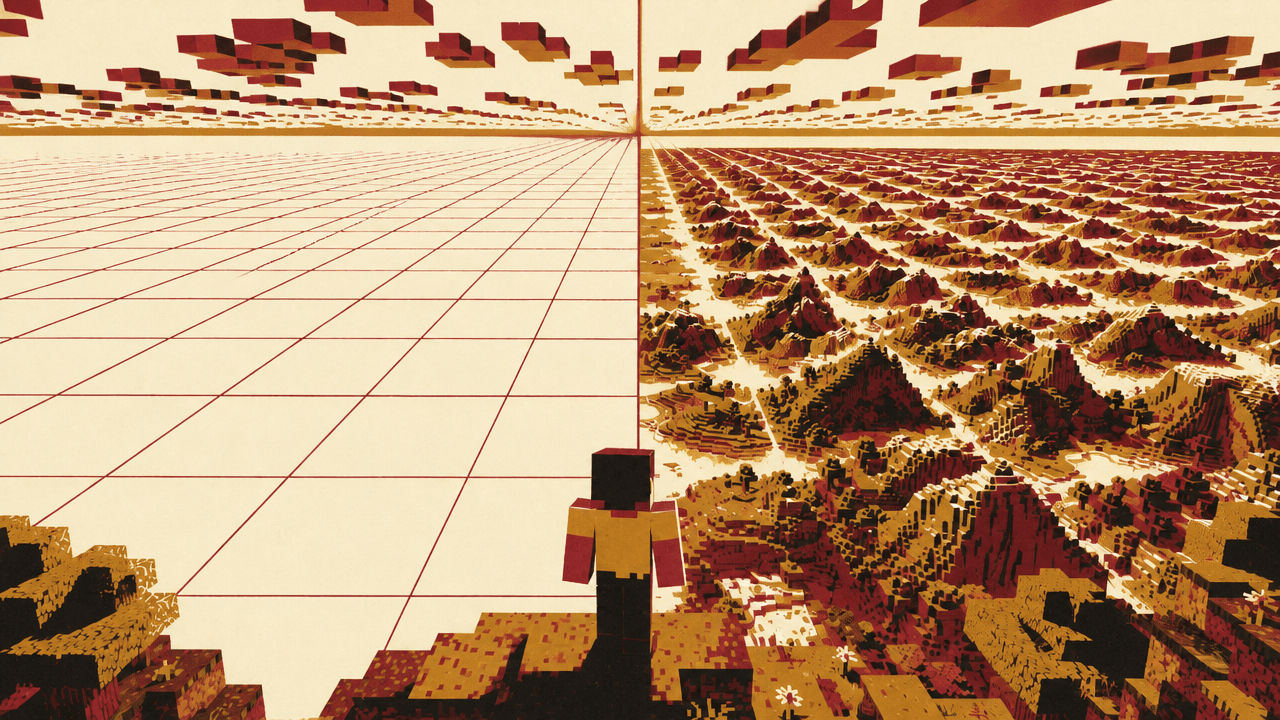
Local denoising is the claim that changes the scaling problem
Károly Zsolnai-Fehér presents Alexander Goslin’s InfiniteDiffusion as a terrain generator designed around a consequential constraint: generating a new location should not become slower merely because the virtual world has become larger.


The system uses diffusion, the family of techniques that starts from noise and progressively reorganizes it into a clean result. Applied to terrain, diffusion can learn from examples of landscapes rather than rely solely on procedural noise. But Zsolnai-Fehér frames the older trade-off simply: conventional noise functions are fast and can extend indefinitely, yet their output often lacks a “global plan”; diffusion-based terrain can be more coherent, but its cost rises when every new area must account for the rest of the world.
InfiniteDiffusion’s central move is to make generation local. For a new region, region R, the method considers the overlapping windows that touch that region, runs the denoiser within each window, and combines the resulting estimates through a weighted average. As Zsolnai-Fehér puts it, the method asks “a bunch of overlapping windows that touch region R,” then blends the neighbors’ views while ignoring the rest.
That means the query depends on nearby overlapping regions, not on the total size of the generated planet. Zsolnai-Fehér describes this as decoupling generation cost from world size: expanding the world does not, in this account, make a request for one location slower. The footage illustrates the consequence with rapid travel to distant coordinates and a terrain scene labeled as generated live on an RTX 3090 Ti at about 140 frames per second.
The paper’s scale illustration starts with a region spanning roughly five million square kilometers, including about 2.2 million square kilometers of land, which it compares with the Congo. Red boxes mark progressively smaller regions, showing terrain that remains continuous through repeated zooming across four orders of magnitude in scale. Minecraft is one implementation of the technique, but Zsolnai-Fehér says the approach can generate continuous worlds in other engines.
A height map must preserve both the mountain and the creek
Terrain has a second problem beyond the extent of the world: its meaningful elevation range spans radically different scales. The source contrasts Mount Everest’s approximately 8.8-kilometer summit elevation with an ocean trench at roughly 11 kilometers below sea level—a range of around 20 kilometers. Yet the details that make land read as terrain can be only about a meter high: ridges, riverbanks, riverbeds, and fine surface texture.
Zsolnai-Fehér argues that diffusion cannot simply denoise raw heights across that entire range. A representation that concentrates on small local changes can miss large mountain-scale structure; one that accommodates mountain-scale variation can wash out the creek-scale detail.
His analogy is a photograph of a friend standing at a mountain’s foot. Include the whole mountain and the person becomes nearly imperceptible; frame the person properly and the mountain drops out. The solution presented in the paper is called Laplacian re-extraction denoising for height maps.
Rather than treating elevation as one undifferentiated signal, the technique works across multiple scales. In the analogy, it takes a suitable image of the mountain and a separate image of the person at the scale where the person is visible, then combines them. Zsolnai-Fehér says the same approach lets the terrain system retain broad landforms alongside smaller features: “the mountains and the creeks have an even fight.”
The displayed outputs include green hills, high mountain terrain, and dune-like landscapes. Several flyovers are explicitly labeled, “This world does not exist,” and show synthetic-world telemetry including temperature and annual precipitation.
The reported hardware budget is part of the result
The project’s practical claim is unusually prominent. Its compute statement says almost all training was performed on an RTX 3090 Ti, with all experiments fitting into 24 GB of VRAM. It reports that end-to-end training took approximately two weeks on that GPU, or one week on an RTX 5090.
The same RTX 3090 Ti appears in the live-generation demonstration, where the overlay reports roughly 140 frames per second. Zsolnai-Fehér emphasizes the contrast between that consumer-GPU setup and the system’s learned terrain generation, describing the model as interactive after training.
Goslin released the code and a Minecraft Fabric mod. The mod page describes Terrain Diffusion as using specialized AI to generate infinite terrain instead of traditional noise. It lists Windows with a GPU as a requirement; it specifies 1.5 GB of VRAM and 2.5 GB of system RAM, while noting that Minecraft’s RAM allocation may need adjustment. The initial online launch downloads models of about 2.5 GB, after which users can select the Terrain Diffusion world type and configure world scale.
Zsolnai-Fehér also identifies Goslin as an independent researcher and says the work was published at SIGGRAPH. For him, the solo authorship and free release sharpen the significance of the project: the source presents a learned, multiscale terrain generator not only as a research result, but as code and a playable mod available for others to run.