Token Prediction Produces an Emergent Line-Length Counter
Anthropic researchers Gurnee, Ameisen and Batson argue that a language model trained only on token sequences learned an internal, approximate way to track line length and predict whether a word will fit before a line break. Their analysis traces that decision to features representing token length, position, inferred line width and distance from the boundary, arranged not as a simple counter but as a curved, spiral-like geometry analogous to biological place cells.
A language model learned to sense the edge of a line
A language model receives text as a sequence of integer tokens, not as words laid out on a page. It is not given character counts, page width, or visual access to the document. Yet the model examined in the research can correctly judge whether adding a word such as “aluminum” would fit on the current line or run past its boundary.
To make that prediction, the model needs to recover several quantities absent from its direct input: an estimate of the line-width constraint, its current position within the line, the length of the candidate token, and the remaining room. The paper excerpt shown in the source describes line-boundary detection as requiring two operations: determine the overall line-width constraint, then compare the current character count with that width to calculate the characters remaining.
The mechanism is not a direct character counter supplied by the system’s designers. Instead, the research identifies learned representations that support an estimate of line length from the token stream. Károly Zsolnai-Fehér says the model first has to learn to count, infer how wide the page is, and subtract one from the other.
The model’s count is approximate rather than literal. Zsolnai-Fehér says it counts tokens and treats each as roughly four characters, comparing the strategy to estimating a shelf’s length by counting books and assuming each has about the same thickness. That estimate can be useful even though individual books—or tokens—vary.
The attribution graph shown from Gurnee, Ameisen and Batson et al. traces the proposed chain for “aluminum,” identified there as “element with atomic number 13.” It links the prediction that the next word is too long to features for the width of the previous line, position in the current line, token length, and distance from the line limit.
| Learned feature | Role in the “aluminum” prediction |
|---|---|
| Width of previous line | Estimates the line-width constraint |
| Position in current line | Tracks progress across the active line |
| Token length | Estimates the candidate word’s character length |
| Distance from line limit | Signals remaining capacity before the boundary |
| Prediction | The next word is too long |
The point is not that “aluminum” is intrinsically difficult. Predicting the next token has yielded internal features that handle a latent formatting constraint: approximately how much room remains, and whether a continuation will exceed it.
The model's counter is a geometry, not a register
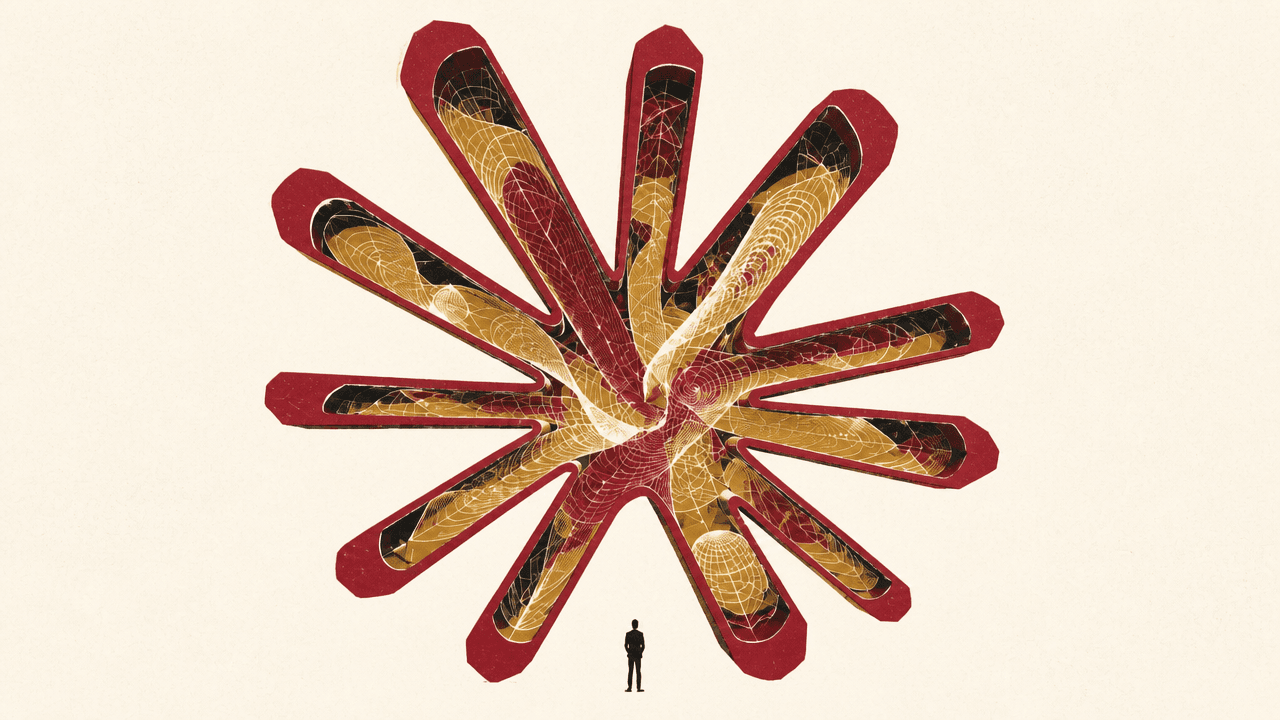
The most unusual part of the account is the form of the learned counter. Rather than storing a single scalar corresponding to a character count, the model represents counts through a low-dimensional curved structure populated by sparse features. In the source, that structure appears as a rippling spiral.
The counter is not one number. It is a rippling spiral.
The paper’s phrasing, quoted on screen, is that “character counts are represented on low-dimensional curved manifolds discretized by sparse feature families, analogous to biological place cells.” In plainer terms, sparse features mark positions along a continuous quantity—here, progress along a line—rather than an explicit register simply ticking from one count to the next.
Károly Zsolnai-Fehér offers an old radio as an intuition for the geometry. Stations that are too close together bleed into one another; spacing them further apart makes their signals easier to distinguish. He suggests the spiral can similarly separate numerical states into more distinct channels, making them more reliable to tell apart.
The learned structure was not manually specified. Zsolnai-Fehér says the model found during training that it needed this arrangement to become more reliable.
Nobody built this into the system. It found that it has to learn this by itself.
Line position is represented like a map
The analogy to place cells is more than a flourish. Earlier researchers recorded neural activity in a mouse moving through a box and found place cells: cells that fired when the animal was in particular spots. Károly Zsolnai-Fehér also describes boundary cells, which fire when the animal is near a wall.
The language model develops two comparable kinds of features in an abstract domain. Some respond to how far text has progressed across a line; others respond when the model approaches the line boundary. The relevant “place” is not a physical location but a position within a formatting constraint inferred from tokens.
An on-screen paper excerpt compares this structure with curve-detector features in vision models and place cells in biological brains. In all three cases, it says, a continuous variable is represented by a collection of features. For the line-break task, those features collectively encode position relative to the edge of the line.
Zsolnai-Fehér’s comparison is that the model has developed an internal sense of a nearby wall: where a mouse’s boundary cells signal proximity to a physical boundary, the model’s features signal proximity to the end of a line.
Inspection reveals the tool behind the answer
The value of this example is not merely that the model gets a line-break decision right. The attribution graph makes an internal chain inspectable: an approximate measure of token length, an inferred line width, current position, remaining capacity, and a prediction that the candidate word will not fit.
That matters, Károly Zsolnai-Fehér argues, because models often perform well on tasks they have already encountered, while genuinely new tasks can expose missing capabilities. Here, during training, the system appears to have recognized that solving line-length problems required a tool and built one internally. The source labels that emergent capability a “line-length counter.”
Zsolnai-Fehér calls opening the model and finding that tool “a spark of intelligence.” Researchers identified features associated with approximate character count, line position, line width, boundary distance, and a specific line-break prediction.
The narrow example also motivates a broader question. If a model developed spiral-like numerical representations and boundary-sensitive features without being explicitly given them, other learned strategies may remain present but unexamined. Zsolnai-Fehér calls that investigative posture “robopsychology,” borrowing Isaac Asimov’s term: studying a machine mind not only through what it produces, but through the structures it develops to produce it.