A $280 Single-Board Computer Can Replace a $28 Monthly Agent VPS
A video test of the Rubik Pi 3 argues that a small single-board computer can be enough to run an always-on AI agent server when the language model itself remains in the cloud. Comparing the Qualcomm Dragonwing-based board with a $28-a-month DigitalOcean VPS running OpenClaw, the presenter found that task times were often shaped less by hardware than by the agent framework’s planning, tool choices and execution path. His conclusion is that the Rubik Pi is not a replacement for fast interactive chatbots, but is viable for asynchronous background agents and could replace his VPS.
Agent infrastructure is not the same problem as model inference
Most AI infrastructure arguments treat compute as a question of GPUs and accelerators. The distinction here is narrower: frontier model inference needs specialized compute, but a personal or work AI agent often is not doing inference locally at all. If the model is hosted elsewhere, the local agent server is mainly a harness for orchestration.
That orchestration still matters. The agent framework calls APIs, searches the web, coordinates tools, runs shell commands, waits on external systems, and decides how to sequence those actions. The hardware question becomes less “can this device run a large model?” and more “can this device keep an always-on agent responsive enough while the model runs in the cloud?”
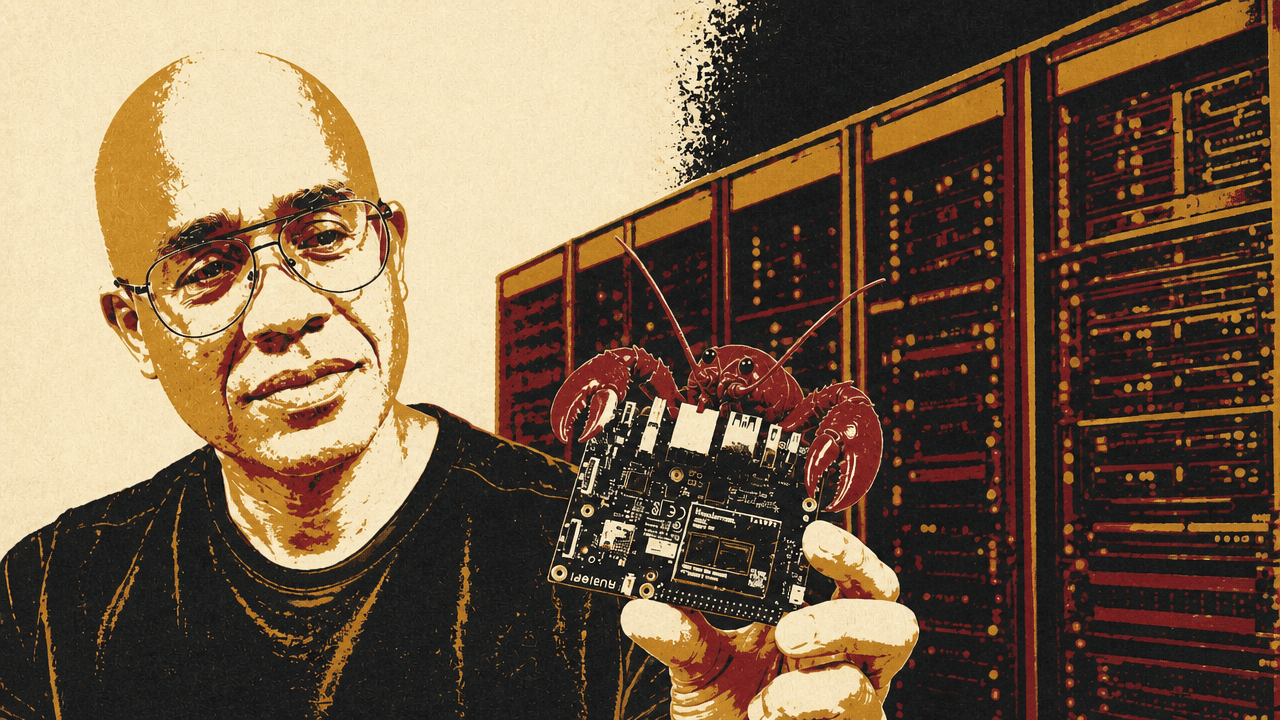
The device under test was a Rubik Pi 3, a small single-board computer built around Qualcomm’s Dragonwing platform. Its relevant specifications were an 8-core ARM CPU, 8GB of RAM, 128GB of onboard storage, gigabit networking, USB 3, and a dedicated AI accelerator. The accelerator was not central to the experiment because the models were remote. The comparison target was an existing $28-per-month DigitalOcean VPS, used as a conventional home for OpenClaw agents.
Qualcomm provided the hardware for the test; the methodology, opinions, and conclusions were the presenter’s.
Setup was not presented as a bottleneck. The Rubik Pi 3 shipped with Linux pre-installed, though it was reflashed with Ubuntu Server through Qualcomm’s Launcher utility to establish a known baseline. OpenClaw was then installed using the official installer. The comparison offered was that this took less effort than fighting with DigitalOcean’s “one-click OpenClaw droplet” in an earlier setup.
The benchmark exposed the agent’s choices more than the machine’s limits
The test workload was intentionally practical rather than synthetic. One on-screen prompt asked the agent to “summarize the last 3 openclaw releases in one paragraph each” from the project’s GitHub releases page. The second, longer prompt asked for a small Hacker News briefing system: infer the presenter’s interests from his favorites, create a skill and tools to fetch the Hacker News front page, identify five to seven likely-interesting posts, summarize them, and send a first briefing. The prompt explicitly told the agent not to use the browser plugin or browser automation skills.
The results were repeatedly caveated as anecdotes rather than formal benchmarks. That caveat was not cosmetic. The most important observation was that run-to-run agent behavior created more variation than the difference between the VPS and the Rubik Pi.
On the short OpenClaw release-summary task, the DigitalOcean VPS agent, named Ace, finished in about 29 seconds. The Rubik Pi agent, named Thunda, finished in 32 seconds. The roughly 10% difference was technically significant but not practically noticeable. The split-screen run showed Ace labeled as the VPS and Thunda as the Rubik Pi 3.
The more revealing point was how fragile that timing was. In earlier versions of the simple research task, the agent tried to determine the latest OpenClaw releases by inspecting local OpenClaw source code and reading the project changelog, rather than simply using the GitHub releases page. The visible agent trace showed web fetches and shell-command steps against a CHANGELOG file. That path took materially longer. The device was not the main variable; the agent’s route through the task was.
The complex Hacker News task made the same point more forcefully. In one run, the Rubik Pi finished in 1 minute 7 seconds, while the VPS took 1 minute 47 seconds. In another, the Rubik Pi took 1 minute 39 seconds, while the VPS finished in 1 minute 18 seconds. Those reversals led away from a simple hardware verdict. For these tasks, the Rubik Pi and the VPS were “mostly in the noise” relative to the agent’s planning and tool-use variability.
| Task/run | Rubik Pi 3 agent | VPS agent | Observation |
|---|---|---|---|
| OpenClaw release summary | 32 seconds | 29 seconds | Small timing gap in this run |
| Hacker News system, run 1 | 1 minute 7 seconds | 1 minute 47 seconds | Rubik Pi was faster in this run |
| Hacker News system, run 2 | 1 minute 39 seconds | 1 minute 18 seconds | VPS was faster in this run |
Because inference stayed remote, these timings should be read as an orchestration comparison, not as a test of the Rubik Pi’s AI accelerator.
The examples behind those timings were concrete. In one run, the VPS tried to use a browser, which was slower than direct web fetches. In another, it found an online database of Hacker News posts and skipped some steps entirely. In some Rubik Pi runs, the agent did more planning and spun up sub-agents to write code. A rigorous benchmark would require more runs and some treatment of outliers, but the conclusion from these runs was that the Rubik Pi was competitive with the VPS that had been running the agent workload for months.
The cloud chatbot comparison changed the question from hardware to harness
The Rubik Pi and VPS looked roughly equivalent when compared to each other. They did not look fast when compared to a consumer chatbot interface.
The same OpenClaw release-summary prompt was run directly in ChatGPT using a comparable model. It returned in 12 seconds on both an M4 Max MacBook Pro and an iPhone 16 Pro. Against the 29-to-32-second OpenClaw runs, that was a significant responsiveness gap, but it was not treated as a pure hardware result.
The gap was not attributed to hardware alone. The MacBook Pro and iPhone were substantially more expensive devices, but the more important distinction was the software stack. OpenClaw was described as a general-purpose agent framework with hooks, abstractions, and layers designed for flexibility and extensibility. ChatGPT, by contrast, was described as a closed system heavily optimized for performance and responsiveness.
The experiment started as a hardware comparison, but the software stack plays a huge role in the overall experience.
That distinction reframes what “minimum viable” means for an AI agent server in this context. If the workload is interactive and the user is waiting for a response, a 30-second task can feel slow, especially for someone accustomed to ChatGPT, Claude, or Gemini. If the workload is asynchronous, the tolerance changes. Scheduled jobs, triggered automations, content gathering, summarization, and background workflows do not need the same level of immediate responsiveness.
Agent benchmarking is difficult because the system being measured can make different choices across runs of the same task. In these examples, different tool choices, different plans, and different execution paths often had a bigger impact on runtime than whether the task was running on the VPS or the Rubik Pi. For these OpenClaw-style workloads, the harness — the agent framework and its tool abstractions — mattered as much as the hardware.
The Rubik Pi crossed the threshold for background agents
The practical conclusion was not that a Rubik Pi 3 should replace every cloud AI setup. The presenter said he was probably not switching to this kind of setup for everyday interactive AI use. Direct use of ChatGPT, Claude, or Gemini on a laptop or phone was faster and more convenient.
For OpenClaw-style asynchronous work, however, the Rubik Pi was judged sufficient. These are tasks that run on schedules or triggers: gathering information, summarizing content, performing background automation, and producing briefings while the user is doing something else. For that class of work, the responsiveness gap matters less, and the Rubik Pi performed well enough to replace the existing VPS.
The economic comparison was simple. The VPS cost $28 per month. The Rubik Pi cost about $280. On that basis, the payback period was estimated at roughly 10 months. Based on the observed performance, the presenter said he would shut down the VPS and run his OpenClaw-style agents on the Rubik Pi instead.
The remaining questions are not primarily about whether a small board can run an agent harness. In this test, it could. The unresolved questions are where the bottlenecks sit across agent frameworks, how much overhead comes from flexibility, and how different planning and tool-use strategies affect real workloads. For this class of cloud-model, local-orchestrator agent, the result was that the board was viable, while many of the harder performance questions were in the framework, planning, and execution path rather than the board itself.