Artists Need to Master the Rules Before They Can Break Them
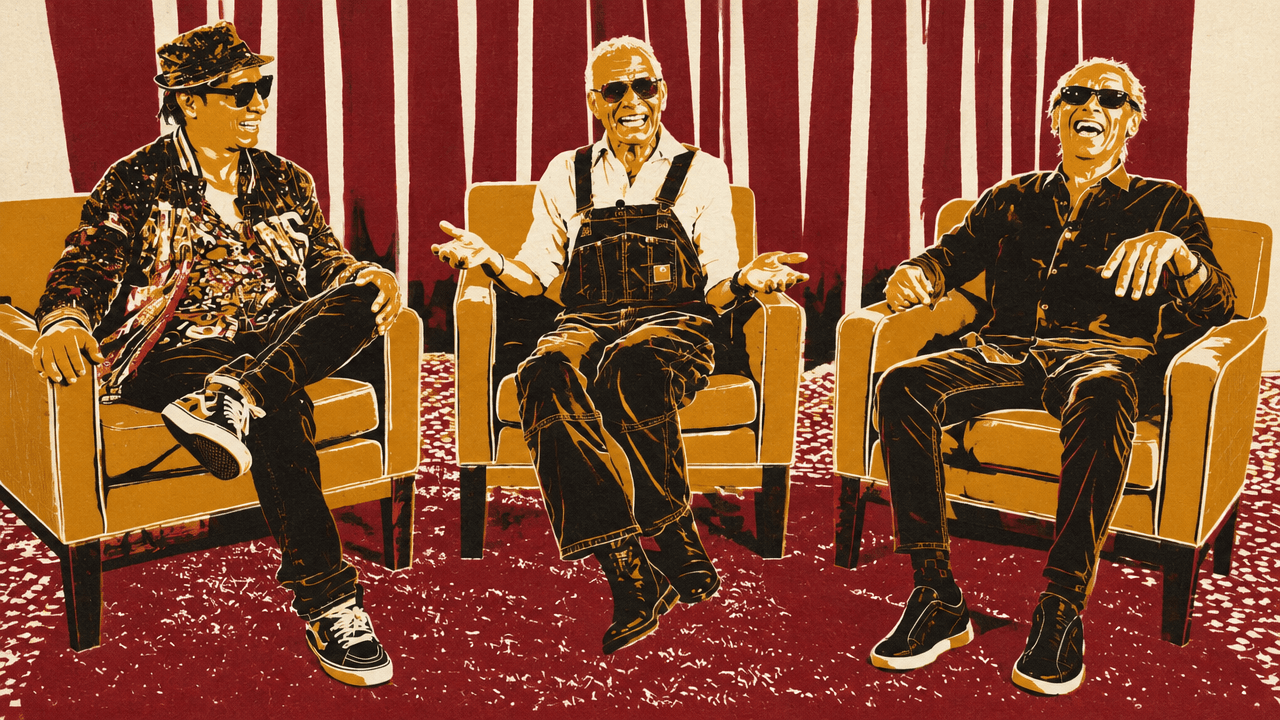
Alex Van Halen, David Lee Roth and muralist Robert Vargas argue that creative risk depends on preparation: learn the craft and its conventions before you try to break them. In their TED conversation, Van Halen says artists must absorb what they can see, hear and experience; Vargas describes letting places and people shape his work, while accepting that viewers may read it differently than he intended. Their account treats rehearsal and experience not as ways to eliminate uncertainty, but as groundwork for making art under it.
Risk depends on knowing what you are breaking
Alex Halen describes a two-part discipline for making art: learn the basics, then break the rules. The order matters. Freedom does not come from pretending to know what you have not learned; it comes from knowing enough to move beyond convention. Asked what counts as homework, Van Halen says to immerse yourself in everything you can see, hear and experience. Risk, in that account, is not a substitute for preparation. It is what preparation makes possible.
David Roth gives the idea an intentionally extravagant edge: get your heart broken, get it broken in a foreign language, then run away and join the Foreign Legion. “Now you got a song,” he says. Robert Vargas answers that the bigger the painting, the bigger the heartbreak. Behind the joke is a shared insistence that the artist’s life enters the work.
Roth recalls a professor’s claim that music, graphic art, photography, theater and stagecraft will never be more than you are as a human being. He translated that into a desire to go everywhere, meet people and eat what they eat. Experience is not decorative material added after the work; it shapes what the work can express.
Vargas says he had just returned from painting in Paris, London, Greece, Berlin and Tokyo. He tries to arrive without a preconceived idea, letting the place—its food, conversations and surroundings—influence the work. Once he understands why he is making something, he says, how to make it begins to come together.
The artist’s presence is part of the work
Robert Vargas says he has painted for as long as he can remember. He made his first mural at 10; at 15, he completed another that was unveiled at the Western Heritage Museum in Los Angeles, with Gene Autry in attendance. His current process still depends on direct observation rather than mechanical aids: he uses no grids, projections or stencils, and says he will eyeball a subject whether it is small or 20 stories tall.
To begin, Vargas grounds himself by touching the wall or other surface. He may work with music, but he also likes to hear the city and keep people close. The public can watch the work take shape, even when the artist and spectators do not share a language. For Vargas, that shared attention helps bring a community into the process.
His description of mark-making makes the physical dimension explicit. He thinks of a mark as language, a way to articulate emotions drawn from experience. As a child, he took Japanese ink-painting classes and learned to hold a brush almost like a sword. When he paints, he puts his whole body into the mark. The surface is not simply a place to apply an image; contact with it helps him center himself and make the work.
The audience is not required to see exactly what the artist intended. Roth asks whether Vargas wants viewers to feel what he feels while painting—or whether he can accept that he paints a Buick and someone sees a refrigerator. Vargas welcomes the mismatch. Art, he says, is a provocation, with an element of alchemy: it can invite a response without controlling it.
Confidence and rehearsal make room for the unexpected
Roth carries several objects he associates with good luck: a watch his mother gave him, a chess piece from his father and his mother’s glasses. He describes them as personal reminders, not generic tokens. Van Halen says people need something they perceive as lucky because it can raise their “vibration” beyond where they normally are; in those moments, he says, creative sparks can go beyond what is already in them. The point is not that a charm makes the work. It can help a person enter a state in which more becomes possible.
Roth says he has always liked rehearsal better than the show, when the elephant is late or a light falls. Vargas agrees that you expect problems and deal with them. Van Halen makes the purpose of preparation blunt:
You rehearse for the things that go wrong, not the things that go right. If it goes right, what the hell do you need to rehearse it for?
Vargas’s public process carries a related risk: the work unfolds in front of people, without a template to hide behind. The audience sees the decisions being made, and the artist cannot dictate what viewers will take from the finished mark. Preparation gives Vargas a method; it does not remove uncertainty from either the making or the reception.
Creative differences can change the work
Alex Halen says no single style of creativity dominated Van Halen’s work. He describes material that he and Ed made and that Roth later added to and embellished, becoming better than it was before. He compares collaboration to fusion: combining contributions can produce something more powerful than each contribution alone. The image is not of compromise that smooths out differences, but of parts interacting and changing the result.
Roth recalls that the calm of the band’s public presentation coexisted with family arguments and backstage conflict. Van Halen says they were conscious of sharing creative control. The friction mattered because no one style simply took over.
Their musical examples show how context and feeling can cross boundaries without making taste identical. Roth says that growing up next door to jazz saxophonist Joe Henderson exposed him to a modal sound that could feel happy and sad at once. He says the band used that contrast in its harmonies, so a listener might hear more than one emotional color. Van Halen points to “Happy Trails,” which the band included on a record, as an example of music traveling beyond the boundaries people assign to it.
Roth offers a more personal account of cultural exchange. He says a busing program took him to Black and Spanish-speaking schools and that he still listens to music from those traditions. For him, becoming part of a community means knowing people—not just borrowing a sound. He describes the woman behind a deli counter in Kyoto and the waiters at a Thai restaurant in New York, with the small exchanges of asking after one another’s families. In Japan, his dog Russell helped make those connections: people who had initially found Roth intimidating began greeting him and asking after the dog.
Roth suggests that people may like different music for different reasons. Van Halen agrees, but argues that the essential question is whether the music brings out emotion; he says that if it makes people listen and forget what they are doing, it has achieved something. They do not settle the difference. That exchange is itself part of their account of collaboration: distinct responses can coexist without preventing a shared work.
Learn the constraints before you unlearn them
Asked what advice they would give a young creative, Roth jokes, “Life is short, smoke ’em if you got ’em.” Van Halen’s answer returns to the discipline behind risk: learn everything, then unlearn it. Vargas calls that deconstruction. Van Halen emphasizes that the learning comes first. Without it, breaking away from rules is only pretending to be free.
Roth puts the commitment personally: “Be true to your work and your work will be true to you.” Vargas urges young artists to make the work they feel they need to make. Their advice is less a formula for a finished result than a way to approach the uncertainty: build the knowledge, stay open to experience and make room for what cannot be planned.