Americans Are More Ready for Democratic Reform Than Their Pessimism Suggests
Pew Research Center president Michael Dimock argues that American democracy was never meant to be a finished system, but an unfinished project requiring each generation to repair and adapt it. In a TED talk, he says Pew’s data show a public caught in polarization, civic disconnection and distrust of government, yet also more open to major democratic reform than its pessimism suggests.
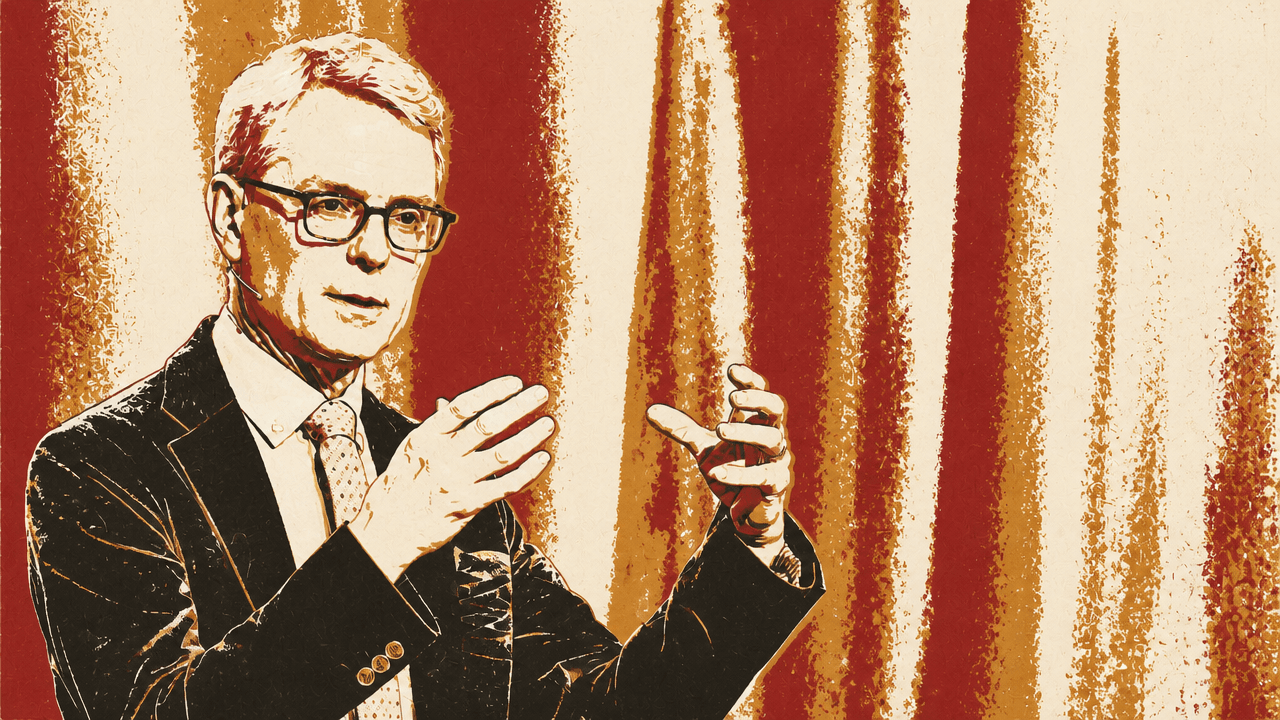
Democracy was framed as an unfinished project
Michael Dimock argues that the American democratic inheritance is not a fixed design to be preserved unchanged, but a project that each generation is responsible for renewing. The founding act, as he frames it, was not only the declaration of “life, liberty and the pursuit of happiness,” but the next principle: governments derive “their just powers from the consent of the governed.”
That claim, Dimock says, was the democratic imagination that made 1776 consequential beyond the United States. It produced a form of civic identity built around shared principles rather than “a common ruler, a common history, a common faith, a common creed.” The country’s self-conception, in this account, rests on the idea that it can be an inspiration to later generations and “a beacon to the world.”
But the founders did not hand down a completed system. Dimock’s central claim is that they handed down an ongoing project: a republic that requires engagement, creativity, adaptation and repair. A democratic republic, if it becomes static, risks becoming “stuck, or rigid, or even cynical.”
The public mood is dark, but not inert
From Pew Research Center’s work asking Americans about their views, values, opinions and concerns, Dimock says the current public mood is “pretty dark.” Americans feel scared, stuck and divided. Yet he also hears something else in the data: a readiness for democratic innovation that he connects back to the founding idea that political systems must be altered when they no longer secure the ends they were meant to serve.
He describes the present condition as a “doom loop” built from three mutually reinforcing forces: partisan polarization, civic disconnection and cynicism about government. These are not isolated complaints. In Dimock’s telling, each worsens the others, and all are accelerated by a fragmented media environment and an algorithmically driven digital ecosystem.
The result is a public that feels pulled apart by “centrifugal forces,” with common bonds under strain.
Dimock uses that pessimism as the hinge for the talk. The question is not only whether Americans think the country is declining, but what would be required to “turn that lens.”
Polarization has moved from disagreement to mistrust
Michael Dimock distinguishes ordinary political disagreement from the current civic condition. Americans no longer merely differ over issues or candidates, he says. They increasingly mistrust one another “at a civic level” and use dehumanizing language about political opponents.
Pew’s data, as shown in the talk, compared Democratic and Republican views of the other party between 2016 and 2022 across traits including “closed minded,” “dishonest” and “immoral.” The chart showed both parties moving further in negative assessments over that period, with especially large increases on judgments of immorality.
Dimock says the United States stands apart globally for this level of polarization. During and after the pandemic, Pew surveyed publics around the world, and the American public was the most divided or among the most divided on the outbreak, vaccination, government responses and civil society.
That figure, Dimock says, was higher than in any other country Pew surveyed. The pandemic did not create the broader pattern in his account, but it exposed how thin the shared civic fabric had become.
Disconnection has weakened democracy’s social premise
The second part of the doom loop is disconnection. Dimock points to falling interpersonal trust over roughly half a century: in 1972, 46 percent of adults said “most people can be trusted”; by 2024, that share was 34 percent.
More damaging for democracy, in his account, is that Americans have come to doubt “the very wisdom of the crowds” — the collective judgment on which democratic self-government depends. A Pew visual shown during the talk reported that six in ten adults say they have little or no confidence in the wisdom of the American people when it comes to making political decisions.
The pattern is not merely domestic over-time decline. Dimock says that in a Pew survey of 24 countries, Americans were the least likely to say they feel connected to fellow citizens in their country, and among the least likely to say they feel connected to people in their local communities.
| Measure | U.S. result | Comparison shown |
|---|---|---|
| Feel very or somewhat close to people in their country | 66% | Hungary: 93% |
| Feel very or somewhat close to people in their local community | 54% | Nigeria: 91%; South Korea: 50% |
The third component is cynicism about the political system itself. Trust in government to do what is right “just about always or most of the time” was shown as 73 percent in 1958 and 17 percent in 2025. Dimock says Americans are now more likely to believe elected officials care about winning partisan fights, or enriching themselves, than about listening to and representing constituents.
Personal repair is necessary, but not sufficient
Dimock offers individual civic practices, but he does not present them as a substitute for institutional reform. He says the response begins with each person: putting phones down, reclaiming attention, and making room for human connection in communities. He treats attention as a civic asset, not merely a personal productivity issue.
He also calls for more conversation across the public, but specifies the kind of conversation he thinks is missing. Americans have become afraid to talk about democracy because the frame has been set around grievances, fears and differences. Dimock argues for conversations about hopes for the country and what people can do together.
These are small steps, and he acknowledges they can be hard to initiate, especially with strangers. But he frames them as cumulative. No one else can take that local step on a person’s behalf.
Still, the larger claim is institutional: Americans must remember that solutions are possible. The Constitution, signed near the TED Democracy Philadelphia venue, is presented not only as permission but as an obligation to act when democratic arrangements become stuck.
The system must adapt because every fix creates the next problem
Michael Dimock says democratic dynamism is not just about responding to new technologies, though he notes that the founders could not have imagined artificial intelligence or offered guidance on its effects on society, politics and the economy. His more fundamental point is that any system balancing liberty and governance becomes trapped if left still too long.
He applies that principle to several areas. The founders could not have imagined the Republican and Democratic parties of 2026, but they did understand that polarization would arise in democratic systems and would become dangerous if unattended. They could not have fully anticipated the size, distribution and diversity of the American population, but they understood that translating public voice into effective representation through elections would require constant adaptation. Dimock points to contemporary redistricting as evidence of how representation can become trapped or “hijacked.”
He also argues that the founders could not have fully understood the scale of the American economy or the amount of money that would flow through politics. But he says their writings show they understood money as a fundamental democratic challenge where representation is concerned.
His broader point is anti-finalist: democratic reform does not produce a permanent cure. Every time a problem is fixed, another arises. “That’s not a flaw,” he says. “That’s the nature of a democratic republic.”
Americans are more open to major reform than their despair suggests
Dimock says Pew asked Americans across the country what they would do to fix the political system, and the responses showed substantial appetite for change. At the broadest level, he says a vast majority of Americans are willing to consider major reform on a scale unusual among countries with comparable economic means.
The priorities he names include improving the quality of representation, reducing the influence of money in politics and defusing aggressive partisan rhetoric. A Pew visual reported that 72 percent say there should be limits on the amount of money people and organizations can spend in campaigns, while smaller shares said people and organizations should be able to spend all they want. Another visual showed 83 percent overall saying elected officials should avoid aggressive language because it could encourage violent action; the same view was held by 75 percent of Republicans and 78 percent of Democrats in the chart shown.
Dimock lists possible reforms without endorsing any one of them: term limits for members of Congress, age limits for elected officials or judges, eliminating the Electoral College, and other electoral reforms. His argument is not that these proposals are all right, but that they are serious enough to debate.
The absence of constitutional reform is part of his warning. Dimock says the United States has not engaged as a society or public in a conversation about constitutional amendment in 55 years, since lowering the voting age from 21 to 18. The previous time the Constitution went unamended for that long, he says, was in the lead-up to the Civil War.
The barrier, in his account, is fear: fear that change could make things worse, and especially that it could benefit “the other side.” That fear has narrowed the democratic imagination. Americans have stopped seriously imagining how the system could be made better.
The right to alter government is part of the founding logic
Dimock returns to the Declaration of Independence not as ceremonial language but as an instruction about democratic responsibility. After asserting rights and consent, the Declaration says that when any form of government becomes destructive of those ends, “it is the Right of the People to alter or to abolish it.”
In 1776, Dimock says, the founders were arguing that they had no choice but to abolish the system they lived under and begin again. But he reads their hope for future generations differently: not constant rupture, but the ability to alter and iterate on the framework they built.
The work will not “drop down magically,” he says. It requires hard civic labor. But if the country is to remain whole, thrive and continue to inspire future generations, Americans must be willing to make “brave leaps of democratic imagination” of their own.