The Accordion’s 226 Buttons Give One Instrument a Remarkable Range

Accordionist Maria Telesheva argues that the instrument’s range depends on a player coordinating its many controls: 226 buttons, registers that alter its tone and bellows that shape its dynamics. She describes mastering those demands as both physical work and an intense mental exercise, and points to the music she plays—from Bach to the Beatles and AC/DC—as evidence of the repertoire she embraces.
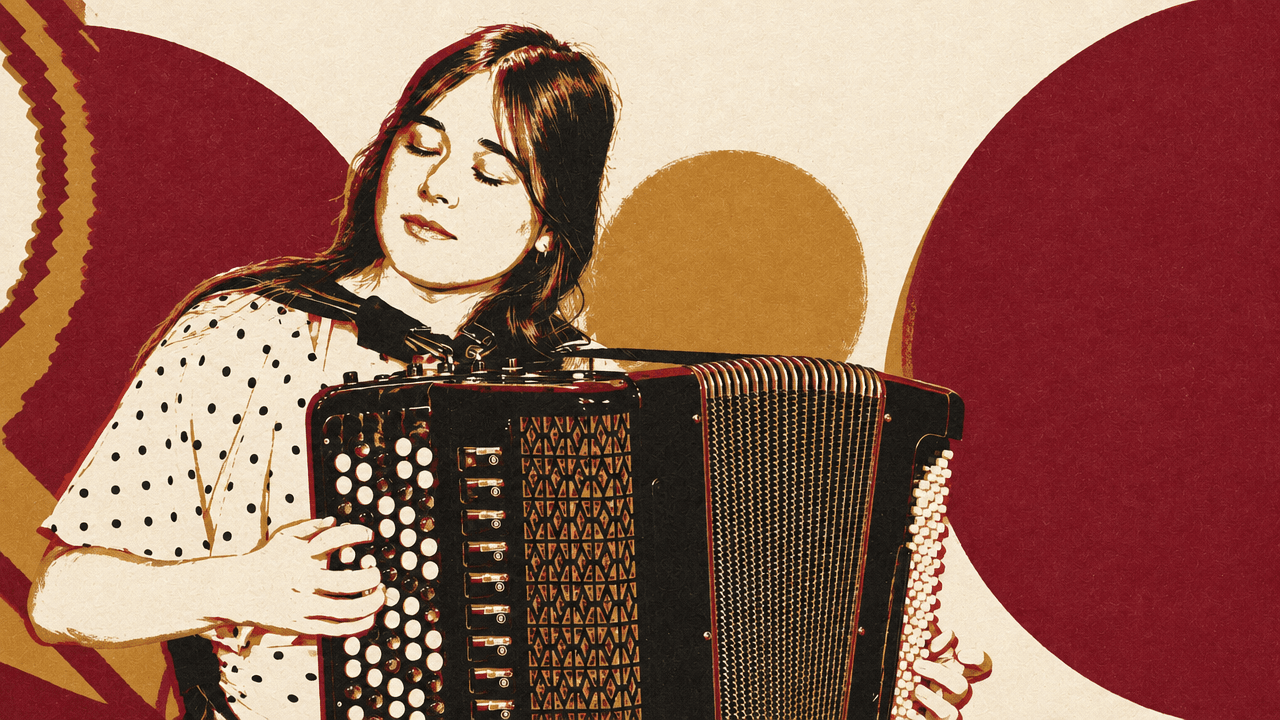
Versatility depends on the player working several controls at once
Maria Telesheva describes her professional B-system chromatic button accordion as having 120 buttons on the left and 106 on the right. Registers let her change the instrument’s tone; she says they can imitate sounds including the bassoon, piccolo and organ. Some of the register controls are duplicated as “chin switches,” which she operates with her chin.
The bellows—the middle section she pushes and pulls—pump air through the instrument and control its dynamics. Telesheva calls them “the lungs of the accordion.” The accordion she demonstrates weighs about 35 pounds, making its control a physical task as well as, in her words, “an intense brain exercise.”
Her account ties that workload to the range of music she likes to play: Bach, the Beatles and AC/DC. She particularly enjoys playing in a duet with her father, who is both her teacher and a professional accordion player. The range she describes comes from the combination of repertoire and controls: the registers change the tone, while the bellows shape airflow and dynamics. She does not explain how she adapts the instrument to each style.
A small first instrument led to a professional model
Telesheva says she began playing about 12 years ago, as a child, on a tiny accordion in her family’s living room. She asked her father to teach her and started with a few chords and simple melodies. That first instrument, she says, did not even have all the notes. Her father’s presence as a teacher at home helped her progress quickly.
The contrast with the professional model she describes now is striking: her first accordion was limited in its notes, while the instrument she demonstrates has 226 buttons, registers for changing tone, chin switches and bellows that control dynamics. Telesheva presents her early attachment to the instrument as preceding that technical complexity. She says she fell in love with it while learning basic chords and melodies, with her father close by to teach her.
The music she names makes clear that she does not confine her playing to one style. She says she enjoys everything from Bach to the Beatles to AC/DC, but does not describe particular arrangements or how she changes her approach between them. The examples instead establish the breadth of repertoire she associates with the accordion.
Bach had just been played; Schubert was next
Telesheva distinguishes two classical works in her performance. Before explaining the instrument, she says she had just played Bach’s Prelude and Fugue, by one of her favorite classical composers. She also says she recently performed that piece for NPR’s Tiny Desk Concerts.
At the end of her explanation, she introduces the piece she is about to play: Moments Musicaux by Franz Schubert. The Bach work is therefore both the performance that preceded her explanation and one she says she had played at Tiny Desk; the Schubert is her announced final piece. Alongside her references to the Beatles and AC/DC, the two works give specific examples of the musical range she says she enjoys, without implying that she describes how she adapts the accordion to each one.