Jacob Collier Builds “All You Need Is Love” Live With an Unrehearsed Orchestra

At TED2026 in Vancouver, Jacob Collier conducted the VSO School of Music Orchestra through an unrehearsed arrangement of the Beatles’ “All You Need Is Love,” built in front of the audience without sheet music or prior plan. The performance argues, by demonstration, that improvisation at orchestral scale depends less on vagueness than on precise, rapidly revised instructions: pitches, loops, dynamics, entrances and roles assigned in real time.
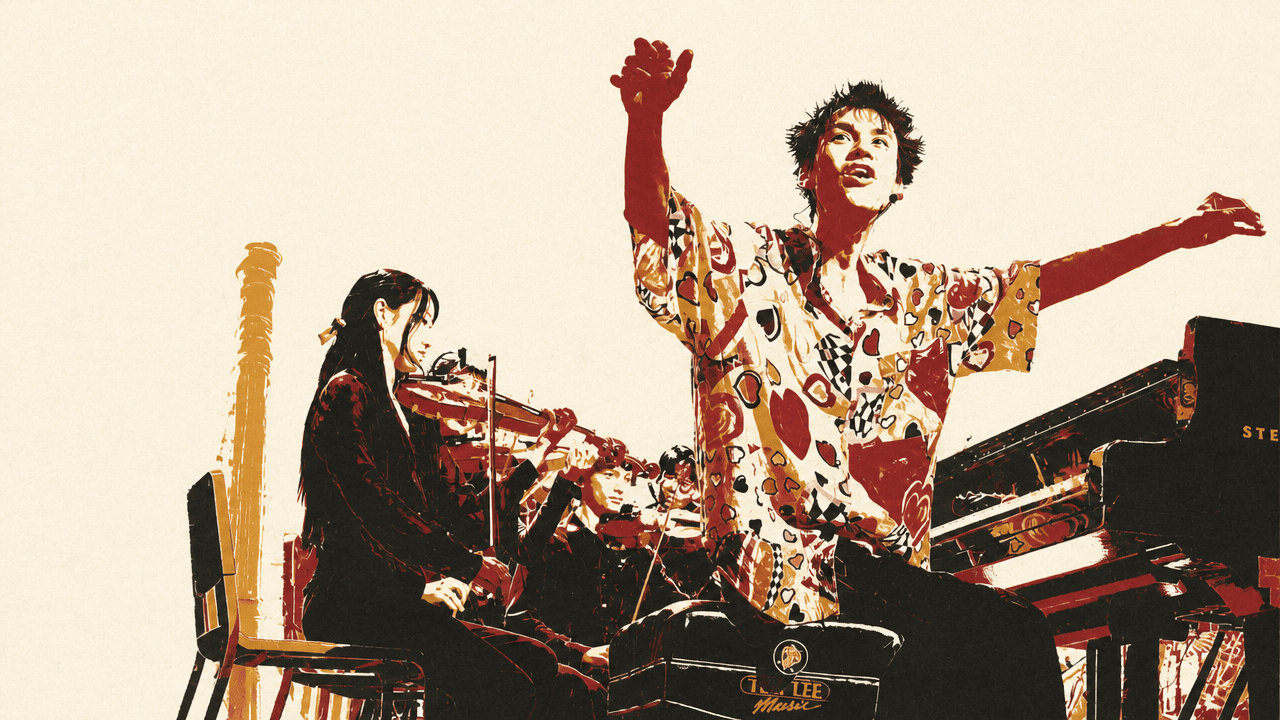
The arrangement was built in public
Jacob Collier began with a hard constraint: the VSO School of Music Orchestra had not rehearsed, had no sheet music, and had received “no plan or prior discussion of any kind.” The performance was recorded at TED in Vancouver in April 2026, with the stage identified on screen as the VSO School of Music Orchestra.


There is no sheet music. We have had no plan or prior discussion of any kind.
That constraint was not separate from the music. It was the method Collier chose for the room. He treated the orchestra as a set of live musical resources and assembled the arrangement in front of the audience: pitch by pitch, section by section, with immediate correction, encouragement, and repetition.
He started with the violins on a D, then added A, G, and D around it. He tried tremolando, returned them briefly to arco, and decided “tremolando’s better.” The opening texture was not explained abstractly; it was auditioned and kept. Violas were then given G and D on the beat, establishing the pulse: “dun, dun, dun, dun.” Harp entered with a G-major glissando from the bottom to the top of the instrument, and vibraphone was asked for a high G, then another G above it, “even louder.”
The result was a recognizable orchestral ground before anyone had named the song. Collier’s working language moved between note names, sung syllables, instrumental technique, and feel. A part might be “G, F sharp, E,” or it might be “doo, roo, doo, roo.” He did not separate composing from rehearsing; the arrangement existed as he taught it.
The verse became a loop
The first full section became the verse. Jacob Collier gave cello and flute a three-note exchange: cello on G, F sharp, E; flute answering A, G, first tested at one octave, then moved lower. He then assigned the second half of the verse to bass, cello, and clarinet.
The bass was asked to descend the G-major scale starting on A, on the G string, eventually landing on G. Clarinet was asked to mirror the descent starting on concert C. Collier then connected the sections: when the descending line landed on G, the earlier cello-and-flute figure would restart. “So it kind of loops around,” he told them.
That loop turned a collection of parts into form. The verse was not simply a melody with accompaniment in the usual rehearsal sense; it was a mechanism the musicians could remember. Collier tested it “all the way through,” adding harp at the beginning, and after the run stopped to have the audience applaud the players.
So that will be our verse. But every good song needs a chorus.
The line marked the shift from texture-building to song architecture. The verse had been assembled from strings, harp, vibraphone, flute, bass, and clarinet. The chorus would be built from brass and percussion, with a louder, more declarative function.
The chorus needed brass, drums, and volume
For the chorus, Jacob Collier turned to the brass: tuba, trumpets, trombone, and horn, with a percussionist handling snare drum, kick drum, and cymbal. The first brass gesture used trombone one, trumpet one, and horn. Each had three notes, played twice. Trombone moved G, A, B; trumpet took G, G, F sharp; horn took B, C sharp, D.
After hearing it, Collier made two changes. First, it needed to be “five times louder.” Second, it needed a percussion setup: a snare roll on beat three landing on beat one with kick and cymbal together. He framed the requested volume as “louder than is responsible for the TED theater,” making clear that the chorus required a different physical impact from the verse.
The second half of the chorus filled in the remaining brass. Tuba received seven notes — G, F sharp, E, D, C, then D, G — which Collier described as a sequence drawn from the G-major scale. Trombone was assigned B, A, G, G, C, C, B. Trumpet received what Collier called “a sneaky little part”: a chromatic line starting on D, moving up to F and back to D. When the first attempt did not sit right, he corrected himself: “That’s totally my bad. Half speed trumpet.”
That correction matters because the arrangement was still being shaped. The orchestra was not merely executing commands from a fixed score; Collier was adjusting the parts as he heard them. His role combined instruction, listening, and fast repair.
The audience became part of the form
Once the verse and chorus had been assigned, Jacob Collier checked whether everyone had something to do. The audience did not. He turned that absence into a part.
Their line was simple: “Ra-ta-da-da-da.” He had them repeat it louder, then asked whether they were doing it “more drunkenly.” That, he said, was “exactly the vibe.” The audience part was not musically complex, but it changed who was inside the arrangement. The orchestra carried the harmonic and formal structure; the audience supplied a short responsive figure on cue.
Collier then gave the performers the roadmap from the top: violins, violas, harp, vibraphone, cello and flute, clarinet, tremolo bass, chorus, then audience. Only after this public construction did his own part become clear. He began singing “All You Need Is Love.”
The completed performance revealed why the earlier fragments had been chosen. The verse supported the lyric: “There’s nothing you can do that can’t be done. Nothing you can sing that can’t be sung.” The chorus brass then carried the release into “All you need is love,” repeated with the orchestra. The audience’s earlier syllables were replaced at the end by the lyric “Love, love, love,” which they echoed back to him.
The closing screen identified the finished collaboration plainly: “Jacob Collier + VSO School of Music Orchestra.”
The freedom came through exact instructions
The absence of preparation did not mean absence of structure. Jacob Collier supplied key, tempo, parts, loops, dynamics, entrances, repeats, and transitions. He did not ask the orchestra to improvise in a general way; he gave exact pitches and gestures, then revised them by listening. Tremolando stayed because it sounded better. The flute moved down an octave. The trumpet line slowed to half speed. The chorus grew louder because the first dynamic was not enough.
The musicians’ task was demanding in observable ways. They had to hold parts without notation, track form after hearing it only moments before, respond to verbal and sung cues, and re-enter when Collier signaled. The audience saw a score being constructed publicly, not a polished reveal of music the players already knew.
By the final repetitions of “Love, love, love,” the separate assignments had resolved into a shared refrain. What began as isolated pitches, glissandos, tremolos, descents, brass calls, and audience syllables became the recognizable shape of the song.