Apple’s New Siri Tests Who Controls the Default AI Assistant
John Coogan and Jordi Hays read Apple’s WWDC as a test of whether the company can turn its long-delayed Siri promise into a defensible AI interface without giving up control of defaults, privacy, and the iPhone camera. The Diet TBPN segment argues that Apple’s AI story is less about a single keynote than about older bets now becoming technically possible, while Anthropic’s Claude Fable release and Meta’s data-center training push show the same shift toward long-running inference and physical AI infrastructure.
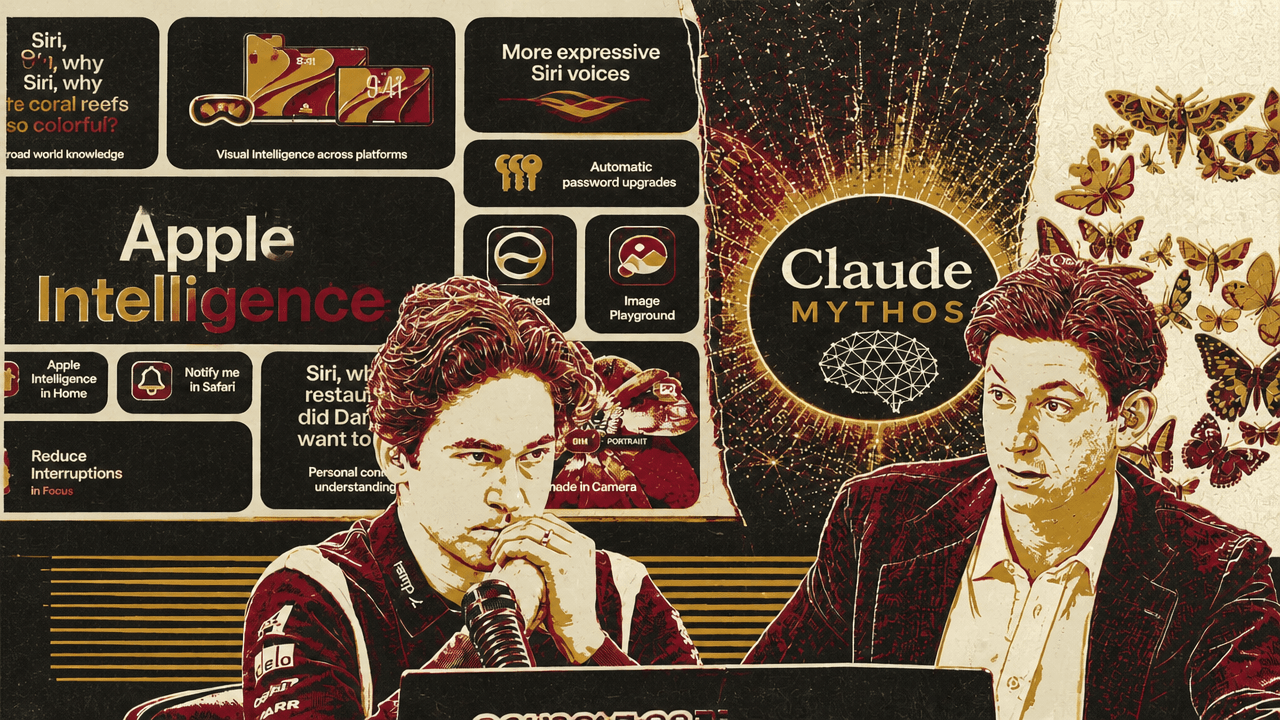
Apple’s Siri story is now a Tim Cook story
John Coogan framed Apple’s latest WWDC around an unusually long arc: Siri was announced at what he described as Tim Cook’s first WWDC as Apple CEO, and the newest Siri was the focus of what Coogan called Cook’s “last WWDC.” The symmetry mattered because Siri’s original promise already sounded like the current promise of LLM-powered assistants.
In the 2011 Apple clip played during the segment, the presenter described the frustration of voice technology that forced users to “learn a syntax” for simple commands like calling a name, dialing a number, or playing a song. The point of Siri, Apple said then, was that users should be able to ask naturally — “What’s the weather going to be like today?”, “Will it rain in Cupertino?”, “Do I need an umbrella today?” — and have the phone infer what they meant.
Coogan’s reading was not that Apple suddenly discovered AI. It was that the original pitch was AI all along, but the technology was not ready for what Apple was selling. Siri, he noted, came out of SRI International, the Stanford Research Institute, and its Artificial Intelligence Center. Apple acquired Siri Inc. and released Siri with the iPhone 4S in October 2011. Steve Jobs died the next day.
That made the new Siri launch feel, to Coogan, like a bookend on Cook’s tenure: Apple spent more than a decade with a voice assistant whose original ambition was beyond the state of the art, while Cook built an enormously valuable business through operations, the App Store, and hardware execution. Jordi Hays put the point more bluntly: “The stock did fantastically well. Tim Cook created an immense amount of value. But it was this AI winter. They made it lighter, cheaper, faster, stronger.”
Coogan agreed with the operational assessment, but argued that Cook was CEO during “the greatest AI winter ever basically,” from 2011 until the LLM and chatbot era began in 2022 and 2023. Siri was “the best of a very mediocre category,” then slowly fell behind. Hays added that even before ChatGPT, in 2019, ordinary users did not think Siri had delivered on the promise of a C-3PO-like agentic computer — but the gap did not matter competitively because Google Assistant and Alexa were not causing mass switching away from iPhones.
The change came when chat apps made Siri’s limitations obvious. In Coogan’s view, Apple is behind, but not as catastrophically as the discourse suggests. If the original Siri vision is treated as a 15-year project, he argued, and frontier AI labs reached the relevant threshold after roughly 12 years, Apple is “three years behind” — an eternity in AI, but only about “10% slower” on that longer timeline.
Back in 2023, I said, “With all these incredible advances in conversational AI chatbots, I’m willing to put down a firm prediction. By the year 2043, Siri will be useable.” And I think it came true.
Hays immediately qualified that claim: Coogan had not yet verified the new Siri because it was not live for another couple of months. Coogan accepted the correction. The confidence, for now, was anticipatory.
Apple is selling phone safety as a product feature, not a moral panic
John Coogan said Apple spent roughly 12 minutes of what he considered a notably short keynote on child safety and parental controls, compared with what he estimated was about 15 minutes on products. He saw that allocation as revealing. Apple, in his description, does not usually send executives out to make sweeping doom claims and then retrofit solutions. With environmental concerns, he said, Apple worked privately on clean energy and later marketed the solution rather than first performing climate alarm. He suggested the company is taking a similar line on phones, children, and attention.
The features he listed were concrete: child accounts with built-in age protections, adult-site limits, age-appropriate media, “Ask to browse” approvals for new websites, and communication controls that let parents manage who their child talks to and require confirmation before adding new contacts.
Jordi Hays connected this to a broader cultural turn: more people, he said, are “waking up” to the possibility that phones are causing systemic social problems, and Apple may be trying to get ahead of that. Coogan used terms like “brain rot” and “futility stuff,” and tied the issue loosely to recent writing about fertility decline and phone addiction. He said the correlation was not perfect, but argued that reasonable people are increasingly placing phones in the “probably linked” bucket among causes of modern fertility decline. He attributed to Derek Thompson the idea that phones might account for something like 30% of the reasons, while treating that as part of a broader debate rather than a settled number.
The business logic was just as important. Coogan said many parents are hesitant to give children smartphones. If Apple can credibly say that parents remain in control — that the device is locked down, contacts are managed, sites require approval, and the child is “safe with us” — it has an answer to the growing niche market for kid-focused dumb phones, GPS watches, and devices that allow calling home without screens or social media.
His praise was specifically for Apple talking about the tools rather than the apocalypse. “Being proactive about building solutions and then only talking about the solutions,” he said, was “extremely refreshing” and a good move.
The camera is becoming an AI system, and the labeling problem is not solved
The WWDC feature that generated the most philosophical friction was Spatial Reframing in Apple Photos. Apple showed a photo of a person in a train station being adjusted so the perspective appeared straightened, with interface copy instructing users to touch and drag to adjust perspective and use two fingers to pan, zoom, or rotate. After processing, the app displayed that the photo had been reframed and could be tapped to see the original.
John Coogan liked the feature because it did not feel, to him, like generic image-generation “slop.” It felt like a practical tool placed directly inside the camera roll: take a photo from an angle, then use AI to make it appear more straight-on. He also distinguished it from cases where Apple merely absorbs an obvious startup feature or copies something already baked into Instagram. Spatial Reframing, he said, felt more like Apple’s own DNA: understanding the technology and turning it into a specific, polished consumer feature.
Jordi Hays saw the same feature as more notable because of where Apple put it. Post-production apps have long offered image manipulation. Bringing this into the camera experience changes the camera from a device that captures reality into a device where “the computer is now the camera.” Coogan agreed that Apple has historically prized a “what you see is what you get” camera experience, but said that line had already shifted through artificial depth of field, tone mapping, low-light cleanup, upscaling, and other computational photography.
The disagreement was less about whether the feature is useful than about how much it changes the status of a photograph. Coogan’s position was permissive: if users do not want reframed photos, they can avoid the option, and in any case they could always take an image into Photoshop and manipulate it there. Hays pushed toward the downstream consequences. People’s memories of lived experience, he said, may begin to diverge from reality.
The examples quickly became extreme. Coogan invoked Joe Weisenthal’s provocative idea that if images can be generated on demand, users might not need to store photos in the cloud; they could ask for a picture of a child riding a dinosaur at age five and have one invented. Hays imagined a future AirPods request: “Hey Siri, make sure to generate some images of my time at Disneyland today.”
The practical problem becomes labeling. Coogan wondered whether Instagram will develop a visible divide between accounts that constantly receive AI tags and accounts that claim “no AI ever.” Hays asked when the tag should apply. Is a small spatial reframe enough? Coogan drew a tentative distinction: a color grade enhances colors, while Spatial Reframing captures a picture that “never existed.” But he did not pretend the boundary was clean. Passing an image through a neural network to make it black and white, applying a filter, removing a background, reframing perspective, and generating whole scenes sit on a continuum.
Spatial reframing is slightly... because it’s capturing a picture that never existed, whereas a filter is just sort of like enhancing colors. I don’t know. It’s clearly like a blurry line. But it’s the blurriest we’ve ever seen.
A producer said Apple did not appear to release much in the way of AI-detection features around this. There may be metadata indicating that reframing was used, he suggested, but Hays immediately noted that screenshotting would defeat that.
A tweet shown from Brian MacDuff said Apple’s Photos “Clean Up” feature was “DRASTICALLY improved in iOS 27,” with side-by-side original, iOS 27, and iOS 26 examples. Coogan said the older version had been “very rough,” and speculated that the improved version might involve something like Nano Banana under the hood or a model fine-tuned on it. Hays added earlier that Android’s AI camera features had been ahead on cleanup.
The Siri model-picker dispute is really about who controls the default assistant
John Coogan and Jordi Hays treated the Gruber-versus-Gurman dispute less as a media fight than as a proxy for the real question: will Siri become a neutral front end for the user’s preferred AI model, or will Apple preserve friction and control?
Coogan summarized Mark Gurman’s March 2024 Bloomberg reporting as saying Apple planned to open Siri to rival AI assistants in iOS 18: if Gemini, Claude, or ChatGPT were installed, Siri could send queries to those services, similar to ChatGPT integration in Apple Intelligence. John Gruber, according to Coogan, argued that Apple had not fully announced that at WWDC, speculating that maybe Apple ran out of time, forgot, or had scrapped and rebuilt the next-generation Siri in the prior month.
Hays said Gurman responded with screenshots of integrations that “basically match” his original reporting, including what appeared to be a model picker in the Siri app. Hays’s view was that both interpretations could be roughly correct because the gap lay in expectations.
Coogan defined the expectation from hardcore AI users by using himself as the example. They want the Siri button to fully remap to their AI model of choice. If a user has built habits, memory, workflows, and trust around ChatGPT, they want pressing the Siri button to invoke that model by default. The current pattern, as Coogan described it, is more cumbersome: ask Siri to ask ChatGPT, receive a pop-up, click okay, and pass the request along. Hays called that “playing telephone.”
The screenshots of a model picker did not settle the matter because it was unclear whether the selection would persist or reset regularly, perhaps on each query. Coogan expected more details to emerge. He also cited Marques Brownlee’s interpretation of Apple’s “Golden Gate” naming as a kind of nominative determinism: a golden gate preserving the walled garden and producing gold from what remains inside it. Coogan said Apple may simply like San Francisco, but he found the take fun.
The infrastructure piece matters because Apple’s AI ambitions still have to fit its privacy posture. Coogan said he had gotten more information that Apple’s Private Cloud had been extended into Google Cloud. He referred to AFM, Apple Foundation Models, and to “AFM3 Cloud Pro,” which he described as Apple’s reasoning model, but then hedged the underlying model relationship as “a fine-tune of Gemini or some train on Gemini.” His account was that Apple had worked with Google and Nvidia to extend private cloud compute onto Nvidia GPUs in Google Cloud while maintaining the same privacy guarantees.
That is a real tension in Apple’s positioning. Coogan emphasized that people store “everything” on their iPhones and trust Apple with that data. Apple is now trying to carry that trust into infrastructure associated with Google, which Coogan jokingly characterized as the advertiser and “dangerous one,” before qualifying that Facebook is more commonly cast in that role.
The M&A angle sat alongside the infrastructure choice. Coogan reminded viewers that Siri itself was an acquisition and said “M&A for AI is in Apple’s DNA.” A quote tweet from Coogan referenced Apple’s reported meeting with Mira Murati, former OpenAI CTO, about a potential deal for Thinking Machines Lab. Coogan called the Gemini path a major fork in the road: Apple could have tried to bring Thinking Machines’ engineering team inside Apple, but it would have had to “pay through the nose.” Siri, he said, was likely a couple-hundred-million-dollar acquisition; Thinking Machines, in his rough guess, might have required “ten or something” billion.
Claude Fable points to the economics of long-running inference
Anthropic’s new model release appeared under two names: Mythos and Fable. John Coogan opened by saying Anthropic launched Mythos or Fable, with Fable as the main consumer model and Mythos carrying more cybersecurity-oriented details. Later, he and Jordi Hays returned to the release after noting that people on X had already had access.
The Information’s characterization drew immediate scrutiny. Hays said the outlet called Fable a “neutered version of Mythos.” Coogan objected to that framing as not how Anthropic presented it. Hays restated the likely company line: safer and more reliable for certain things, and probably cheaper. Coogan put it as “added safety.”
The price shown in a tweet quoting The Information was $10 per million input tokens and $50 per million output tokens for Claude Mythos (Fable), with the note that it was expensive — twice the price of Opus — but perhaps not as expensive as initial Mythos pricing, which was described as five times Opus.
| Model reference in visual | Input price | Output price | Source characterization shown |
|---|---|---|---|
| Claude Mythos (Fable) | $10 / MTok | $50 / MTok | According to The Information, via tweet shown on screen |
Coogan’s practical takeaway was simple: if users are “token maxing,” they should expect to pay. But he also said the capabilities “seem sane,” citing reports of the model running for nine hours straight or over a weekend without getting confused. He described it as a very exciting model and noted that Dan Shipper at Every was doing a live “vibe check” after having access.
The broader AI point came from Noam Brown’s writing on large-scale test-time compute. Coogan quoted Brown’s answer to why researchers do not simply evaluate a harness that pushes test-time compute until performance plateaus: empirically, the plateau is “very far out,” and sometimes not visible within practical budgets. “You can just spend, spend, spend,” Coogan summarized.
A chart attributed to @polynoamial plotted “Erdös unit distance problem accuracy at test time,” with pass@1 accuracy rising against log test-time compute. Coogan connected this to Andrej Karpathy’s Auto Research Experiment, where performance continued improving even after hundreds of experiments.
The striking implication, for Coogan, was that a model might run for longer than it takes to train and release the next model. A user could assign a job, the model could work on it, and before the job completes, a stronger successor model might already be ready. He called that “a crazy, crazy world” and argued it was not what people had predicted: more compute, more inference, and more reasoning across the board.
AI’s second-order effects are showing up in labor, policing, maps, and media
The AI buildout theme moved from models to labor with Meta’s new Workforce Academy. John Coogan described it as a free five-week program to train workers to build data centers, offered in partnership with CBRE and the Associated Builders and Contractors. A displayed article said the program guaranteed a job and followed recent layoffs of 8,000 employees.
Coogan’s read was that this is the “learn to weld” meme becoming real. “Forget learning to code,” he said: Meta is effectively saying it is time to pick up a wrench. Skilled trade workers are becoming sought after because data centers have become critical AI infrastructure. The underlying point was straightforward: AI’s bottlenecks are not only model architecture, researchers, and GPUs. They are also the physical systems and trades required to construct and operate the data centers.
Apple Maps supplied a more consumer-facing infrastructure example. Coogan reacted to a clip saying Gaussian splatting is coming to Apple Maps and said the resulting 3D city imagery looked much better. He was unsure when he would use it. Jordi Hays suggested a practical case: arriving in a new city, checking into a hotel, and using the map to learn orientation and get a feel for the area.
Hays also introduced a No Jumper clip about Flock Safety as an “admitted criminal” discussing its impact. The clip was stopped almost immediately because of profanity, and the claim was summarized instead. Hays said the people in the clip claimed it had become difficult to commit car-related crimes in San Francisco because, if someone steals a car, a drone begins following from thousands of feet up, often without the driver realizing it. Coogan added that police would not need to chase immediately; they could wait until the car stopped or parked, then box it in.
Hays said the No Jumper host asked whether someone could still “steal a car, run up on your ops and ditch the car after,” and the guests said no. Coogan noted the host described that sequence as “the classic” version of the crime, as if it were a recognized tactic. Coogan joked that, “not to lay out a bear case for Flock,” perhaps law enforcement should also listen to podcasts where criminals admit crimes and then arrest them. Hays added that one of the people was listed as among the most prolific criminals in San Francisco, and that he complained he could not “even do drive-bys anymore.”
The media-business coda was Pat McAfee. Coogan cited reporting from The Athletic that ESPN and McAfee’s representatives were discussing a contract extension that could pay McAfee more than $60 million per year. The deal was not completed, and Coogan said the final number could involve a sliding scale based on new responsibilities. ESPN could make McAfee even more visible, especially in NFL coverage.
Coogan called McAfee one of TBPN’s role models and said he would welcome a larger McAfee role in NFL coverage. Hays noted that McAfee had done a watch-along on actual TV for a Knicks game. Coogan added that McAfee had become part of the college football ecosystem and was an important voice there.
The structure of McAfee’s existing arrangement was the more interesting detail. Coogan said ESPN views it as a production contract plus a separate talent agreement, unlike most on-air personality deals. McAfee hosts a three-hour daily show with his crew; the first two hours air on ESPN, while all three air on YouTube. ESPN, in that reading, is not only paying for an on-air commentator. It is buying into a working media machine: talent, production, community, distribution, and a show that already exists across television and YouTube.