Apple’s WWDC Leaves Siri-Scale AI Infrastructure Questions Unanswered

John Coogan and Jordi Hays used Apple’s WWDC announcements to argue that Apple’s AI challenge has shifted from invention to integration: putting familiar model behaviors inside Siri, iOS and Mac workflows without breaking the company’s privacy and product-control instincts. The discussion also treated Apple’s “private cloud” language as an unresolved infrastructure question, then turned to strong U.S. jobs data as a check on AI layoff claims and to viral VC horror stories as a distinction between bad fundraising theater and more serious disclosure or board-level problems.
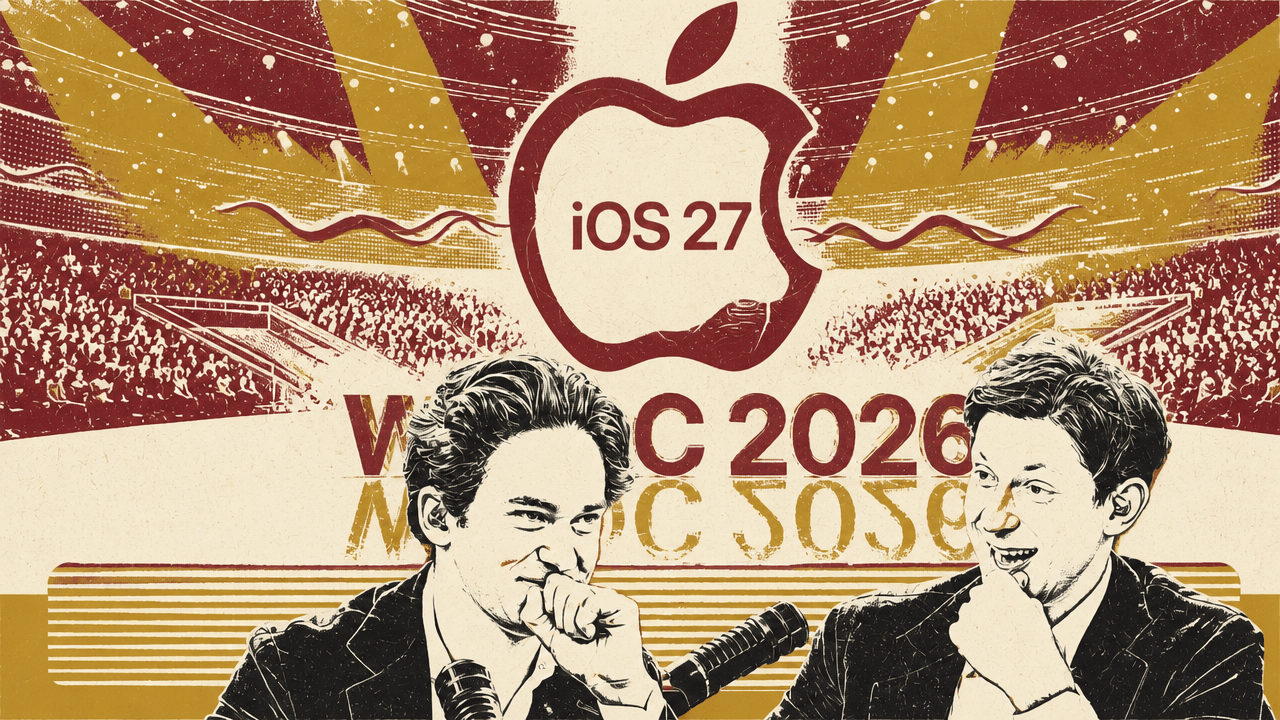
Apple’s AI problem is no longer invention; it is integration
John Coogan framed Apple’s WWDC as a different kind of AI test than the one the company faced when it first promoted Apple Intelligence. The bar, in his view, is not whether Apple can produce a breakthrough that no other company has achieved. It is whether Apple can take the AI behaviors users already understand from ChatGPT, Gemini, Claude, Grok, Google Search Overviews, and enterprise tools, and place them naturally inside Apple software.
“All people are asking for,” Coogan said, is that Apple implement the “best practices” people already know: ask a model for clarification, get a summary, retrieve an extra fact, query a business system in natural language. He pointed to Grok inside X as an example of useful proximity. When a user sees a claim in a tweet, the value is not an abstract AGI promise but the ability to ask “is this real?” without copying text into another app. He also cited Google AI Overviews and Ramp’s chat interface for company spend as examples of AI that is not revolutionary in presentation but is useful because it appears where the question arises.
Jordi Hays argued that Apple helped create its own earlier problem. A year or two earlier, he said, Apple was putting Apple Intelligence on billboards, emphasizing genmoji and other features in a way that “set themselves up for failure.” Coogan agreed that those features were overhyped. His view was that Apple now seems to have the right partnerships and product strategy: models are good enough, users are familiar enough, and the job is to make them available at the click of a button — ideally through Siri.
That Siri point was central. Coogan described the Siri button as having been “completely nerfed” for the last two years, and said Siri has never received the level of adoption or “product love” other Apple products have. The question now is whether Siri becomes a real interface into Apple software and third-party apps, rather than a legacy assistant with limited utility.
The cultural challenge, Coogan said, is that Apple is entering a world of non-deterministic outputs. Google has already shown that broad AI deployment can produce both useful features and ridiculous viral failures. Coogan gave the example of Google mishandling the word “disregard,” responding as if it were an instruction rather than a term to define. Apple, he said, will have its own viral hallucination moments.
But he does not think those moments will necessarily matter in usage metrics. He pointed to Apple’s text summaries, which he described as often funny, sometimes wrong, and still useful enough that he leaves them on. Hays asked whether he still keeps them enabled; Coogan said yes.
Your PR team will have many heart attacks, because you're not in the world of deterministic outputs anymore.
For Apple, Coogan argued, that is a major internal shift. The company is accustomed to polished, controlled, deterministic product experiences. AI introduces stochastic behavior that can be useful to users while creating ugly screenshots for public relations teams.
The open-agent question cuts against Apple’s privacy instincts
Coogan identified two tensions Apple will have to resolve: whether to make its devices and operating systems better hosts for open AI agents, and whether to preserve its traditional posture of restrictive privacy controls.
On the Mac side, he asked whether Apple would lean into what he called the “open claw Mac mini boom” — his shorthand in the discussion for developers buying Mac minis and using Apple hardware for AI-agent workflows. Apple could embrace that community, he said, by making the next version of macOS more effective for agents and open tooling. Or it could move in the opposite direction and restrict more functionality on privacy grounds.
The same tension applies to “vibe coding” and the iOS App Store. Coogan recalled that Hays had asked John Gruber about this on a prior appearance, and said Apple does not yet have to respond publicly. Apple’s typical pattern, he argued, is to stay quiet until it has a solution. He compared this to climate: Apple did not want to talk loudly about environmental issues until it had made investments in net-zero commitments, eco-friendly buildings, and solar panels, after which it became much more vocal. Hays added that Apple tends to start talking once it has figured out how to make money on the issue — a posture he said he supports.
The deeper product question is how much iOS functionality native apps from AI labs will be allowed to access. Coogan asked what the pathway looks like for ChatGPT, Claude, Gemini, or other AI apps to interface with iPhone data and functions. Will users be able to grant an AI app access to iMessage, for example, in the way they grant camera-roll access to social apps? Or will iOS force users to approve every action one at a time, making deep integration too burdensome to matter?
He used camera-roll permissions as the analogy. Many apps ask for access to a user’s entire photo library “forever,” and many users simply approve it, even though that means an app can download the whole camera roll. Apple also offers more limited permissions, such as temporary access to a single photo. Coogan’s question was what the AI equivalent of that permission model will be, and whether it will be built mostly on Siri App Intents or on deeper iOS APIs.
The privacy discussion widened briefly into a separate tech-accountability aside. Coogan raised recent arguments that phones and social platforms may be contributing to declining fertility rates, referring to a research paper and Derek Thompson’s changed view that phones could account for “up to 30%” of the recent decline below replacement. He used the example to suggest that big tech companies, social media companies, and device manufacturers may eventually face questions about device effects in less controlled settings.
The contrast, in his telling, is that AI CEOs are often willing to discuss existential AI risk for an hour, while device and social media companies are unlikely to welcome questions about phones, brain rot, and fertility. Hays noted the debate is different from cigarettes: “a single drag” is clearly poison, while a single look at a screen is not what reduces fertility rates. Coogan replied that perhaps “the cure for cancer is right around the corner, but the cure for brain rot is not.”
Private cloud raises the practical question Apple did not answer
During the WWDC stream, Tyler Hogge reported that Apple repeatedly emphasized privacy when introducing AI features. Each time Apple discussed a new AI capability, he said, the company stressed that it ran on a “private cloud,” was not public, and was extremely secure. When Coogan asked what “private cloud” means, Tyler said he did not know, but understood Apple to be emphasizing its own foundation models.


Hays asked whether Apple said the word Gemini. Tyler said he did not know whether it was spoken, but that Gemini appeared on screen.
Coogan then raised a speculative possibility about Apple’s Gemini relationship: perhaps Apple has the ability with Gemini to white-label, fine-tune, mid-train, or otherwise package model capabilities under Apple’s own branding. He called that “a great deal” if true, but said it leaves a major infrastructure question: who is doing the inference?
Apple has a billion iPhone users, Coogan noted. If a meaningful share of them begin pressing the Siri button all day, and if the resulting model is anywhere near frontier capability, that creates a large amount of inference demand. Coogan did not claim to know how Apple is serving that demand. He asked whether Apple has built a secret data center, whether “private cloud” might mean capacity inside Google Cloud, or whether Apple has assembled some other architecture — jokingly, even “a bunch of Mac Minis wired together.”
His point was that the capacity would have to show up somewhere. Even if capital expenditure did not make the buildout obvious, he said, energy use would appear in emissions or ESG data unless Apple had some unusually clean power source. He acknowledged that some inference could happen on device, and called that exciting, but resisted the idea that “private cloud” could mean entirely local execution.
Hays relayed that someone in the chat said “on device.” Coogan pushed back: if the computation were on device, Apple would just say on device. “Cloud,” by definition, means not on device. He also noted Tyler’s report that Apple had brought up rate limits and a subscription plan. In Coogan’s view, rate limits and subscriptions make little sense for purely on-device computation.
Apple already has significant data-center capacity, Coogan said. iCloud Photos, device backups, and storage plans make that obvious. The question is where AI inference goes over time and how Apple reconciles the scale of model serving with its privacy and environmental commitments.
The WWDC reactions also included more conventional product expectations. Coogan said he had seen Apple emphasize performance gains — faster lock-screen opening, faster app launches, and other optimizations. He connected that to a prior discussion with Mark Gurman, who had argued that AI features can be too abstract for many users. People usually want basics: battery life, cameras, beautiful screens, fast performance. Coogan called this “time to chop wood.”
Hays joked that Apple was effectively putting up a model card by advertising incremental improvements. Coogan said Apple already has a version of that in its “Bento box” graphics: megapixels, GPU cores, storage, compute, and other specifications. He and Hays connected that to a broader point about product maturity. When a product is sold on performance metrics rather than brand aura, Coogan said, margin compression often follows. Hays supplied the phrase “margin compression.”
Apple’s Liquid Glass design also appeared to be moving toward usability constraints. Jane Manchun Wong’s post, quoted by Hays from an on-screen tweet, said Apple had “conceded” on Liquid Glass and compromised for usability. Hays described that as Apple pulling back. Coogan said he liked the new Apple Maps icon’s use of Liquid Glass, but had seen complaints that the new Mac operating system had contrast issues — too bright or too dark — though he had not noticed them himself.
Strong jobs data undercuts the AI layoff narrative and complicates the Fed path
Coogan treated the latest labor report as a direct challenge to the more extreme AI unemployment narrative. Citing the Labor Department report, he said the United States added a seasonally adjusted 172,000 jobs in May and that unemployment remained at 4.3%. Coogan described it as the third month in a row of job gains, while also noting that the prior month had been slightly lower than the month before it.
He joked that the “bubble popped” because Friday had been the Nasdaq’s worst day in more than a year, down 4.2%, before noting that stocks were already up 1.5% on the day of the discussion. Hays described that as the bubble popping and then reinflating. Coogan rejected the framing: it was not 1999 or 2000, he said, but “officially 2003” — after the bubble had already popped and rebuilding had begun.
The employment data, in Coogan’s view, was “terrible news” for AI leaders predicting mass job losses. He joked that the “AI job apocalypse is canceled at least for the month of May,” while adding that conditions could change. His point was not that the labor market has no nuance; he acknowledged jobs are not being added in all the “most critical industries” and that the trend may not last. But he said he believes the jobs report, does not expect it to be massively revised downward, and thinks it tracks with ADP and other numbers he had in mind.
The macro problem, as Coogan described it, is that strong employment arrives alongside inflation pressure. He said inflation was already running hotter than the Federal Reserve would like before the closing of the Strait of Hormuz spiked gas costs. Hays added that inflation has been well above the Fed’s 2% target for basically as long as he has been an adult.
Coogan said the combination makes a rate cut less likely and may put the Fed near rate-hike territory. That, in his view, is bad for tech companies whose earnings forecasts stretch far into the future.
There is, he said, one “copium” silver lining: if rates are high and the economy later slows, the Fed has room to cut. During COVID, rates were already very low, unemployment rose suddenly, and the response depended heavily on fiscal stimulus. In the current setting, Coogan argued, the Fed would at least have something in the tool chest.
Hays observed that for people who came of age in the zero-interest-rate era, it once seemed impossible to imagine the current level of market speculation with rates where they are. He suggested that the persistence of speculation is itself an argument to raise rates further. Coogan agreed, then recalled a friend who made bumper stickers saying, “Please God, just one more bubble.” His punchline: “And God delivered.”
Pitch horror stories are different from board horror stories
The viral VC horror-story thread began, Coogan said, with Greg Isenberg. Isenberg’s on-screen post described pitching a $15 million Series A in a boardroom at a top-three venture firm with 12 people in the meeting, where one general partner fell asleep for more than 30 minutes and nobody acknowledged it. Isenberg wrote that he kept presenting his Series A slides to “an unconscious man in a Herman Miller chair” and that this was somehow considered normal in venture capital.
The post mattered because it set the tone for the broader thread: venture as a performance in which founders may fly across the country, present to a room of powerful investors, and discover that some of the people judging them are not fully present. Coogan treated the anecdote as funny and disrespectful, but not as the whole story.
Hays immediately complicated the outrage. If a founder or operator falls asleep in the office because they are exhausted from grinding, he said, they are treated as a hero. Coogan cited Packy McCormick’s similar joke: when Elon Musk falls asleep in a factory, it is no big deal; when a VC falls asleep, it is the end of the world.
Coogan did not defend disrespectful behavior. Falling asleep in a pitch, he said, is disrespectful. But he drew a line between VC pitch horror stories and VC board horror stories, and said he has much less sympathy for the former.
His reasoning was structural. In Silicon Valley, he argued, the market has usually been so high-growth and positive-sum that relatively good behavior becomes the equilibrium. Even if a startup fails, investors often do not want to burn the founder relationship: that founder might start the next major company. A VC may help with a soft landing, serve as a reference, support an acquihire, or fund the next company because venture is an iterated game.
Pitch meetings, by contrast, are part of selling equity. Founders may take 50 fundraising meetings, and some will inevitably be bad: the investor did not read the materials, did not understand the company, was rude, or was checked out. Hays noted that compared with other kinds of sales calls, VCs are often nicer; a customer who is not interested may simply be blunt that the product is not a fit.
The best investor relationship, Hays said, is often one where expectations are accurate. One of his favorite VCs tells founders plainly: he gives them money, helps them raise more money, gets dinner occasionally, and does not pretend to be a daily operator. Founders like him because he does exactly what he says he will do.
Coogan agreed. Some firms genuinely help with go-to-market. Some help with marketing. Some claim they will and do not. The issue is not whether every VC is deeply involved, but whether they are transparent about the help they will actually provide.
Dylan Field’s on-screen reply offered a counterexample from Figma’s 2013 seed round: “Most folks didn’t get it but everyone I met was super nice to me,” helped, he wrote, by warm introductions and meeting people known to be founder-friendly. Coogan’s practical advice followed that logic: founders should reference-check investors, think through competitive investments, and find buyers for their equity who are a fit.
He did not elevate a sleeping GP into one of the worst things a founder will face. It is rude, he said, but “far from the worst thing that regularly happens in the course of growing a business.”
The ‘Sequoia scam’ accusation was really about structured rounds and disclosure
The sharper VC dispute came from Brendan Foody, CEO of Mercor, whose on-screen post criticized what he called the “Sequoia scam.” Foody wrote that in the previous six months he had seen “half a dozen” rounds where Sequoia invested in two tranches, everyone pretended only the higher valuation mattered, founders misrepresented that to employees, and then shopped the headline valuation to angels. He wrote that Sequoia’s blended price was “blatantly deceptive” and less than 50% of the valuation projected to the market.
That post was central because it moved the discussion from rude meetings to financing mechanics. A sleeping investor is a bad experience. A structured round that is described one way internally and another way externally can affect employee expectations, angel-investor decisions, and the public story about a company’s momentum.
Coogan translated the mechanism: a firm might invest across two tranches, one at a $500 million valuation and one at a $1 billion valuation, after which the founder says the company raised at $1 billion. In reality, the investor’s blended entry price is lower.
Coogan’s view was that the structure itself is not illegal and can make sense for both sides. Tranched and structured investments are common, he said. He pointed to Sequoia’s original YouTube investment memo as an example of a structured and tranched investment, and said the practice has existed for decades. “Nobody read the manual,” he said, because people who “know ball” should know structured investments exist.
The legal and ethical risk, as Coogan described it, comes from misrepresentation. If a founder tells another investor only the higher valuation and conceals the structure of the round, he said, that can become securities fraud. Coogan also said a VC should not go to another investor and present the entire deal as having happened at the higher valuation without context. But he did not see the practice as unique to Sequoia; he said crossover funds and many top firms have used similar structures.
Hays called it aggressive and unnecessary to label the practice a “Sequoia scam,” especially because Foody later replied to his own viral post by saying that, in fairness to Sequoia, the practice is common across top firms. Coogan noted the asymmetry in attention: the accusatory post had roughly 1,000 likes, while the clarification had three.
At the same time, Coogan did not put the burden entirely on employees, angels, or journalists to understand every financing structure. If employees are evaluating stock options or outsiders are trying to understand the “heat” around a company, he said, there is a responsibility to communicate the structure clearly.
The distinction was consistent with his broader VC view: the existence of hard terms is not itself scandalous. The failure to disclose what those terms mean can be.
Fundraising theater is real, even when it is not a scandal
The viral thread also produced older and stranger fundraising stories. Travis Kalanick wrote that in 2001 he intercepted a VC partner who was trying to leave before their meeting, then pitched him from the passenger seat of the partner’s parked Lexus. At one point, according to Kalanick, the partner grabbed his laptop, placed it on his belly against the steering wheel, and rapidly flipped through the slides himself. “2001 fundraising hit different,” Kalanick wrote.
Hays wanted to know how the story ended: did the investor write a check?
Tyler’s own fundraising story came from Divvy’s SoftBank pitch process. At Divvy, he wrote in an on-screen post, the team pitched Rajeev Misra at SoftBank’s Redwood City headquarters and then Masayoshi Son in Tokyo soon after. Tyler described the experience as “absolute cinema”: zyns, vaping, loud coughing to throw them off, assistants whispering in Misra’s ear, “some of the most asinine questions ever asked,” and, in Tokyo, Masa opening the meeting by saying, “you have 10 minutes,” after the team had flown roughly 20 hours.
Hays called the whispering assistants a power play. Coogan agreed. Tyler jokingly reframed the 10-minute limit as a way to get to the substance quickly. Coogan’s diagnosis was simpler: Tyler had been power played.
The sleeping-GP story also prompted Tyler to bring in a study he had found about older men, ages 66 to 83, sitting in a slightly dim room with little stimulation. The median time to fall asleep, he said, was 36.9 minutes. Coogan and Hays applied this jokingly to venture meetings: many pitches are 30 minutes to an hour, meaning a slow, boring business pitched to an older investor in a comfortable chair may enter the “danger zone.” Coogan’s advice was to keep the pitch under 30 minutes and “bring the air horn.”
The fundraising stories were not treated as evidence that venture is broken. They were presented as part of the industry’s long-running theater: sometimes disrespectful, sometimes funny, sometimes structurally risky, and often survivable. The underlying advice was practical: know who is across the table, keep expectations explicit, and do not confuse a bad pitch meeting with the deeper consequences of a bad investor on the board.