Apple’s AI Challenge Shifts From Invention to iPhone Integration

John Coogan used Diet TBPN’s WWDC discussion to argue that Apple’s AI challenge is now less about inventing a breakthrough than deciding how deeply Siri, iOS, third-party models and cloud inference can touch the iPhone without breaking Apple’s privacy and product-control instincts. The episode also framed strong US hiring as a problem for tech’s rate-cut hopes, and separated viral VC pitch-room complaints from the more serious risk of opaque financing structures that founders may misrepresent.
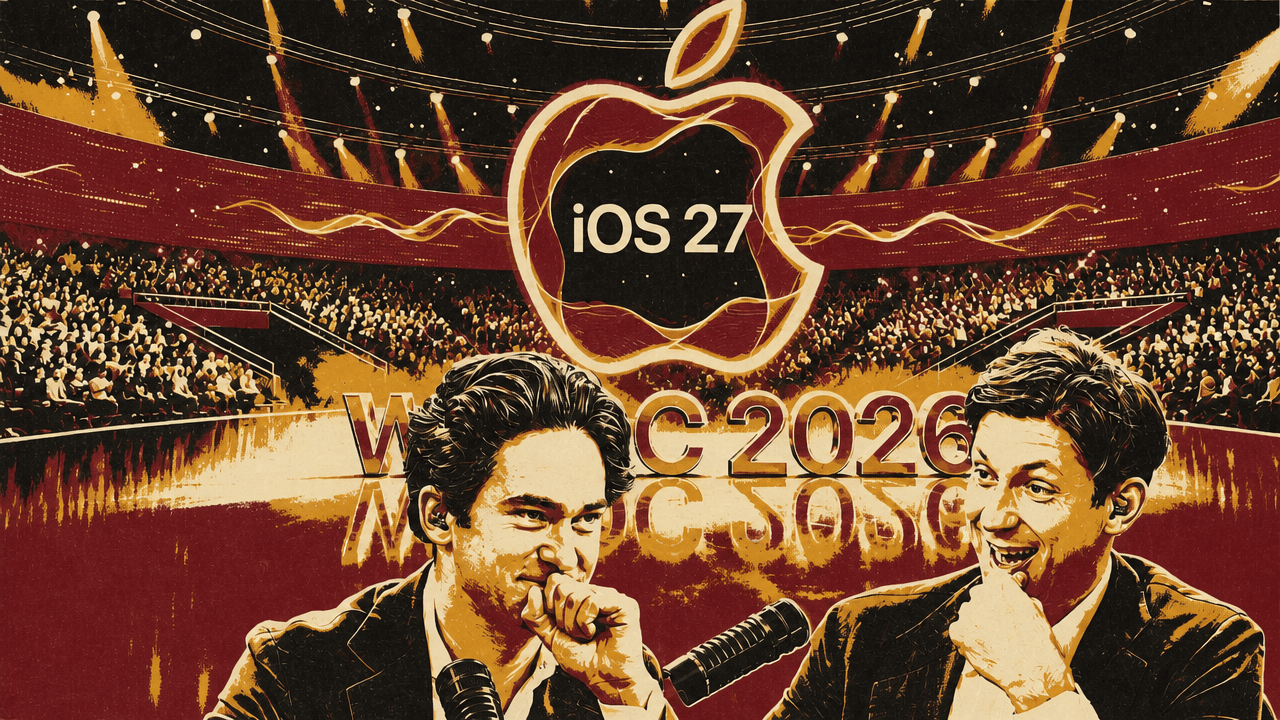
Apple’s AI problem is no longer invention; it is integration
John Coogan framed this year’s WWDC as a different kind of Apple AI moment from the one the company created around Apple Intelligence and Genmoji. The pressure is still high, but not in the Vision Pro sense, where Apple was expected to produce a breakthrough no one else had built. The bar is more prosaic and harder to dodge: Siri and iOS need to absorb the best practices users already recognize from ChatGPT, Gemini, Claude, Grok, Google AI Overviews, and enterprise chat interfaces.
Users have learned what a useful embedded AI layer feels like. Grok inside X can be summoned in context to ask whether a post is real or to fetch an extra fact. Google has put AI answers where search users expect answers. Ramp has a chat interface that lets a user ask how much the company spent on Amazon last month and have the system retrieve it. None of that requires “revolutionary AGI,” Coogan said. It is a tool that appears where the user already is.
That is the standard he applied to Apple. Models are good enough, he argued, that Apple’s task is to make them available “at the click of a button,” ideally through the Siri button, which he said has been “completely nerfed” for years and has never had the product love or adoption of Apple’s stronger products. Jordi Hays added that Apple may have done a better job this time by letting hype build more organically. A year or two earlier, Hays said, Apple was putting up billboards for Apple Intelligence and Genmoji and “setting themselves up for failure.” Coogan agreed that the earlier effort was overhyped, but argued that Apple now appears to have better partnerships and a more realistic product strategy.
The hard part, in Coogan’s telling, is cultural as much as technical. Apple is used to deterministic outputs and tightly managed launches. AI products do not behave that way. Google’s AI work can be impressive at the model level while still producing viral failures; Coogan cited the kind of confusion where a user asks for the definition of “disregard” and the system responds as if instructed to stop doing something. Apple’s own text summaries, he said, are often funny because they hallucinate or misread. He keeps them on anyway.
Your PR team will have many heart attacks because you're not in the world of deterministic outputs anymore.
The claim was not that those mistakes do not matter. It was that they may not matter in the way Apple fears. Viral screenshots of failed summaries or strange answers will happen, and Apple dislikes that kind of exposure. But Coogan doubted those moments would show up meaningfully in churn or usage. Users may keep imperfect AI features enabled because they are occasionally useful, amusing, or simply convenient. Apple’s shift, then, is not only to ship better AI; it is to tolerate the stochastic surface area that comes with it.
The open question is how much of the iPhone Apple will let AI touch
The unresolved WWDC questions John Coogan emphasized were less about whether Apple would have AI features and more about access: what Siri can do, what third-party AI apps can reach, and how Apple balances privacy with usefulness.
One axis was the Mac ecosystem. Coogan asked whether Apple would lean into what he called the “Open Core Mac Mini boom” and the use of Mac Minis in AI-agent workflows, or whether it would clamp down under a privacy rationale. The company could choose to embrace agents and make them more effective in its ecosystem, he said, especially if customers already love the hardware and are buying it aggressively. Or it could restrict them.
A second axis was the App Store. Coogan raised “vibe coding apps” and whether Apple will adjust its position as more apps are generated or assembled through AI tools. Jordi Hays said Apple does not want to talk about this category yet. Coogan compared that silence to Apple’s earlier posture on climate: the company did not foreground the issue until it had concrete work to point to, such as net-zero goals, eco-friendly buildings, and solar panels, after which it became much louder about the subject. Hays said Apple may start talking once it has figured out how to make money on it; both hosts treated that as legitimate for a business.
The third and most important axis was iPhone functionality for AI apps from other labs. Coogan asked what pathway ChatGPT, Claude, Gemini, or other AI apps will have to interface with the device. Could an app, with user permission, draw on iMessage? Would the user have to approve access every time, creating friction that makes deep integration impractical? He compared the issue to camera-roll permissions, where some social apps ask for permanent access to the full library while Apple also allows more limited, temporary access to a single photo. The AI version of that choice, he suggested, will determine how deep outside assistants can become inside iOS.
This access question ran directly into Apple’s privacy positioning during the keynote. Tyler Hogge, who had been watching the live stream, said Apple repeatedly emphasized that new AI features were running through a “private cloud” and were “extremely secure.” Coogan immediately pressed on what “private cloud” meant. Tyler said Apple appeared to be talking about its own foundation models. When Coogan asked whether Apple had said “Gemini,” Tyler said he did not know if it had been spoken, but that it was on screen.


From that on-screen reference, Coogan speculated about possible model and infrastructure arrangements. He wondered whether Apple might have a deal with Gemini that lets it white-label, fine-tune, mid-train, or otherwise adapt a model under Apple branding. He did not present that as confirmed Apple architecture. His central question was inference. If a billion iPhone users press the Siri button all day and the system is anywhere near the frontier, he said, that would require substantial compute. He asked whether Apple had built a secret data center, whether “Private Cloud” might mean capacity in a corner of Google Cloud Platform, or whether the answer could be something more unusual, such as Mac Minis wired together.
Those were questions, not findings. Coogan’s reasoning was that if the work is on-device, Apple can say it is on-device. If it is “cloud,” it is not on the device. Rate limits and subscription plans, which Tyler said someone in the live discussion had mentioned, would also point away from pure on-device execution if accurate. Coogan acknowledged Apple already has data-center capacity for services like iCloud storage and has worked to make that infrastructure ESG compliant. But he wondered whether heavy AI inference at iPhone scale would eventually show up somewhere, whether in capital expenditure, SEC filings, emissions data, or ESG reporting, unless powered in some unusually clean way.
Hays also noted a Jane Manchun Wong post shown on screen saying, “Apple concedes on Liquid Glass design, compromising for usability,” alongside screenshots of interface designs. Coogan said he thought the new Apple Maps icon’s Liquid Glass treatment looked good, though he had seen complaints about contrast in the new Mac operating system. The design thread served the same larger question: whether Apple can preserve usability, visual control, and privacy while letting software become less deterministic and more deeply agentic.
The phone debate is moving beyond screen time
John Coogan introduced a separate but related pressure on Apple and other device makers: the possibility that phones and social software become part of a larger public argument about declining fertility. He said another research paper had circulated and that Derek Thompson had changed his view, now believing phones may explain “up to 30%” of the recent decline below replacement rate. Jordi Hays clarified that the benchmark was below the replacement rate.
The article treats those as speaker-attributed references. Coogan did not present the research paper, Thompson’s argument, or the percentage as independently established within the source. He said “maybe there’s something there,” but treated it as a topic that could plausibly bubble up into the kind of issue big tech companies, social-media companies, and device manufacturers have to answer for in public forums. His contrast was with AI CEOs, whom he described as willing, even eager, to talk for an hour about the possibility that AI kills everyone. Phone makers and social companies, by implication, are less likely to welcome a debate over whether their products are affecting family formation or population trends.
The example that concentrated the issue was a comment Coogan attributed to a European prime minister, saying she would rather let her children smoke cigarettes than use an iPhone. That, too, was presented only as a speaker-attributed reference in the source. Hays noted the difficulty of the comparison: a single drag on a cigarette is plainly ingesting poison, while a single look at a screen is not what reduces fertility. The question, then, is not whether screens are intrinsically equivalent to cigarettes, but whether the aggregate behavioral effects of phones become a political and cultural liability.
Coogan’s line captured the asymmetry: “Maybe the cure for cancer is right around the corner, but the cure for brain rot is not.”
Strong hiring made the rate-cut story harder for tech
The market discussion turned on a contradiction: the labor market looked strong, while tech stocks had sold off sharply. John Coogan cited the Labor Department’s report that the United States added a seasonally adjusted 172,000 jobs, with unemployment unchanged at 4.3%. He described it as the third straight monthly increase and cited the Wall Street Journal cover line, “US hiring gathers steam.” He also said hiring included “a lot of health care stuff” and mentioned travel, tourism, and World Cup-related workers, but did not break out figures by category.
Coogan used the report to push back on what he called “blackpilled AI leaders” predicting large-scale job losses. For May, at least, he said, the “AI job apocalypse is canceled.” He added caveats: the jobs are not necessarily in every critical industry, the pattern may not continue, and there is nuance in the composition of hiring. But he said he believed the report and did not expect the figures to be massively revised down, saying they tracked with ADP and other numbers.
The market reaction was not celebratory. Coogan said Friday had been the Nasdaq’s worst day in more than a year, down 4.2%, before rebounding 1.5% on Monday. His joke was that the bubble had popped and the market was now in “2003,” not 1999 or 2000. Jordi Hays called it “reinflating”; Coogan preferred “building back.”
Strong jobs can be bad for tech equities when they make monetary easing less likely. Coogan said inflation was already running hotter than the Fed wanted before what he described as the Strait of Hormuz closure spiking gas prices, and that a strong labor market makes rate cuts less likely. He then said it looked as if the economy might be approaching rate-hike territory. That was his market read, not a formal Fed forecast. The problem for tech companies, he argued, is that higher rates are harder on businesses whose earnings forecasts stretch far into the next decade.
Hays said inflation has been well above the Fed’s 2% target for essentially as long as he has been an adult. He also argued that the current level of speculation, despite rates being where they are, could itself be an argument for raising rates further. Coogan agreed, noting that after the end of zero-interest-rate policy, many assumed froth and meteoric tech-stock rises would not return. Then, he said, “God delivered” another bubble.
The silver lining Coogan offered was monetary-policy optionality. If rates are high and the economy slows, the Fed has room to cut to 3%, 2%, 1%, or zero. During COVID, he said, rates were already so low that the response leaned heavily on stimulus checks and fiscal spending because there was less conventional Fed room to maneuver.
VC horror stories split into annoyances and real governance risk
The viral discussion of venture-capital horror stories began, in Coogan’s telling, with Greg Isenberg. Isenberg had posted that he once pitched a top-three VC firm for a $15 million Series A with 12 people in the room, while one general partner fell fully asleep for more than 30 minutes and nobody acknowledged it. John Coogan treated the story as funny and rude, but not among the worst things that happen in company-building.
His broader argument was that Silicon Valley’s high-growth, positive-sum structure usually pushes investors toward relatively good behavior. Even when a startup fails, a VC cannot permanently write off the founder, because that founder might later start a generational company. An investor may help with an acqui-hire, make introductions, serve as a reference, or fund the next company. The relationship is an iterated game.
That is why Coogan distinguished between “VC pitch horror stories” and “VC board horror stories.” He had much less sympathy for the former. A bad pitch meeting can be unpleasant, disrespectful, or inefficient, but a founder can pass on that investor. Jordi Hays added that founders often take 50 financing meetings, so some are likely to be terrible: the investor has not read the materials, does not know the company, is rude, or fails to show up. Coogan added that some founders may even want a checked-out investor who treats the deal financially and lets them operate without daily involvement.
Hays described his preferred version of investor candor: a VC who says plainly, “I give you money and then I will help you raise more money,” and does exactly that. Coogan contrasted that with firms that promise help with go-to-market or marketing; some deliver, some do not. The key, he said, is transparency and accuracy.
Dylan Field’s counterexample, cited on screen and read by Coogan, was that when Figma raised its 2013 seed round, most investors did not understand the company, but everyone he met was nice. Field added that warm introductions and meeting founder-friendly investors helped. Hays compared VC meetings favorably to many customer calls: a potential customer who is not interested is often less friendly than an investor.
Brendan Foody’s criticism of what he called the “Sequoia scam” moved the issue from pitch-room etiquette to financing structure. Foody’s post, shown on screen, said that “in the last 6 mo’s” he had seen “a half dozen rounds where sequoia invests in 2 tranches,” while “everyone pretends they only did the higher valuation.” He alleged that founders then misrepresent the round to employees and shop it to angels, and called Sequoia’s blended price “blatantly deceptive.”
Hays explained the structure as a hypothetical: a firm invests in two tranches, perhaps one at a half-billion valuation and one at a billion, while the founder announces the round as if the full raise happened at the billion-dollar valuation. Coogan’s view was that tranched and structured investments are not inherently illegal or wrong and can make sense for both sides. The danger is misrepresentation.
If you go and misrepresent that to another investor and you don't tell them the actual structure of the deal, that can be securities fraud.
But he did not think this was uniquely a Sequoia issue. He said crossover funds and many other funds have used structured investments, and that Sequoia itself has a long history with tranched deals, including the original YouTube investment memo. His criticism was partly that people in the market had not “read the manual.” At the same time, he did not expect every employee receiving stock options, every journalist, or every angel investor to understand the financing structure unless it is clearly disclosed. Hays noted that Foody later replied that, in fairness to Sequoia, the practice is common across the industry; Coogan observed that the original accusation got far more engagement than the qualification.
The remaining stories were more pitch-room theater than governance risk. Travis Kalanick posted that in 2001 he intercepted a VC partner trying to escape before their meeting, pitched him from the passenger seat of the partner’s parked Lexus, and watched the investor place Kalanick’s laptop on his belly against the steering wheel while flipping through the slides himself. Hays wanted to know whether the investor wrote the check.
Tyler Hogge had his own story from Divvy, shown in an on-screen post: the team pitched Rajeev Misra at SoftBank in Redwood City and Masayoshi Son in Tokyo. Tyler described it as “absolute cinema,” including Zyns, vaping, loud coughing, assistants whispering into Rajeev’s ear, “asinine questions,” and then, after a 20-hour flight to Tokyo, Masa opening with “you have 10 minutes.” Hays treated the whispering and the 10-minute constraint as power plays.
Tyler also said he had found a study involving older men, ages 66 to 83, sitting in a dim room with little stimulation, where the median time to fall asleep was 36.9 minutes. Coogan immediately mapped Tyler’s study anecdote onto VC offices and hour-long pitches: if an early pitch drifts past 30 minutes, the danger zone begins. The practical “lesson,” delivered as a joke but with a founder’s edge, was to keep boring pitches to older VCs under 30 minutes or bring an air horn.